The men outside the wreck thought the sound might be loose metal.
Then it came again. Bang. Bang. Pause. Bang.
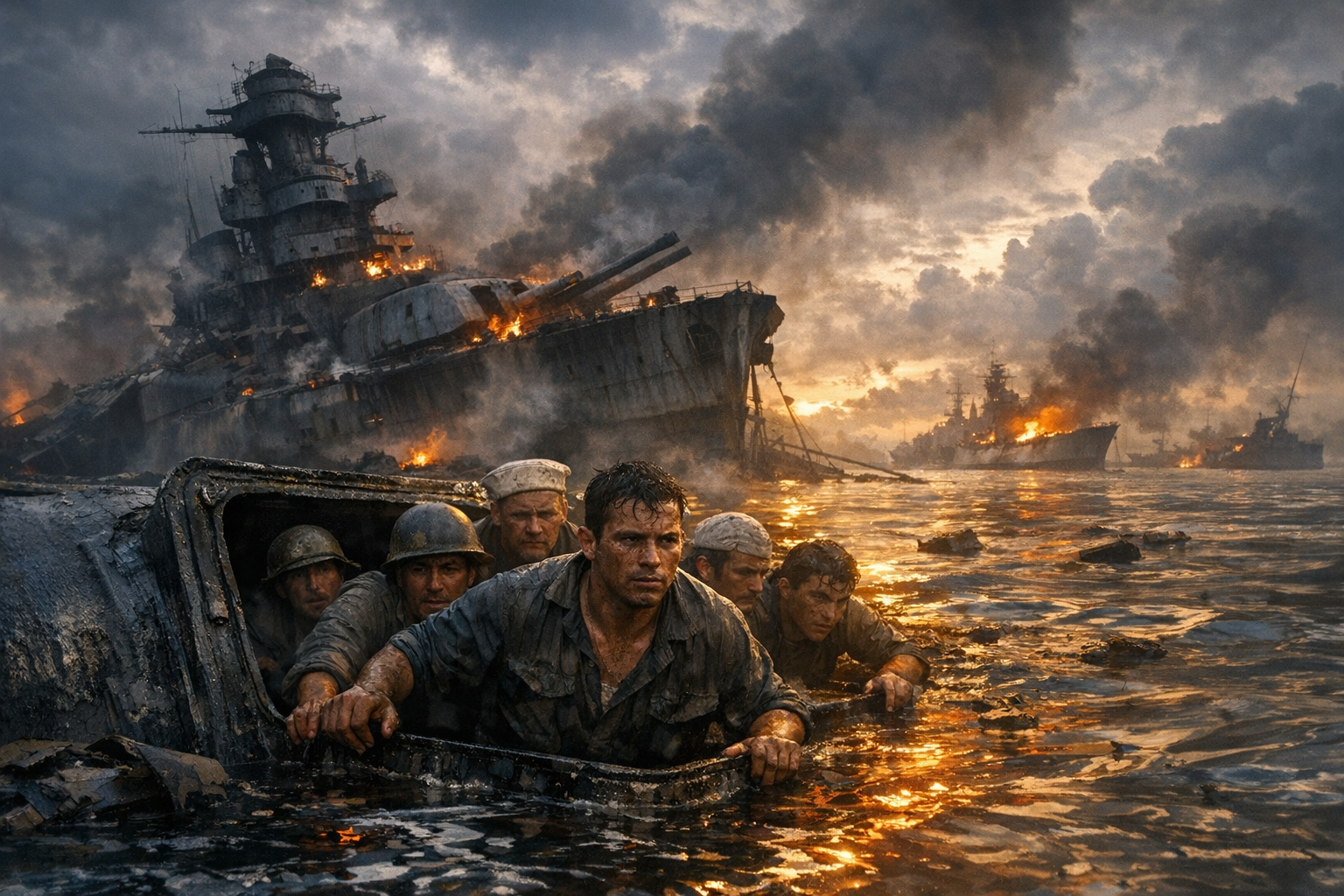
It was December 1941. Pearl Harbor was still smoking. Oil burned on the water. The USS West Virginia had been ripped open by torpedoes, scorched by fire, and dragged into the harbor mud. From somewhere inside that steel darkness, sailors on watch said they could hear knocking.
The story of the USS West Virginia at Pearl Harbor is one of the most haunting survival stories of World War II because it sits at the edge between rescue and helplessness. What happened inside the ship after the attack has never stopped unsettling people: three men appear to have survived in a sealed pocket of the hull for more than two weeks, close enough to be heard, but too deep and too dangerously trapped to reach.
That is part of what makes this case impossible to shake. If this kind of rescue-clock story pulls you in, the Survival Stories Archive opens into the same pressure chambers, where survival often comes down to time, noise, and whether somebody finds you before the air runs out.
On the morning of December 7, the West Virginia was moored at Battleship Row, outboard of the USS Tennessee. It was supposed to be a quiet Sunday. Instead, just before 8 a.m., Japanese aircraft came low over the harbor and hit the battleship with multiple torpedoes and bombs. In minutes, the ship was wrecked. Fires tore through compartments. Water flooded inward. Orders were given to close hatches and seal sections of the vessel to preserve what could still be preserved.
That decision mattered. It helped save the ship from rolling over completely, and it likely helped many men escape. But it also created the kind of brutal tradeoff that makes Pearl Harbor still feel personal instead of historical. Somewhere in the chaos below deck, sailors who obeyed procedure or simply ran the wrong direction may have sealed themselves into compartments that became underwater tombs.
The three names most often tied to that final ordeal are Clifford Olds, Ronald Endicott, and Louis “Buddy” Costin. Olds was 20. Endicott was 18. Costin was 21. None of them knew, when the hull went dark around them, that the outside world would keep moving while their entire universe shrank to steel walls, stale air, emergency rations, and the desperate hope that somebody could still hear them.
By the next day, sailors and Marines near the wreck reported a sound coming from the forward section of the ship. It was not constant. It came in patterns. Knocking. Banging. Enough to make men stop what they were doing and listen. Enough to know that somebody was still alive inside.
That is where this story becomes unbearable. Hearing them was not the same as reaching them.
The West Virginia was sitting in shallow harbor water, but the trapped compartment was still effectively entombed. Oil floated on the surface. Gas vapors and fire danger made torch work risky. Cutting in the wrong place could flood the air pocket or trigger an explosion. So men outside the ship listened, and some later said they knocked back. Every hour made the math worse. Time was no longer measured in clocks. It was measured in breaths.
Timeline of the USS West Virginia Trapped Sailors Story
- December 7, 1941: Japanese forces attack Pearl Harbor. The USS West Virginia is hit by multiple torpedoes and bombs, burns, and settles at her mooring.
- During the attack and its aftermath: Compartments are sealed and counter-flooding measures are used to keep the ship from capsizing completely.
- December 8 and after: Personnel near the wreck report hearing knocking from inside the ship’s forward hull.
- For days afterward: The banging reportedly continues, creating hope but also the grim realization that rescuers cannot safely cut through to the trapped men.
- Months later, during salvage work: Bodies are found in storeroom A-111. Reports say emergency rations had been eaten, flashlight batteries were used, and a calendar had dates marked through December 23.
That final detail is the one that keeps this story alive in people’s minds. According to later accounts, a calendar found with the men had red X marks running from December 7 through December 23. If that account is accurate, at least one of the men survived for 16 days after Pearl Harbor.
Pearl Harbor is usually remembered in explosions, speeches, and casualty counts. But inside one sealed room, the story may have become something slower and worse: three sailors trapped with enough air to live for a while, enough water nearby to hold off death a little longer, and enough awareness to understand that rescue might never come.
There is a reason the knocking is what people remember. Noise is hope. Noise means there is still a person on the other side of the steel. Noise means the ending has not happened yet. In buried-alive cases, submarine disasters, collapse rescues, and shipwreck survival stories, the smallest sound can become the only thread connecting two worlds. That is why the story belongs naturally beside pages like Buried Alive Survival Stories. The knocking itself becomes the whole emotional center of the event.
But unlike many of those stories, this one did not end with a hatch forced open and men stumbling into daylight. That is also important to say clearly, because the documented version is more devastating than the kind of cinematic rescue people wish had happened. The men inside the West Virginia were not found alive. When salvage crews later got far enough into the ship, they found the bodies of Olds, Endicott, and Costin inside the compartment where they had apparently made their final stand against darkness, thirst, and time.
What they found suggested discipline rather than panic. Emergency rations had been eaten. There was access to fresh water through a manhole. Flashlight batteries had been used. The room was not the scene of men who died immediately in chaos. It looked, instead, like the scene of men who understood exactly what they were trying to do: conserve, endure, and wait.
What Doesn’t Add Up – and Why Rescuers Couldn’t Simply Cut Them Out
At first glance, the question people always ask seems brutally simple: if sailors could hear the knocking, why didn’t they save them?
- Flooding risk: Cutting into a compromised hull could have flooded the air pocket instantly.
- Explosion risk: Fuel oil, vapors, and fire damage made sparks and torches extremely dangerous.
- Structural danger: The ship had been catastrophically damaged and settled into the harbor bottom. Working blind inside or around it was not a normal rescue operation.
- Location problem: Knowing roughly where sound came from was not the same as having a safe path to the trapped compartment.
- Time pressure: Even if crews had found a theoretical route, every hour raised the danger to both trapped men and rescuers.
That does not make the outcome easier to accept. This was not indifference. It was a rescue problem with almost no safe move left on the board.
There is another layer that deepens the story: the role of naval procedure. Setting Condition Zed and sealing compartments was standard damage-control practice in a ship under attack. Without those closures, more men might have died immediately. But once the ship settled and the fires raged, that same life-saving logic turned into a trap for anyone sealed in the wrong place.
The men inside do not disappear from the story after the attack because the evidence suggests they kept fighting for day after day. These were not just three names added to Pearl Harbor’s dead. For more than two weeks, they were survivors.
Key Evidence and Survival Factors
- Storeroom A-111: The compartment where the three sailors were found is central to the accepted account.
- Marked calendar: Later reports describe a calendar with dates crossed off through December 23, suggesting survival for 16 days.
- Used rations: Emergency food had been eaten, supporting the idea of a prolonged ordeal.
- Fresh water access: Reports say there was access to water through a manhole, which may explain how the men survived beyond the first days.
- Witness testimony about knocking: Accounts from men outside the ship describe hearing banging from the hull for days after the attack.
Those details matter because they transform the event from rumor into a grim survival case with physical clues. At the same time, some parts of the story remain shaped by memory and retelling. Exact sequences and exact durations vary in different accounts. But the broad picture remains steady: the men did not die immediately, and the evidence found later supports a prolonged entrapment.
Seen that way, the USS West Virginia story belongs in the same archive lane as Disaster Survival Stories and collapse rescue cases like Reshma Begum. Different setting, same unbearable countdown: trapped survivors, thin signals of life, rescuers racing a clock they may already be losing.
It also contrasts sharply with stories like Anna Bågenholm’s survival or the USS Indianapolis survival story. In those cases, people survived conditions that sounded impossible. Here, survival itself happened first. The miracle was real. It just wasn’t enough.
The three men inside the West Virginia did not die at the moment the ship was struck. They lived through the blast, through the flooding, and through enough days to keep marking time. Their story is not simply a death story. It is a survival story cut off before rescue could arrive.
Pearl Harbor changed the war in a morning. But for three sailors in the forward hull of the West Virginia, the attack did not end that morning. It stretched into a second kind of battle that almost nobody saw: a fight against stale air, darkness, exhaustion, and the knowledge that the men outside could hear them yet still could not reach them.
That is why the knocking beneath Pearl Harbor still echoes. It was the last proof that hope had outlived the blast.
FAQ
What happened to the sailors trapped inside the USS West Virginia?
Later accounts and salvage evidence indicate that three sailors — Clifford Olds, Ronald Endicott, and Louis Costin — survived the Pearl Harbor attack inside a sealed compartment of the USS West Virginia but eventually died before rescuers could reach them.
How long did the trapped sailors survive after Pearl Harbor?
The most widely repeated account says a calendar found in the compartment had dates marked through December 23, suggesting that at least one of the men may have survived 16 days after the December 7, 1941 attack.
Why couldn’t rescuers save them if people heard knocking?
The ship was badly damaged, partially submerged, surrounded by oil and fire danger, and structurally unstable. Cutting into the hull risked flooding the compartment or causing an explosion, which made rescue attempts extraordinarily dangerous.
Is the USS West Virginia trapped sailors story true?
The core story is supported by later reports, witness recollections about knocking, and salvage findings inside the ship. As with many wartime accounts, some details vary in the retelling, but the central fact that the three men appear to have survived for days inside the hull is widely accepted.
Why does this Pearl Harbor story still get attention?
Because it turns a huge historic attack into an intimate survival nightmare. People remember the knocking because it represents the worst kind of hope: the proof that someone is still alive when almost nothing can be done to reach them.
Related cases if this story stayed with you:
- Real rescues where knocking through darkness was the only sign anyone was alive
- Disaster survival stories built around rescue clocks, collapsing structures, and impossible waits
- The factory worker who survived 17 days beneath rubble while the world assumed no one was left
- The woman trapped under ice so long that survival should have been impossible
- The sailors who drifted for days after the USS Indianapolis went down
Explore more Survival Stories here: