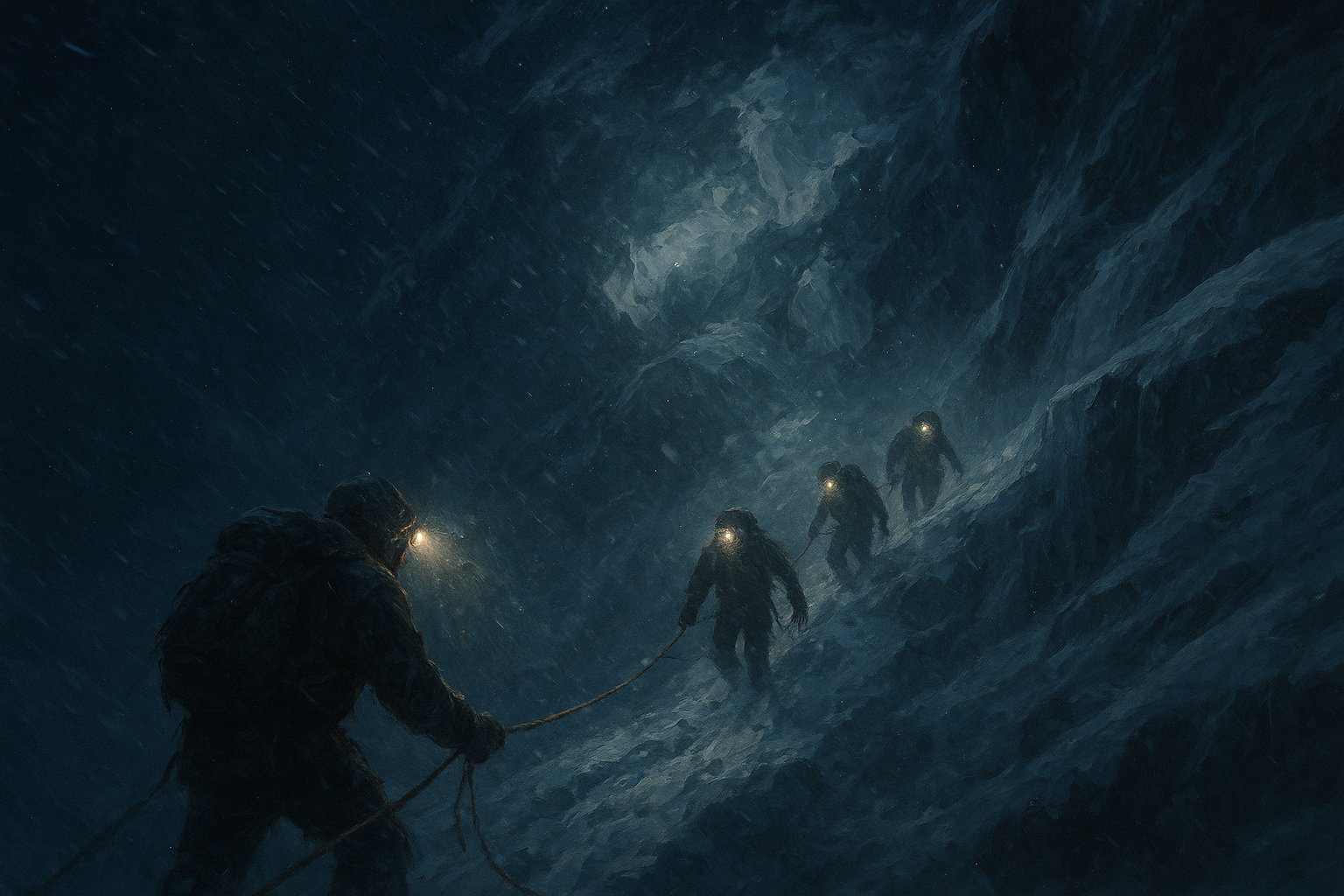
Just below the summit ridge, the mountain stopped feeling like rock and ice and started feeling like a trap with a memory.
Headlamps hung in the dark above the Bottleneck like stranded stars. Beneath them, the slope dropped away into blackness. Above them, a wall of unstable serac ice leaned over the route like something already in the act of falling. Every climber on K2 knew that section by reputation. Move fast. Do not stop. Do not trust it. And on the night of August 1, 2008, too many people had no choice but to be there too long.
The 2008 K2 disaster remains one of the most infamous mountaineering tragedies of the modern era because it was not one clean accident. It was a chain reaction of delays, exhaustion, route congestion, damaged fixed lines, and then a catastrophic serac collapse high above the Bottleneck on the world’s deadliest major mountain. In the broader Survival Stories Archive, it stands out because the summit was only the halfway point. The descent was where the mountain began taking people back.
Before dawn, the route still looked possible. Climbers left high camp in darkness, breathing hard through masks or into the open cold, each step tiny and expensive. At those elevations, even simple movement stops feeling human. A boot placement becomes a decision. A clip into fixed rope becomes a task that needs concentration. The body is not recovering anymore. It is only declining more slowly if you keep going.
Some fixed lines needed attention. Some climbers slowed in technical sections. Others had to wait because the route narrowed into one exposed channel where passing was difficult and mistakes were not survivable. The Bottleneck, sitting around 8,200 meters beneath unstable hanging ice, is dangerous even when everything is going well. On that day, things were already beginning to stack the wrong way. Every minute spent there was borrowed time.
Still, the push continued. That is the logic of summit days on mountains like K2. Turning around feels rational from a safe distance. Up there, rationality starts fighting with momentum and the simple human refusal to quit when the summit finally feels close enough to touch.
By late afternoon and evening, climbers reached the top of the world’s second-highest mountain at 8,611 meters. There were moments of relief, even joy. But good high-altitude climbers understand a brutal rule: summits create false endings. The real test often begins after the photo, after the handshake, after the brief moment where the sky opens and the goal seems complete. On K2 in 2008, too many climbers reached the top too late. Darkness was already closing in when they still had the hardest part left.
Timeline of the 2008 K2 Disaster
- Before dawn, August 1, 2008: Multiple teams leave high camp and begin climbing the Abruzzi Spur toward the Bottleneck.
- Morning to afternoon: Delays build on the route as climbers bunch in steep technical terrain and fixed-line issues slow progress.
- Late afternoon into evening: Climbers continue summiting later than ideal, reducing their daylight margin for descent.
- Nightfall: Descending climbers move back through the Bottleneck in darkness, extreme fatigue, and worsening cold.
- During the descent: A large serac collapses above the route, sweeping ice across the slope and severing fixed lines.
- After the collapse: Some climbers are killed immediately, while others become stranded high in the Death Zone without a secure descent path.
- Overnight into the next morning: Survivors attempt improvised descents, wait for light, or become separated in confusion and exposure.
- After dawn: The scale of the disaster becomes clear as radio reports, missing climbers, and survivor accounts begin to converge.
The descent turned ugly fast. Temperature dropped. Wind cut harder. Headlamps reappeared on the slope, scattered and uncertain, moving through one of the worst places on Earth to be slow. The fixed ropes that had helped organize the climb upward now mattered even more, because tired climbers in darkness were trying to reverse steep terrain at an altitude where the brain itself starts failing.
Then the mountain made the final decision.
A huge section of serac ice broke loose above the Bottleneck and crashed down across the route. Survivors later described a violent cracking sound and then a roaring wall of ice and debris. Fixed lines were ripped away. Snow dust and chaos swallowed the descent line. Some climbers were swept off the mountain. Others, still above the damage, suddenly found themselves stranded in the Death Zone with sections of their route gone.
That phrase gets repeated so often in mountaineering that it can lose force, but this is what it means in plain English: above eight thousand meters, the body cannot heal, cannot rest properly, cannot really recover. It only runs out more slowly if conditions are kind, and on K2 that night conditions were not kind at all. Oxygen bottles were running low. Judgment was degrading. Hands were freezing. The route down had become uncertain in exactly the place where uncertainty is most lethal.
Some climbers tried to wait for first light. Others tried to improvise. Some attempted traverses around damaged sections. Some descended on fragments of rope or what anchors remained. The difference between a workable plan and a fatal one could be one misplaced crampon point or one knot tied with hands too numb to trust. In normal life, confusion can be corrected. Up there, confusion compounds.
And this is one of the reasons the 2008 K2 disaster still gets studied so intensely: the deaths did not come from one simple cause. They came from a pressure system. Late summit timing mattered. Congestion mattered. Dependence on fixed lines mattered. The instability of the serac mattered. So did fatigue, darkness, altitude, and the fact that once the ropes were gone, climbers were being asked to solve impossible technical problems with failing bodies and shrinking oxygen.
What Doesn’t Add Up Until You Look at the Descent
- The ascent was never the full story. K2 in 2008 became catastrophic because too much risk was pushed into the descent window.
- Route congestion changed everything. Time lost in the Bottleneck was not abstract. It pushed climbers into darkness on the way down.
- Fixed lines created both safety and dependency. Once those ropes were severed, climbers were stranded on terrain that had already taken most of their strength.
- Altitude punished every delay twice. The longer climbers stayed high, the worse their decision-making, movement, and ability to self-rescue became.
- The mountain did not need one villain. K2 was lethal because several manageable problems combined into one unmanageable night.
That is also why survivor stories from the disaster feel less like triumph than testimony. Pakistani climber Muhammad Ali Sadpara and other high-altitude climbers moved back into danger to help where they could. Survivors such as Wilco van Rooijen endured terrifying unplanned exposure while trying to find a way off the mountain. There were reports of shared oxygen, delayed descents to assist others, and exhausted people trying to solve technical problems no one should have to solve after dark at that height.
The details that linger are not glamorous. A headlamp vanishing. Rope ends hanging where the route used to be. Gloves stiff with cold. A climber sitting down for what feels like a harmless minute and needing to be forced back to his feet before sleep becomes death. That same cruel narrowing of survival shows up in other extreme mountain ordeals, from Anna Bågenholm’s survival under ice to the wider pattern collected in Wilderness Survival Stories.
And K2 went wrong in layers. The Bottleneck delayed people. The summit came too late. The descent took place in darkness. The serac collapse erased the route. After that, survival was no longer about climbing well. It was about enduring exposure, finding any workable line downward, and resisting the mental collapse that altitude brings when the body is already empty.
There is a temptation with famous disasters to flatten them into a lesson. Don’t summit late. Don’t crowd technical ground. Don’t depend too heavily on fixed lines. All of that is true, and none of it is enough. The real horror of K2 in 2008 is that many of the people on that mountain were experienced, disciplined climbers who understood the risks perfectly well. Experience is not immunity. On mountains like K2, experience mainly teaches you how clearly you can see the danger before it kills you anyway.
By morning, the upper mountain was giving back fragments of what had happened. Radio calls. Missing names. Movement where no movement should have still been possible. The final toll reached eleven dead, making the 2008 K2 disaster one of the deadliest single-day events in modern high-altitude climbing. Some fell after the ropes were lost. Some were swept away by the icefall. Some died from exposure and exhaustion when the route down became too broken, too dark, and too high for the body to endure any longer.
That death toll is part of why the story remains infamous, but not the only reason. What keeps people returning to it is the setting of the disaster itself. The Bottleneck is where mountaineering risk compresses into one narrow corridor where timing, traffic, weather, and human judgment all have to cooperate at once. On August 1, 2008, they didn’t.
That is why the event also belongs beside pages like Disaster Survival Stories and Plane Crash Survival Stories. The mechanisms differ, but the emotional structure is the same: the first danger is only the opening act.
And maybe that is the most unsettling truth about K2. Nothing supernatural happened there. No hidden mystery. No single impossible twist. Just ice, altitude, delay, darkness, and a mountain that gives almost no margin when those elements line up the wrong way. That makes the story feel harsher, not softer. Because if the disaster came from ordinary high-altitude realities pushed into one terrible sequence, then it was not bizarre. It was possible all along.
When daylight returned, the summit was there. In photographs, K2 looked immaculate. But beauty on that mountain is the shallowest layer. Under it are the same forces that made August 1, 2008 one of mountaineering’s darkest nights: unstable ice, brutal exposure, and the terrible fact that going up is only half the story.
That is why the disaster still holds people: for one night, K2 became completely, brutally itself.
FAQ
What happened on K2 in 2008?
On August 1, 2008, multiple teams summited K2 late in the day, and during the descent a large serac collapse above the Bottleneck swept ice across the route and severed fixed lines. Climbers were killed, stranded, or forced into improvised descents high in the Death Zone.
How many climbers died in the 2008 K2 disaster?
Eleven climbers died, making it one of the deadliest single-day tragedies in modern mountaineering.
What caused the K2 disaster?
There was no single cause. The disaster came from a combination of route delays, late summit timing, congestion in the Bottleneck, extreme altitude, darkness on the descent, and the serac collapse that destroyed key fixed lines.
Where is the Bottleneck on K2?
The Bottleneck is a steep, exposed section on the Abruzzi Spur at roughly 8,200 meters, directly beneath unstable overhanging serac ice. It is one of the most feared parts of the standard route on K2.
Why is the 2008 K2 disaster still so infamous?
Because it shows how elite climbers can still be overwhelmed when several high-altitude risks combine at once. The story is not just about a summit push. It is about how fast a descent can become a mass survival crisis on one of the hardest mountains in the world.
🔎 If this story stayed with you, the author suggests these real cases next:
- More wilderness ordeals where isolation became the real enemy
- Disasters where the real fight began after the system broke
- Survival stories where the aftermath became more dangerous than the impact
- Entrapment stories where survival depended on lasting one hour longer
Explore more Survival Stories here: