
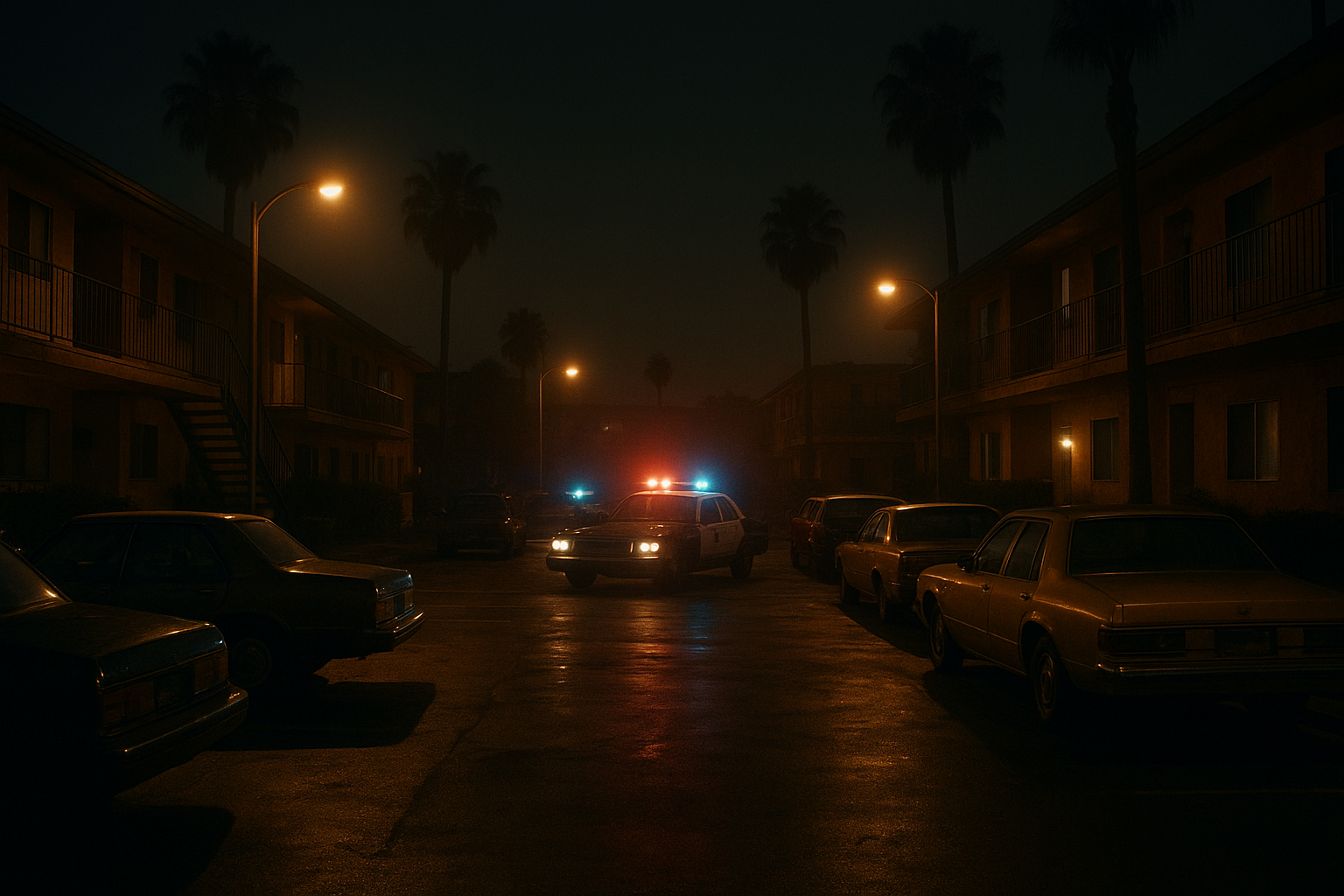
Before sunrise on November 11, 1978, something terrible happened inside a small apartment in Simi Valley, California.
Twenty-four-year-old Rhonda Hamilton Wicht was killed in her bedroom. Her four-year-old son, Donald “Donnie” Wicht, was killed nearby.
Hours later, when Rhonda failed to arrive for plans with her younger sister, concern turned into dread. Shelley Hamilton and her husband went to Rhonda’s apartment and discovered the horrifying scene.
The murders would eventually produce what appeared to be a clear answer.
Rhonda’s former boyfriend, Craig Coley, was arrested, tried twice, convicted in 1980, and sentenced to life in prison without parole.
For nearly four decades, that was the official story.
Then investigators went back.
Old evidence was found. DNA testing became possible. Witness testimony was reconsidered. Medical evidence was reevaluated. And in 2017, the Ventura County District Attorney and Simi Valley police announced that they no longer had confidence in Coley’s conviction and believed the evidence met the standard for factual innocence.
Governor Jerry Brown pardoned him. His convictions were vacated. A judge made a finding of actual innocence.
But reducing the case to **“DNA proved the wrong man spent nearly 38 years in prison”** leaves out much of what actually happened.
There was evidence against Craig Coley. Two juries heard it. One could not reach a verdict. The other convicted him.
There was also powerful evidence uncovered decades later that caused police and prosecutors to reject that conviction.
And after all of it, one question remains unanswered:
Who killed Rhonda and Donnie?
That is the real story of the Craig Coley case.
The Morning Rhonda and Donnie Were Found
Rhonda Hamilton Wicht was 24 years old and raising her four-year-old son, Donnie, in Simi Valley.
She was divorced, attending cosmetology school, and building a life for herself and her child.
On Saturday, November 11, 1978, Rhonda was supposed to meet her younger sister. She never arrived.
When calls went unanswered, her sister and brother-in-law went to the apartment.
Rhonda’s car was still outside.
Inside, Rhonda had been strangled with a macramé cord.
Donnie had been smothered in his bed.
Investigators believed parts of the apartment appeared disturbed as though someone had committed a burglary, but police came to suspect that the scene had been staged.
Attention soon turned to Craig Coley.
He was not a stranger who happened to cross investigators’ path.
Coley had been Rhonda’s boyfriend, and their relationship was ending.
That gave investigators an obvious person to examine.
But the case against him would eventually involve much more than the relationship itself.
The Evidence Against Craig Coley
Later accounts of wrongful convictions can make the original prosecution sound almost inexplicable.
The Coley case was more complicated.
A next-door neighbor reported awakening around 5:30 a.m. to banging and sounds of a struggle coming from Rhonda’s apartment. She later said she saw a truck she believed was Coley’s outside, with someone inside it, although she could not identify the driver.
Another neighbor reported hearing noises from the apartment, although questions developed over the timing.
Investigators found no obvious signs of forced entry.
Then there was physical evidence.
Police searching Coley’s home recovered a bloodstained towel and one of Donnie’s T-shirts.
The prosecution argued that the towel contained Rhonda’s blood and treated the shirt as evidence connecting Coley to the crime.
Coley did not deny that the items were in his home.
According to the trial record later summarized by the National Registry of Exonerations, Coley testified that Rhonda had visited his apartment with Donnie the morning before the murders and that he and Rhonda had consensual sex. His account offered an innocent explanation for how the items came to be there.
There were also injuries documented on Coley after his arrest. A physician described scratches and abrasions, although the defense disputed their significance.
No single piece necessarily proved that Coley committed the murders.
The prosecution’s case was largely circumstantial.
But circumstantial does not mean nonexistent.
The question was what all those pieces meant when placed together.
The first jury could not agree.
Timeline of the Craig Coley Case
- November 11, 1978: Rhonda Wicht, 24, and her four-year-old son Donnie are found murdered in their Simi Valley apartment.
- November 1978: Police focus on Rhonda’s former boyfriend, Craig Coley, and arrest him.
- 1979: Coley’s first trial ends in a mistrial after jurors cannot reach a unanimous verdict.
- January 1980: A second jury convicts Coley of first-degree murder.
- 1980: Coley is sentenced to life in prison without parole.
- Years later: Simi Valley detective Michael Bender becomes convinced the conviction is wrong and advocates for another look at the case.
- 2016: Simi Valley police begin an extensive reinvestigation.
- 2017: DNA testing and other findings undermine important parts of the original prosecution.
- November 20, 2017: The Ventura County District Attorney and Simi Valley police announce that they no longer have confidence in Coley’s conviction and believe the evidence meets the standard for factual innocence.
- November 22, 2017: Governor Jerry Brown grants Coley a pardon based on innocence. Coley is released after nearly 38 years in prison.
- November 29, 2017: Coley’s convictions are vacated and a judge makes a finding of actual innocence.
- 2019: Simi Valley agrees to a $21 million settlement in Coley’s federal civil-rights lawsuit.
The First Jury Wasn’t Convinced
Coley first went to trial in 1979.
He maintained that he had not killed Rhonda or Donnie and presented witnesses supporting portions of his account of where he had been.
After lengthy deliberations, the jury could not reach a unanimous verdict.
The judge declared a mistrial.
The reported final split was 10 jurors favoring conviction and two favoring acquittal.
Prosecutors tried him again.
On January 3, 1980, the second jury convicted Craig Coley of first-degree murder and found special circumstances involving multiple murder and murder committed during a rape.
He was sentenced to life without parole.
The case appeared solved.
Coley continued to insist that it wasn’t.
For years, those claims changed nothing.
Then someone from inside the same police department that investigated the murders began questioning the case.
The Detective Who Wouldn’t Let the Case Go
Michael Bender was a Simi Valley police detective when he began examining Coley’s case years after the conviction.
Bender became convinced that something was wrong.
He questioned aspects of the evidence and believed the case deserved another examination. Over the years, he advocated for Coley and tried to persuade authorities to take another look.
For a long time, those efforts went nowhere.
Then in 2016, Simi Valley Police Chief David Livingstone authorized an extensive review.
Cold-case detective Dan Swanson began going through the investigation again.
And investigators discovered something crucial.
Evidence from the case still existed.
Although destruction of evidence had previously been authorized, boxes connected to the investigation remained in storage. Additional biological material was located through a private laboratory connected to earlier testing.
Forensic science had changed enormously since 1978.
Investigators could finally ask the surviving evidence questions the original detectives could not.
What the DNA Actually Showed
This part of the case is frequently condensed into one sentence:
DNA proved Craig Coley was innocent.
The actual reinvestigation was broader and more complicated.
Investigators tested biological material from a sheet on Rhonda’s bed. The testing detected sperm and epithelial cells that did not match Coley.
Coley’s DNA was also not detected on Donnie’s T-shirt.
Those findings mattered, particularly because physical evidence had played a role in the original prosecution.
But investigators did not base their conclusion on DNA alone.
They reviewed thousands of pages of records, conducted interviews, reexamined witness testimony, reconsidered forensic evidence and looked again at medical conclusions presented during the original prosecution.
One important issue involved the neighbor who had testified about seeing a vehicle she believed was Coley’s truck around the time of the murders.
Investigators returned to the apartment building decades later and attempted to recreate the observation. They concluded that the lighting and viewing conditions made identifying details on vehicles extremely difficult.
Another issue concerned the prosecution’s rape theory.
Medical evidence from Rhonda’s body had originally been interpreted as supporting sexual assault. During the reinvestigation, a sexual-assault nurse examiner reviewed photographs and concluded that findings described as trauma in 1978 were not definitive evidence of forced penetration under modern medical understanding.
One by one, important pieces of the original case became less certain.
The DNA did not stand alone.
It was part of a much larger collapse in confidence.
Why Authorities Declared Coley Innocent
On November 20, 2017, Ventura County District Attorney Gregory Totten and Simi Valley Police Chief David Livingstone announced the results of the reinvestigation.
Their conclusion went beyond saying prosecutors could no longer prove the case beyond a reasonable doubt.
They said they no longer had confidence in the evidence used to convict Coley and believed the evidence now met the legal standard for factual innocence.
Two days later, Governor Jerry Brown granted Coley a pardon based on innocence.
On November 29, Coley’s convictions were vacated and a judge made a finding of actual innocence.
After nearly 38 years behind bars, Craig Coley was free.
The State of California later approved compensation for his wrongful imprisonment.
In 2019, Simi Valley agreed to pay $21 million to settle Coley’s federal civil-rights lawsuit.
Officially and legally, the transformation was complete.
The man once convicted of murdering Rhonda and Donnie was now recognized as innocent of those crimes.
Why Questions About the Case Remain
Coley’s official exoneration is not reasonably described as merely a technicality.
Police reinvestigated the murders. Prosecutors reconsidered the evidence. New forensic testing was performed. A governor issued an innocence pardon. A court made an actual-innocence finding.
Those facts matter.
But another fact matters too:
The original prosecution did have evidence against Coley.
The towel, T-shirt, witness testimony, Coley’s relationship with Rhonda, observations about his injuries and other circumstances were not invented decades later. They were part of the case jurors heard.
Some members of Rhonda and Donnie’s family have consequently struggled with or rejected the conclusion reached in 2017.
Rhonda’s sister Shelley Hamilton, who was among those who discovered the crime scene, has publicly argued that later accounts minimize evidence presented at trial and overstate what the DNA testing established. She and journalist Alicia Doyle later wrote The Forsaken about Rhonda, Donnie and the case.
That position should not be confused with the official finding.
It does not undo Coley’s exoneration or establish that he committed the murders.
But it illustrates something often lost when complicated cases are compressed into headlines.
An overturned conviction can answer the legal question of whether the convicted person should remain responsible for the crime without answering every historical question surrounding the murder.
And in this case, the biggest historical question remains open.
What We Know—and What We Don’t
- Rhonda and Donnie were murdered on November 11, 1978. Rhonda was strangled and Donnie was smothered.
- Craig Coley was Rhonda’s former boyfriend and became the primary suspect.
- There was evidence against Coley. The prosecution relied on witness testimony, physical evidence, medical evidence and circumstances surrounding his relationship with Rhonda.
- His first jury did not unanimously convict him. His second jury did.
- A major official reinvestigation took place decades later. It included DNA testing and reevaluation of witness, medical and forensic evidence.
- The tested DNA evidence did not identify Coley.
- Authorities concluded much more than simply “there isn’t enough evidence anymore.” Police and prosecutors said the new evidence met the standard for factual innocence, and a court subsequently made an actual-innocence finding.
- Some members of the victims’ family dispute that conclusion. Their position remains a disagreement with the official findings, not a judicial determination of guilt.
- No other person has been convicted of killing Rhonda and Donnie.
Rhonda and Donnie
The strangest consequence of the Craig Coley case may be that almost everything written about it eventually becomes a story about Craig Coley.
That is understandable.
Spending nearly 38 years imprisoned before being officially declared innocent is extraordinary.
But the case existed before Coley was arrested.
Rhonda Wicht was 24.
She was a mother, attended cosmetology school and was trying to build a future for herself and her son.
Donnie was four years old.
Whatever happened inside their apartment on November 11, 1978, ended both of those futures.
The conviction did not change that.
The exoneration did not change it either.
If the justice system convicted the wrong man, then Rhonda and Donnie were failed twice: once when they were murdered and again when the investigation failed to identify the person responsible.
If new evidence someday identifies their killer, it will not merely add another chapter to Craig Coley’s exoneration.
It will finally answer the case that began with them.
The Case That Lost Its Ending
There was a double murder.
There was an obvious suspect.
There was physical evidence and witness testimony.
There was a mistrial.
There was a conviction.
There were nearly 38 years in prison.
Then there was surviving evidence, modern DNA testing and a reinvestigation that caused authorities to reject the case they had once prosecuted.
Craig Coley’s convictions were vacated.
He was officially found innocent.
But exonerating someone and solving a murder are not the same thing.
The first tells us whom the justice system no longer holds responsible.
The second tells us who actually committed the crime.
Nearly half a century after Rhonda and Donnie were killed, this case has the first answer.
It still does not have the second.
FAQ
Who is Craig Coley?
Craig Coley is a California man who was convicted in 1980 of murdering his former girlfriend, Rhonda Wicht, and her four-year-old son, Donnie, in Simi Valley. After nearly 38 years in prison, he was pardoned and his convictions were vacated following a major reinvestigation.
When were Rhonda and Donnie Wicht murdered?
Rhonda and Donnie were murdered on November 11, 1978, in Rhonda’s apartment in Simi Valley, California.
Was Craig Coley proven innocent?
Coley received an innocence pardon from Governor Jerry Brown, his convictions were vacated, and a judge made a finding of actual innocence. The Ventura County District Attorney and Simi Valley police said their reinvestigation produced evidence meeting the standard for factual innocence.
Did DNA alone exonerate Craig Coley?
No. DNA testing was an important part of the reinvestigation, but authorities also reevaluated witness testimony, medical findings, physical evidence and other aspects of the original case before concluding that Coley was factually innocent.
What did the DNA evidence show?
Testing of biological material from a sheet on Rhonda’s bed identified DNA that did not match Coley. His DNA was also not detected on Donnie’s T-shirt. The results became part of the broader body of evidence authorities considered when reevaluating the conviction.
Why do some members of Rhonda’s family still question Coley’s innocence?
Some family members believe evidence presented during the original trials has been minimized in later accounts and dispute the interpretation of the evidence that led to Coley’s exoneration. Their position differs from the official findings of prosecutors, police and the court.
Who killed Rhonda and Donnie Wicht?
No other person has been convicted of the murders. After Coley’s convictions were vacated, the case was left without a judicially established perpetrator.
🔎 If this story stayed with you, the author suggests these real cases next:
- The cases where appeals, retrials, and new evidence blew open the official story
- The cold case archive where old evidence waited years to start speaking clearly
- The wrongful-conviction case that exposed how quickly certainty can outrun truth
- A murder investigation where time passed, but the forensic trail never completely died
Explore more True Crime stories here:

You have the facts of this story all wrong! I don’t know where you got your information but it’s not even close to correct. Rhonda was my sister and Donnie my nephew. It was my husband and I who found their bodies on November 11, 1978 (not August). I have a blog that tells the story: rdjustice.home.blog I also just co-authored a book: The Forsaken by Alicia Doyle with Shelley Hamilton, and my website: RhondaDonnie.com
Shelley, thank you for reaching out and for correcting us. You were absolutely right about the date, and after reviewing the article more closely, we found that it oversimplified important parts of Rhonda and Donnie’s case.
We have now rewritten the article to correct the factual errors and to give a fuller account of the original evidence, the later reinvestigation and exoneration, and most importantly, Rhonda and Donnie themselves.
Thank you for taking the time to bring this to our attention. We sincerely appreciate the opportunity to make the story more accurate and complete.