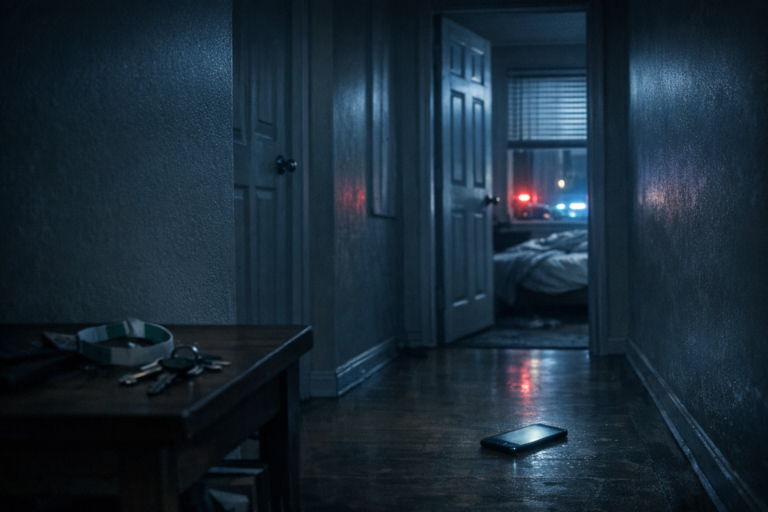
Kezia McAlpine was visiting family when her husband failed to return from an appointment. Kevin had arranged to meet someone at the Key West shopping centre in Krugersdorp. By about nine that evening she was worried. Then her phone registered two transactions on their bank account. Kevin’s mother went to the shopping centre to look for his car. She could not find it.
When Kezia testified in Johannesburg, another woman could describe almost the same appointment. Heather Scholefield’s husband, Anthony, had also agreed to meet a prospective client at Key West at six in the evening. He, too, had disappeared. Both men were later found dead in their cars. A witness who had helped arrange the meetings eventually supplied a detail neither family knew. Just before the appointments, he would phone the men and change the address.
Timeline of Events
- July to October 2012. Natacha Burger, Joy Boonzaier, Pastor Reg Bendixen and Mikeila Valentine are killed. By October, Gauteng police publicly confirm that the four deaths are being investigated in a coordinated effort.
- November and December 2015. Peter and Joan Meyer are killed. Weeks later, members of the group kill Jarod Jackson and use his body to stage Zak Valentine’s death.
- January to May 2016. Glen McGregor, Anthony Scholefield, Kevin McAlpine and Hanlé Lategan are killed after being approached about their work. In June, Valentine is arrested alive.
- 2018. Marinda Steyn and her son Le Roux conclude separate plea agreements. One condition of his suspended sentence requires him to testify for the prosecution.
- June and August 2019. The Johannesburg High Court convicts Cecilia Steyn, Marcel Steyn and Zak Valentine in June. Judge Ellem Jacob Francis sentences all three in August.
The break with Overcomers Through Christ
The early victims came to the group’s attention through a religious community. Ria Grunewald was associated with a ministry called Overcomers Through Christ. Cecilia Steyn presented herself as someone who had escaped Satanism. The falling-out between the two women put people Grunewald knew in danger. The violence came from the circle around Cecilia that became known as Electus per Deus, or “Chosen by God.” People who had attended the ministry’s courses were among its victims.
At trial, Marcel Steyn described an accusation Cecilia made against Natacha Burger. Cecilia blamed a prayer Burger had said for the deaths of children. It was a story Cecilia told the group. Grunewald rejected the suggestion that Burger had used prayer to harm anyone. On July 26, 2012, Burger went to the home of her neighbour Joy Boonzaier in Centurion. According to the account presented in court, Boonzaier had been made to write a note asking Burger to come over. Both women were killed there. Boonzaier had no connection to the ministry, contemporary reporting found. Her connection was to her neighbour.
In August, Reg Bendixen, a pastor and a mentor to Grunewald, was killed at his home. Marcel testified that, as a child, she had been taken along because her presence might reassure him. In October the group killed Mikeila Valentine, who was married to Zak Valentine and had herself taken part in the killings of Burger and Boonzaier, according to the evidence summarized after the verdict. The account Marcel gave in court put responsibility for Mikeila’s death inside the household. Zak supplied access to their home. Marinda, Marcel’s mother, went there with her daughter.
The 2012 investigation was already wider than a single police station. That October a provincial police spokesperson told reporters the four deaths were being investigated together. Detectives still had to establish who had taken part in each killing. Several people who could tell them what had happened had also helped carry it out.
An insurance claim on a living man
Three years later, John Barnard arranged what his employer, Peter Meyer, understood to be a business meeting. Peter and his wife Joan were killed at their home on November 27, 2015. The demand this time was for money. Within weeks, the group found another way to raise it: Zak Valentine had life insurance, and Cecilia was the beneficiary.
On December 16, Jarod Jackson travelled with members of the group into the Free State. They killed him and left him in Valentine’s Mercedes, which they set on fire. Marinda identified the burned body as Valentine’s. The National Prosecuting Authority described what that identification made possible: a death certificate in Valentine’s name and a claim on his life policy for 3.57 million rand. Jackson’s family had lost a man whose body was now being passed off as someone else’s.
The insurer assigned an assessor, Shane Chatzkelowitz, to investigate. He told the court the policy had been in place for less than five months. Cecilia wanted the claim settled quickly. When he asked for details, she told him that Valentine’s wedding ring and medical bracelet had been found in the car. Chatzkelowitz said the report he had did not support her account. Those were particulars someone outside the group could check. Valentine himself spent time under an assumed name; police arrested him in June 2016.
The appointments that changed address
Marinda approached Glen McGregor, a tax consultant, as someone seeking professional advice. In January 2016 members of the group went to his smallholding. Le Roux told the court that his mother drew a gun and that money was transferred from McGregor’s account. McGregor’s sister, Lorna Schroeder, later explained to the court that the family wanted to hold a memorial service in Scotland, where she and her brother had grown up. They were waiting for the proceedings to finish.
In May, the calls arranging meetings with Anthony Scholefield and Kevin McAlpine followed a similar plan. Heather Scholefield had actually spoken to the caller. When she asked for more details, he said his fiancée would bring the information to the meeting. That evening she tried both her husband and the caller. Neither answered. She contacted police, who investigated a vehicle matching the description of her husband’s car.
Le Roux’s testimony supplied the other side of those calls. The last-minute change of venue took the men to his mother’s flat. There the group demanded bank cards, PINs, phones and car keys at gunpoint. A relative searching the shopping centre could be in exactly the place her husband had told her about and still have no chance of finding him. The transaction alerts on Kezia McAlpine’s phone were a record of her husband’s account being used while his family was trying to locate him.
Hanlé Lategan, an estate agent, also left for an appointment with someone posing as a client. On May 30, she parked at a private hospital in Krugersdorp. After she was reported missing, police secured the area around her car. The group left her body elsewhere. It was found near a cemetery in Randfontein the following day.
The evidence the judge accepted
In court the families could describe the calls and searches from outside. Le Roux and Barnard gave evidence from inside the group. Each had a criminal record arising from the same events, and Le Roux’s plea agreement gave him a tangible interest in testifying. The judge heard them under those conditions and found their accounts credible. He reached a different conclusion about Marinda’s attempt to give evidence in support of Cecilia and Marcel.
The investigation also produced material the court declined to use. A police officer had questioned Valentine after a vehicle associated with him was seen at the Meyers’ home. The officer acknowledged having considered him a suspect when he took the statement. The judge excluded it because Valentine should have been informed of that status. The prosecution had to make its case without it.
Marinda and Le Roux had already admitted specific offences in 2018. The NPA’s breakdown makes an important distinction: nine of Marinda’s eleven life terms were for murder; two were for racketeering and running the enterprise. Le Roux received 35 years for seven murders, with ten years suspended on condition that he testify. The other terms ran concurrently. The NPA described his effective term as 25 years.
On August 19, 2019, Judge Francis sentenced the remaining three defendants. The NPA recorded thirteen life terms for Cecilia, eight for Valentine and seven for Marcel, alongside sentences for other offences. The number of terms describes the court’s orders on separate counts. Eleven people had been killed. In the aftermath of the sentencing, Kezia McAlpine spoke about a responsibility that was still ahead of her: explaining to her young child what had happened to Kevin.
FAQ
Who were the Krugersdorp Killers?
The case involved Cecilia Steyn, Marinda Steyn, Marinda’s children Marcel and Le Roux, Zak Valentine and John Barnard. They faced different charges and did not all participate in the same crimes.
What was Electus per Deus?
It was the name of the group led by Cecilia Steyn. Its members targeted people associated with Overcomers Through Christ and later sought out people they could rob.
How many murders were linked to the Krugersdorp Killers?
The prosecution covered eleven victims between 2012 and 2016. The murders took place in more than one location in South Africa, including Centurion and the Free State.
Why were some of the killings called the appointment murders?
Members of the group posed as prospective clients. Witnesses described initial meetings arranged at a shopping centre, a change of address and demands for bank details once the victims arrived.
Was Cecilia Steyn the one who carried out the murders herself?
The judge found that she directed the group. The evidence identified the people who entered particular homes, took victims’ bank cards and carried out attacks. A conviction for a killing does not by itself establish that the defendant personally struck the victim.
Research Sources
The following resources were consulted to verify and update this article.
- South African National Prosecuting Authority, the Steyn plea agreements. The insurance claim, admitted offences, concurrent sentences and the condition attached to Le Roux’s suspended term.
- National Prosecuting Authority, 2019/20 annual report, p. 66. The case study on the three defendants tried in 2019 gives the scope of the prosecution and the sentence for each.
- IOL, the investigation as it stood in October 2012. Comments from a Gauteng police spokesperson and from Ria Grunewald about the early deaths.
- News24, the sequence of the eleven murders. A reconstruction published after the verdict, from the Centurion killings to the last appointment.
- Krugersdorp News, testimony from relatives, the assessor and participants. The accounts given in court by Heather Scholefield, Kezia McAlpine, Le Roux Steyn and others, and the ruling on Valentine’s police statement.
- Krugersdorp News, Marcel Steyn’s testimony. What Marcel told the court about Cecilia’s accusations and the early victims.
- Krugersdorp News, the trial verdict. The June 3 verdict and the judge’s assessment of the witnesses.
- The Citizen, families respond to the sentences. Relatives’ accounts from the August 2019 sentencing, including Kezia McAlpine’s account of what lay ahead for her child.
Related RTRS cases
For other investigations into organized violence, read the Manson Family verdicts and the Aum Shinrikyo prosecutions, or browse Cults & Extremist Groups.
Cases involving violence within a family include the Turpin family escape, the Chris Watts case and the investigation into John List.
Older reading links
The earlier links for Heaven’s Gate and Jonestown currently open the RTRS homepage.
Watch This Story on YouTube
Prefer to watch? See the full story on our YouTube channel.