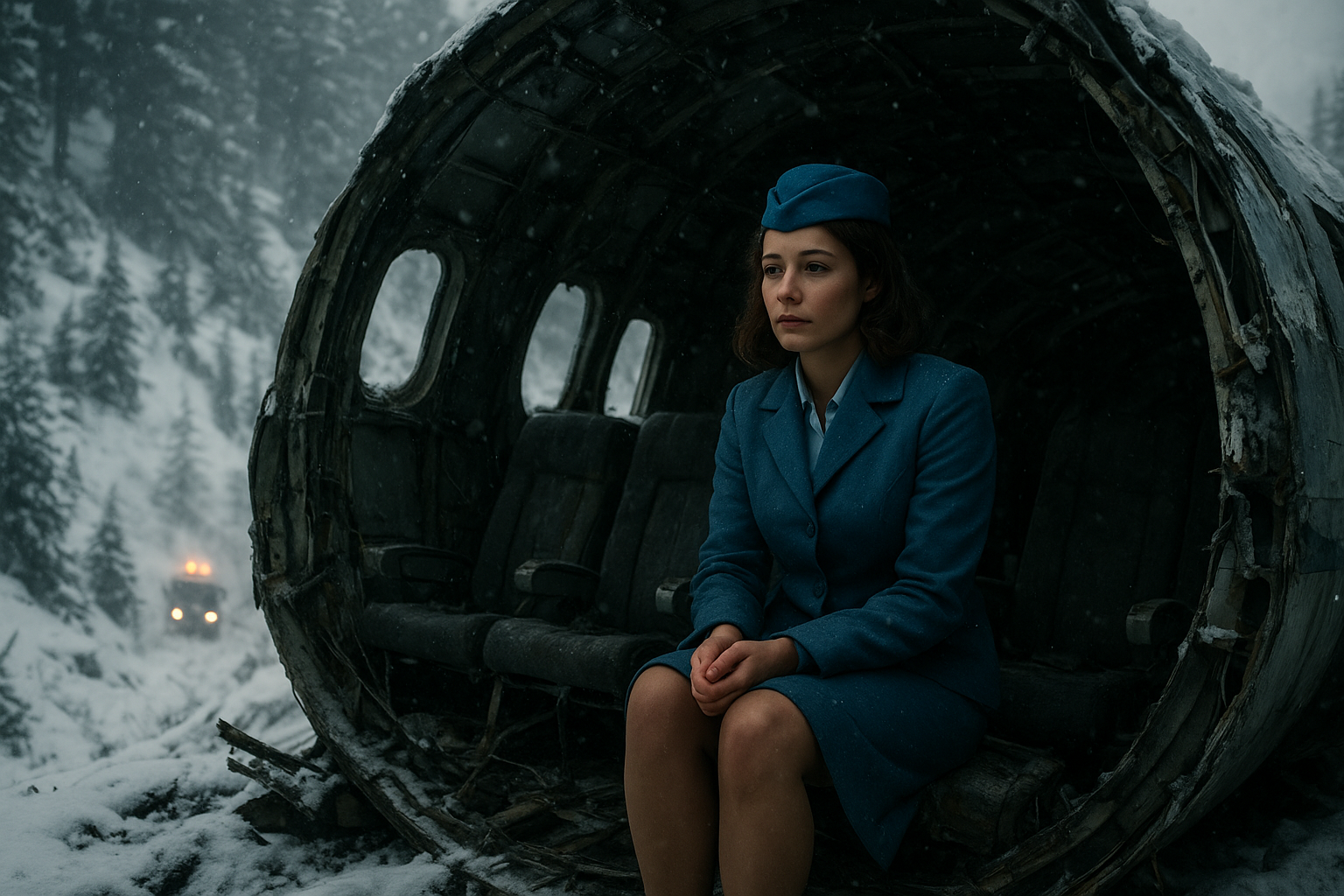
The Vesna Vulovic survival story begins with a routine flight in 1972 and ends with one of the most impossible recoveries ever documented. When a plane exploded high above Czechoslovakia, a 22-year-old flight attendant plunged from the sky inside broken wreckage and somehow lived.
On January 26, 1972, the day began the way so many disaster stories begin: quietly.
Vesna Vulovic was a 22-year-old flight attendant from Yugoslavia. She boarded JAT Flight 367 in Copenhagen as part of the replacement crew, expecting to continue an ordinary working flight.
Years later, people would talk about her as if she had been marked by fate from the start. But nothing about that morning looked supernatural. It looked ordinary, which is what makes the story so disturbing. Ordinary moments can hold the door open for unimaginable things.
The aircraft was a McDonnell Douglas DC-9 operated by JAT Yugoslav Airlines. It was flying a route that connected cities across Europe, carrying passengers who expected a normal trip and crew members who had their minds on schedules, service, and landing times. According to the official accident account retained by Guinness, the aircraft broke apart above Czechoslovakia at 10,160 metres, or about 33,333 feet. A 2009 journalistic investigation proposed a much lower altitude, but its evidence was circumstantial and Guinness has retained the record.
An explosion ripped through the plane.
To understand the horror of that moment, you have to imagine the speed of it. One second there is structure, noise, pressure, control. The next, the aircraft is being torn apart in freezing air high above the ground. Metal separates. Compartments split. Loose objects become weapons. Human beings who had been sitting under reading lights and breathing canned cabin air are suddenly in open sky with winter below them.
The official investigation attributed the explosion to a briefcase bomb in the baggage compartment. No one was arrested for the bombing. But for the people on board, there was no time for theory. There was only violence.
The plane broke apart over the mountains and forests near the village of Srbská Kamenice. Wreckage scattered across the landscape. Most of the people on board were killed immediately or during the fall. There should have been no survivors. That is the part of the story that makes people stop when they first hear her name. Not one survivor in the usual sense. Not someone pulled from the ground after a hard landing. Not someone thrown clear from a low-altitude crash. Vesna survived a fall so extreme that it entered the Guinness World Records as the highest fall survived without a parachute.
But the statistic, as shocking as it is, can flatten the human reality. It sounds like a headline. It sounds like a freak occurrence. What it does not capture is the image of a young woman trapped inside a torn section of a passenger jet as it came down through winter air toward a mountainside.
The fuselage section in which she remained trapped is believed to have helped save her. Instead of falling as a single exposed body through open air, she remained pinned inside wreckage that acted, in the most brutal and imperfect way possible, like a shield. The broken section hit a steep, wooded slope covered with snow. Trees may have slowed the descent. The angle of impact may have mattered. The terrain may have absorbed some of the force. In a story built from physics, chance plays the role that luck usually plays in folklore.
When the wreckage slammed into the mountainside, it should still have been the end.
It wasn’t.
A local man named Bruno Honke, who had served as a medic during World War II, reached the crash site and found Vesna alive. That detail matters more than it gets credit for. Survival in impossible conditions often depends not just on the body enduring the first catastrophe, but on who arrives next. Honke administered first aid before other rescuers arrived. In a story of shattered metal and impossible odds, one of the quiet turning points may have been the presence of a man with the right experience in the right place at the right time.
Vesna’s injuries were devastating. She suffered a fractured skull. Both legs were broken. Several vertebrae were broken, including damage that temporarily left her paralyzed from the waist down. Her pelvis was fractured. Her body had taken the kind of punishment that medicine usually describes with clinical language because the plain truth is too blunt. She had fallen out of the sky and hit a mountain inside a torn airplane, and yet her heart was still beating.
For days, then weeks, and then months, her survival stopped being one miracle and became a chain of smaller, harder miracles. Living through impact was only the first one. After that came surgery, pain, immobility, and the long negotiation between damaged tissue and stubborn life. There is something especially haunting about this part of the story because the headlines make it sound as if survival was one dramatic second. In reality, survival kept asking more of her after the cameras would have gone away.
She spent months recovering in hospital and learning to walk again. The recovery was slow, and the damage to her spine left her with a lasting limp.
And still, Vesna kept recovering.
One of the strangest parts of the story is that she reportedly remembered little or nothing of the crash itself. Trauma can do that. It can erase the moment everyone else wants to understand. For the public, the mystery was in the fall. For Vesna, much of the fall was a blank space. Imagine waking into fame because of something your body survived but your memory cannot fully hold. People around the world knew her name for an event she could not narrate in the way they wanted.
In time, she regained the ability to walk, though not without lasting effects. She returned to life not as the person who boarded that aircraft, but as someone the world now treated as evidence that impossible things sometimes happen. Newspapers celebrated her. The story prompts stunned questions about how anyone could survive such an event. People like stories that turn survival into destiny because destiny is easier to live with than randomness.
But randomness may be the truest part of this story.
A different seat, a different angle, a different stretch of forest, a different rescuer, and there is no legend. There is only another list of the dead. That is what gives the case its emotional weight. Vesna did not survive because disasters are gentle. She survived because a terrible sequence of events, by some impossible alignment, failed to finish the job.
And even then, survival came with a cost.
The explosion that destroyed the aircraft killed 27 other people. Every retelling of Vesna’s story has that shadow running through it. Her name is remembered because she lived, but the event itself was still a mass-casualty tragedy. The miracle exists inside the grief. That is important, because stories like this can start to feel unreal if they are told only as spectacle. They were not spectacle to the families waiting for loved ones who never came home.
Vesna herself later became a symbol in her home country, not just of endurance, but of a strange kind of public courage. She carried the burden of being known for surviving the unsurvivable. That sounds glamorous from a distance, but up close it must have been exhausting. To be introduced forever through your worst day. To have strangers look at you and see not a person, but an event. To keep answering for a fall that should have erased you.
And yet that is why the story remains so powerful. It compresses terror, chance, medicine, and human stubbornness into one unforgettable image: a broken aircraft in snow, a single survivor inside it, and rescuers realizing they are looking at something that should not exist.
The Vesna Vulovic survival story still feels unreal because it attacks one of our deepest assumptions about the world. We believe some thresholds cannot be crossed. Some falls are too far. Some impacts are too violent. Some moments divide life from death so completely that there is no room left for surprise. Then a story like this appears and reminds us that reality can be colder, stranger, and more astonishing than fiction.
A plane exploded high above Europe.
The sky opened.
The mountain waited below.
And somehow, inside torn metal and winter silence, Vesna Vulovic lived.
🔎 Related Investigation:
Research Sources
The following resources were consulted to verify and update this article.
- Guinness World Records — Highest fall survived without parachute
Records the official 10,160-metre fall, its date and location, and the later challenge to the altitude. - Guinness World Records — How Vesna Vulović survived the highest fall ever with no parachute
Summarizes the crash investigation, rescuer Bruno Honke, injuries and recovery; explains why Guinness retains the record. - NOS — Stewardess die beroemd werd na val van 10 km overleden
Dutch public broadcaster coverage of her survival, injuries and later life.
🔎 If this story stayed with you, the author suggests these real cases next:Explore more Survival Stories stories here: View all Survival Stories stories →
- The teenager who fell into the Amazon from a shattered plane and walked out alone
- The crash in the Andes that became a 72-day fight against cold, hunger, and death
- The space mission that turned into a desperate race to bring three men home alive
Watch This Story on YouTube
Prefer to watch? See the full story on our YouTube channel.