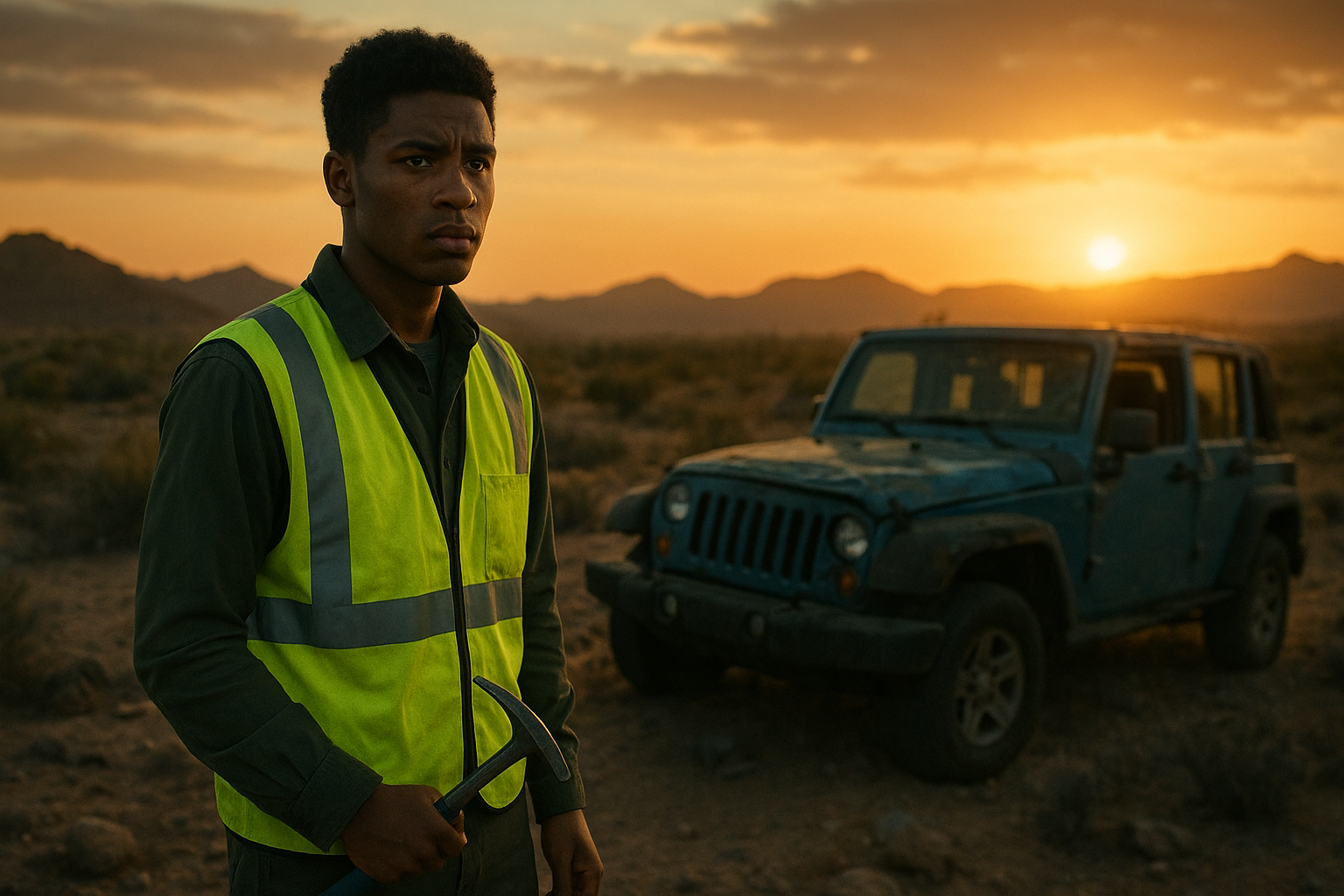
By the time Daniel Robinson’s Jeep was found in the Arizona desert, the scene looked like the ending of a story that had already happened somewhere else.
The vehicle was tipped in a ravine. The airbags had fired. His phone, wallet, keys, and clothing were there. The heat had done what desert heat always does: flatten the air, bleach the ground, and make everything look older than it was. But the one thing that should have been there—the 24-year-old geologist who had driven away from a remote worksite that morning—was gone.
That is the image that keeps this case open in people’s minds. Not just a man missing in Arizona, but a crash scene that looked as if it should explain everything and somehow explained almost nothing.
Daniel Robinson disappeared after leaving a job site near Buckeye, Arizona, on June 23, 2021. His case still matters because the physical evidence, the search timeline, and the condition of the Jeep have kept raising the same question: did the desert swallow a simple accident, or did the scene itself tell a more complicated story?
Cases like this tend to linger because a vehicle can feel like the last honest witness. In the Found Vehicle Disappearances Archive, that pattern appears again and again: the person vanishes, the car remains, and the object left behind becomes more unsettling than the absence itself.
The drive away from the well site
On the morning of June 23, Daniel was working near Sun Valley Parkway and Cactus Road in Buckeye, west of Phoenix, in a stretch of open country that can make even a short drive feel isolated. He had built a life around that kind of landscape. Born without part of his right arm, he had never let that define him. He played sports, studied geology, graduated from the College of Charleston, moved to Arizona, and took a job that demanded patience, independence, and long hours in rough terrain.
Nothing about that morning seemed like the beginning of a national mystery. A coworker later said Daniel left the site at around 9:15 to 9:30 a.m. and drove west into the desert in his blue-gray Jeep Renegade. It was daylight. There was no known sign of panic. No public argument. No confirmed emergency call. He simply drove off, and after that the timeline starts to feel less like a sequence and more like a tear in the day.
For families of the missing, that is often the cruelest part. A disappearance does not begin with a dramatic soundtrack. It begins with a normal moment that refuses to stay normal. Someone leaves. A text does not come. A call goes unanswered. And then, almost without warning, ordinary concern hardens into dread.
When the search turned from urgent to haunting
Daniel was reported missing that same day. His father, David Robinson, quickly became the force that kept the case from fading into one more file. He traveled to Arizona, organized searches, spoke to media, raised money, and did the exhausting work families are too often forced to do themselves when they feel the system is moving too slowly.
Meanwhile, the search area itself became part of the mystery. The Buckeye desert is broad, uneven, and punishing. Distances are deceptive. Tracks can disappear. Evidence can cook in the sun. The longer someone is missing out there, the harder it becomes to separate what was there from what the landscape has already taken back.
And then, on July 19, nearly a month after Daniel vanished, a rancher found the Jeep on his property about four miles from the worksite. That should have narrowed the story. Instead, it changed its shape.
The Jeep scene that refused to settle the case
At first glance, the vehicle looked like it might support a simple explanation: crash, injury, disorientation, exposure. In the desert, that chain of events is not impossible. But the details around the Jeep made the scene feel far less clean than that.
Daniel’s personal items were found there. His cell phone. His wallet. His keys. Clothing. The airbags had deployed. Evidence reportedly suggested the driver had been wearing a seatbelt at the time of the rollover. Yet Daniel himself was nowhere in the immediate area.
That absence is what gives the Jeep so much emotional weight. Most people do not willingly leave the tools that connect them to survival—phone, keys, wallet—and then vanish into desert country without a visible trail. Even when investigators and families disagree about what the evidence means, they usually agree on this much: the vehicle should have brought them closer to Daniel than it did.
The case also began drawing comparisons to other disappearances where the car was recovered but the person was not. That is why stories like What Happened After the Car Was Found? keep pulling readers in. A recovered vehicle feels like the mystery should be smaller now. Instead, it often grows teeth.
Timeline of Events
- June 23, 2021: Daniel Robinson is last seen leaving a remote Buckeye-area job site in his Jeep Renegade during the morning.
- Same day: He is reported missing after failing to return and failing to respond.
- Following weeks: Search efforts expand across the desert with volunteers, off-road vehicles, drones, dogs, and law enforcement support.
- July 19, 2021: A rancher finds Daniel’s Jeep in a ravine about four miles from the area where he was last seen.
- After the vehicle recovery: Daniel’s personal items are found at the scene, but Daniel is not.
- Months that follow: His family presses for deeper analysis of the crash scene, the vehicle data, and the broader search timeline as the missing-person case remains open.
What the Jeep scene changes
The turning point in this case is not just that the Jeep was found. It is that the Jeep became its own argument.
Daniel’s family hired accident reconstruction expert Jeff McGrath, who publicly challenged the idea that the scene pointed to a straightforward crash. McGrath said the Jeep’s data suggested the ignition had been turned over dozens of times after the airbags deployed. He also said there appeared to be additional mileage recorded after the crash sequence and that paint transfer on the vehicle suggested contact with another vehicle. Those claims have been central to why the case still generates debate.
If those findings are interpreted one way, they suggest the final resting place of the Jeep may not tell the full story of how the vehicle got there. Interpreted another way, they raise the possibility that the crash sequence was more chaotic and harder to read than it first appeared. Either way, the effect is the same: the Jeep did not close the timeline. It broke it wider open.
There was also the rancher’s reported statement that he had been in the area shortly before the Jeep was discovered and had not seen it there earlier. For Daniel’s family, that fed one of the darkest possibilities in the case—that the scene may not have been sitting untouched in that ravine for the entire month Daniel was missing.
That is the line this mystery keeps walking. A tragic accident is one form of heartbreak. A staged or incomplete scene is another. One says the desert won. The other suggests somebody else may have had a hand in the silence that followed.
Key evidence and clues people still debate
- The last confirmed sighting: Daniel was seen driving away from a remote worksite in broad daylight, which makes the total collapse of the timeline feel especially abrupt.
- The recovered Jeep: It was found rolled in a ravine with deployed airbags, but Daniel was not nearby.
- Personal belongings left behind: His phone, wallet, keys, and clothing were recovered, which makes a voluntary disappearance hard for many people to accept.
- Vehicle-data controversy: The family’s expert said post-crash ignition attempts and additional mileage raised serious questions about the scene.
- The search scale: Authorities and volunteers covered large areas, but no confirmed trace of Daniel was found.
The part of the case that still won’t go quiet
Over time, more unsettling details surfaced, including concerns from the family that someone had accessed Daniel’s apartment and electronics after he disappeared. Police also examined parts of his recent personal life, including messages involving a woman he had met before he vanished. That material added speculation, but it did not answer the central question. It just widened the perimeter of uncertainty.
And that is what makes Daniel Robinson’s disappearance feel so hard to file away. The case contains enough physical evidence to keep people staring at it, but not enough certainty to let them stop. Every major detail seems to point somewhere, then stop short. The worksite gives you a departure. The Jeep gives you a scene. The desert gives you scale. But none of them gives you Daniel.
It also explains why readers who follow this case often end up drawn into other stories with the same uneasy architecture—cases like Steven Koecher’s disappearance, where the last movement is visible but the reason for it never becomes clear, or Jelani Day’s case, where the evidence left behind only deepened the fracture in the timeline.
Why Daniel Robinson’s disappearance still gets attention
Some cases stay alive because they were witnessed by millions. Others stay alive because they leave behind one image that is impossible to shake. For Daniel Robinson, that image is the Jeep in the ravine and the feeling that the scene should have spoken more clearly than it did.
His father’s persistence has also mattered. David Robinson did not let the case sink beneath the usual current of public forgetting. He kept organizing, pushing, questioning, and insisting that the contradictions deserved more than a shrug. That pressure is part of why the case still lives in documentaries, search threads, news features, and late-night conversations between people trying to decide whether the evidence points toward accident, foul play, or something in between.
Years later, the core question remains brutally simple: what happened in the stretch between Daniel driving away and the Jeep being found? Until that missing part of the story is filled in, the Arizona desert does not feel like the place where this case ended. It feels like the place where it was left behind.
FAQ
What happened to Daniel Robinson?
Daniel Robinson disappeared on June 23, 2021, after leaving a remote job site near Buckeye, Arizona. His Jeep was found nearly a month later in a desert ravine, but Daniel has never been found and the case remains unresolved.
Was Daniel Robinson’s Jeep found?
Yes. His blue-gray Jeep Renegade was recovered on July 19, 2021. The vehicle had rolled over, the airbags had deployed, and several of Daniel’s personal belongings were found at or near the scene.
Why is the crash scene considered suspicious by some people?
Daniel’s family hired an accident reconstruction expert who said the vehicle data raised questions, including reported ignition attempts after airbag deployment, additional mileage, and possible paint transfer from another vehicle. Those findings are a major reason the case still draws debate.
Did investigators find Daniel’s phone, wallet, and keys?
Yes. Reports say Daniel’s phone, wallet, keys, and clothing were found with or near the Jeep. That is one of the main reasons the scene has continued to trouble both his family and people following the case.
Is Daniel Robinson’s case still unsolved?
Yes. Daniel Robinson is still missing, and no final explanation has been confirmed for what happened after he left the worksite that morning.
Continue exploring:
- Cases where the vehicle was found but the person seemed to vanish out of the story
- The archive of disappearances where abandoned vehicles became the most chilling clue
- The man who walked into a neighborhood and never came back out
- The final days in Maya Millete’s case that still resist a clean explanation
- The clues in Jelani Day’s disappearance that only made the timeline darker
More Disappearances stories: