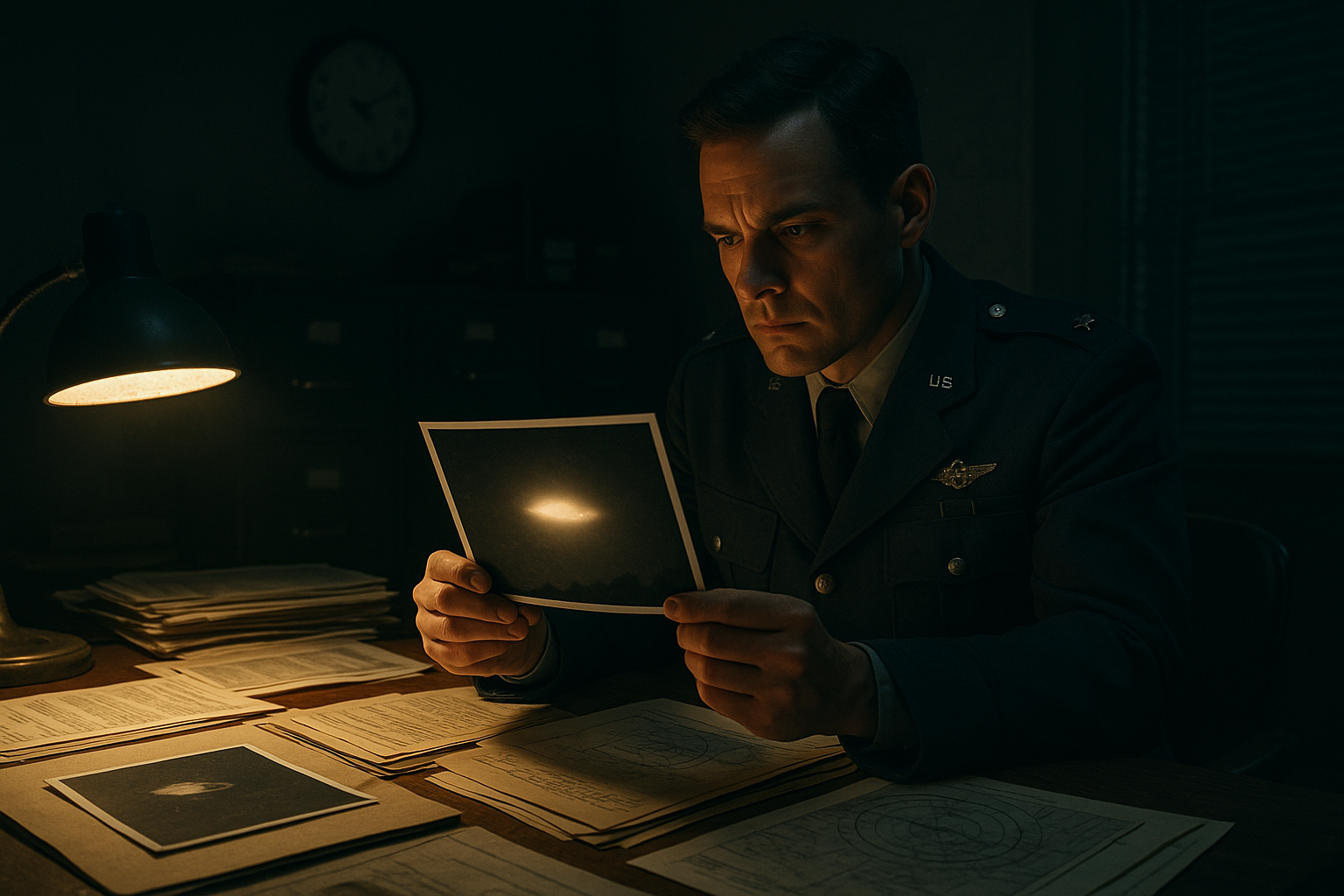
The reports did not begin like science fiction. They began as phone calls, radar marks, witness statements, and pilots describing lights that moved through the dark like they knew exactly where they were going.
Project Blue Book was the U.S. Air Force UFO investigation program that tried to sort rumor from threat during one of the most anxious periods in American history. It matters because it was real, official, and enormous: a government effort to decide whether strange objects in the sky were enemy aircraft, mistaken identity, secret technology, or something no one could explain cleanly.
That is why Project Blue Book still sits beside cases like real government conspiracies that made the public distrust official answers. The story is not just about UFOs. It is about what happens when ordinary people report extraordinary things, and the government answers with files that only make the room feel colder.
The Sky Became a Cold War Problem
In the late 1940s, America was looking upward with a new kind of fear. World War II had ended, but peace did not feel peaceful. The atomic bomb had changed the scale of danger. The Soviet Union was becoming the enemy behind every closed-door briefing. A strange light in the sky was no longer just a strange light. It might be a weapon. It might be a surveillance craft. It might be a warning that the next war had already begun above everyone’s heads.
Then came the stories. Pilots reported objects that seemed too fast. Civilians described discs, glowing shapes, and lights that crossed the sky in patterns that did not feel like weather balloons or ordinary aircraft. Newspapers found a phrase that would never really leave American culture: flying saucers.
The Air Force could not simply laugh it away. Too many reports came from people who knew aircraft, weather, altitude, and speed. Some witnesses were mistaken. Some accounts were probably exaggerations. But enough of them sounded serious that the military had to ask the question no official wanted to ask in public: what if even a small number were real?
Before Project Blue Book, there were earlier Air Force efforts, including Project Sign and Project Grudge. Those programs tried to organize the sightings and drain the panic from them. But the reports kept coming, and the explanations did not always satisfy the people reading them. By 1952, the government needed something more formal, something that looked controlled. Project Blue Book became that machine.
What Project Blue Book Was Supposed to Do
Officially, Project Blue Book had two main jobs: determine whether UFO sightings threatened national security, and analyze the reports scientifically enough to explain them when possible. On paper, that sounds calm. In practice, it meant investigators were handed some of the strangest testimony in modern American history.
They were not only dealing with vague lights glimpsed from porches. They were dealing with reports from airline crews, military personnel, police officers, radar operators, and ordinary people who insisted they had watched something behave in ways no normal plane should behave. The files piled up. The explanations ranged from aircraft and astronomical objects to balloons, weather events, hoaxes, and misidentifications. But not every case fit neatly into a box.
That was the tension at the center of Blue Book. The public wanted certainty. The government wanted order. The witnesses wanted to be believed. And the files kept producing a small, stubborn remainder: cases that were officially unexplained.
The Washington Sightings Changed the Temperature
The summer of 1952 gave Project Blue Book its most cinematic nightmare. Over Washington, D.C., radar operators tracked unknown objects near restricted airspace. Blips appeared, moved, disappeared, and returned. Pilots were sent to investigate. Some saw lights. The targets seemed to vanish when interceptors arrived, then reappear when the planes moved away.
Imagine being in that control room. The capital below. The Cold War pressing in from every direction. Unknown objects on radar over one of the most protected cities in the world. Even if every target had an ordinary explanation, the moment itself carried a terrifying possibility: the government might not control the sky as completely as people assumed.
The official explanations leaned toward temperature inversions, radar confusion, and misidentified lights. Skeptics saw that as reasonable. Believers saw it as too convenient. That split would become the entire emotional legacy of Project Blue Book. Every explanation seemed to calm one group and convince another group that the truth had been softened before release.
Timeline of Project Blue Book
- 1947: Widely publicized flying saucer reports help push UFO sightings into national attention.
- 1948–1949: Air Force projects such as Sign and Grudge attempt to evaluate sightings before Blue Book exists.
- 1952: Project Blue Book begins, and the Washington, D.C. sightings make UFO reports feel like a national security issue.
- 1953: A CIA-sponsored scientific panel reviews the UFO concern and recommends reducing public panic around the subject.
- 1960s: Sightings continue, public pressure grows, and critics argue over whether the Air Force is investigating or managing perception.
- 1968: The Condon Report concludes further UFO study is unlikely to produce major scientific value.
- 1969: The Air Force announces the end of Project Blue Book.
That timeline looks tidy only from a distance. Up close, it is a chain of pressure points: public fear, military caution, scientific skepticism, witness frustration, and a government trying to close a door that millions of people kept staring at.
What the Files Actually Said
Project Blue Book collected more than twelve thousand UFO reports. The Air Force said most were eventually explained. That part matters. Many sightings were not proof of hidden craft or visitors from somewhere else. People mistook planets for moving objects. Aircraft looked strange from certain angles. Balloons reflected sunlight in eerie ways. Weather and radar conditions could create confusion.
But the part that kept the legend alive was the unresolved remainder. Hundreds of reports were left unidentified, not because they proved something alien, but because the available information was not enough to explain them confidently. That difference is important. Unidentified does not mean extraterrestrial. It means unidentified.
Still, for readers of the files, that distinction often felt unsatisfying. A report from a trained pilot was not the same as a campfire rumor. A radar incident was not the same as a blurry backyard story. Every unexplained case became a crack in the official wall, and people began pressing their eyes to those cracks.
What Doesn’t Add Up
- The witness problem: Some reports came from people with aviation, military, or law-enforcement experience, making easy dismissal feel too neat.
- The unexplained cases: The Air Force explained most reports, but the remaining unidentified files kept public suspicion alive.
- The tone problem: Blue Book was presented as investigation, but critics believed its real mission became public reassurance.
- The cultural aftershock: Ending the program did not end UFO belief. In some ways, it made the mystery feel more official.
This is why Project Blue Book connects so naturally to the larger Conspiracies & Theories archive of government secrets, hoaxes, UFO files, and cover-ups. The case sits in the uncomfortable space between documented history and public doubt. The program was real. The files were real. The official conclusions were real. And yet the ending still felt unfinished.
The Skeptics, the Believers, and the Space Between
For skeptics, Blue Book showed how human perception can turn ordinary things into extraordinary stories. People look up at night, see something they do not understand, and their minds rush to fill the gap. In that view, the Air Force files are not evidence of visitors. They are evidence of confusion under pressure.
For believers, the files show something very different. They see credible witnesses, strange radar cases, and official language that feels carefully narrow. They do not need every sighting to be real. They only need a handful to resist explanation. If even one strong case remains open, the question survives.
The most interesting place is between those two camps. That is where Blue Book becomes less about proving aliens and more about trust. What does the public do when the government says, “We looked, and there is no threat,” but the files still contain reports that sound impossible? What happens when an official answer is technically careful but emotionally unsatisfying?
That same tension runs through cases like Operation Paperclip, where the documented record is strange enough without exaggeration. Sometimes the real archive is already unsettling. You do not need to invent a bigger monster. You only need to read what was actually filed.
Why Project Blue Book Still Matters Now
Project Blue Book ended in 1969, but the question it carried never really went away. Decades later, UFOs returned to official language under new names, new hearings, and new military footage. The vocabulary changed. The unease did not.
That is why Blue Book still feels current. It was an early version of a problem governments still face: how to discuss unexplained aerial reports without feeding panic, ridicule, or conspiracy. Say too little, and people assume a cover-up. Say too much, and people assume confirmation. Say “unidentified,” and half the room hears “unknown craft” while the other half hears “not enough data.”
It also belongs beside stranger sky mysteries because the setting is so primal. A person looks up, sees something they cannot explain, and suddenly the world feels larger and less settled than it did a minute earlier. That same feeling runs through collections like strange sky mysteries that still have no clean explanation and the broader archive of signals, sky anomalies, vanishing ships, and impossible manuscripts.
The Official Ending Did Not Feel Like an Ending
When the Air Force closed Project Blue Book, it concluded that the investigated UFOs did not represent a national security threat, did not show technology beyond known science, and did not prove extraterrestrial vehicles. Legally and officially, that was the answer.
But mysteries do not always end when institutions stop paying for them. The files remained. The witness stories remained. The unresolved reports remained. And for many people, the closure of the program felt less like a final explanation and more like someone turning off the lights in a room that still had voices inside it.
That is the lasting power of Project Blue Book. It did not prove the most dramatic theories. It did not erase them either. It left behind a paper trail where fear, science, military caution, public imagination, and unanswered testimony all overlap. The result is not a simple UFO story. It is a government archive that still feels alive whenever someone looks up at the sky and wonders who else is watching.
FAQ
Was Project Blue Book real?
Yes. Project Blue Book was a real U.S. Air Force program that investigated UFO reports from the early 1950s until it was closed in 1969.
What did Project Blue Book find?
The Air Force said most reports had ordinary explanations and concluded the cases did not prove a national security threat or extraterrestrial technology. However, a smaller number of reports remained unidentified because the available evidence was not enough to explain them confidently.
Did Project Blue Book prove UFOs were alien spacecraft?
No. Project Blue Book did not prove that UFOs were alien spacecraft. Its unresolved cases are better understood as unexplained reports, not automatic proof of extraterrestrial origin.
Why does Project Blue Book still matter?
It still matters because it shows how difficult it is for governments to investigate strange public reports without creating more suspicion. The program ended, but the questions around trust, evidence, and unexplained sightings never fully went away.
Continue exploring:
- Real government secrets that made official denials harder to trust
- The crash story that turned UFO suspicion into American folklore
- The secret mind-control program that proved some fears were not imaginary
- The airport mystery where symbols, tunnels, and rumor became a legend
- Step into the full archive of government secrets, UFO files, hoaxes, and cover-ups
More Conspiracies & Theories stories: