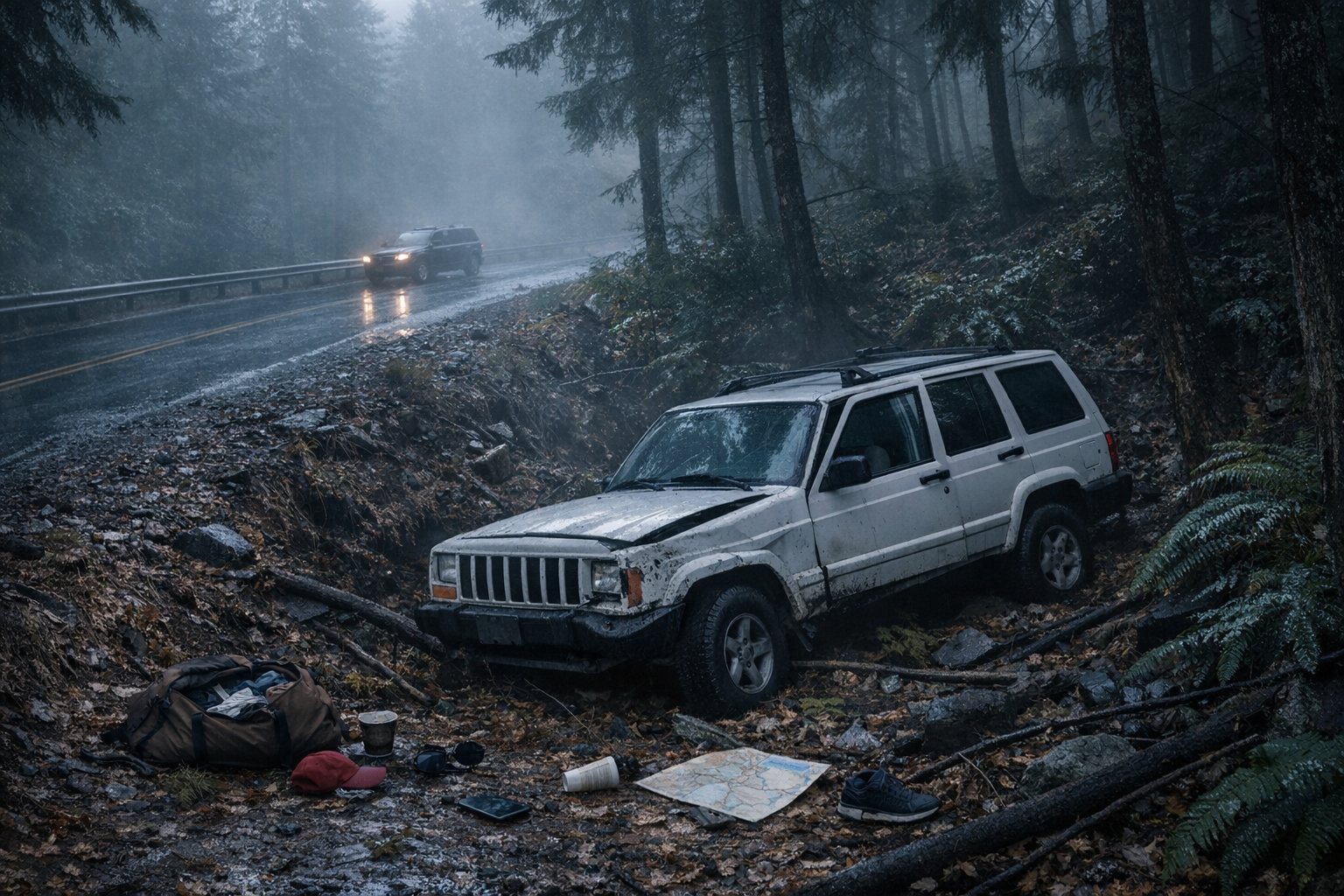
The Jeep was hidden so well that runners could have passed it a dozen times and never seen it.
It was March 18, 2000, and the road near Canyon Creek curved through the Washington woods like a strip of wet ribbon. At the edge of that curve, clothes had been tied to branches. More clothing was scattered in the dirt. Down below, at the bottom of a steep embankment, a white Jeep Cherokee sat crushed among the trees.
At first glance, it looked like the ending to a terrible accident. But the closer investigators looked, the stranger it became. There was no driver. No body. No clear trail leading away from the wreck. And inside that smashed Jeep were the kinds of things a missing person usually takes with them if they leave by choice: cash, a checkbook, a passport, clothes, a guitar, even her mothers ring.
Leah Roberts was a 23-year-old woman whose unsolved disappearance still draws attention because almost every clue in the case points in a different direction. Her story matters not only because she vanished after a cross-country trip inspired by Jack Kerouac, but because the evidence around her abandoned Jeep suggests that whatever happened was not a simple wreck in the woods.
Cases like the disappearance of Kris Kremers and Lisanne Froon haunt people for the same reason this one does: a person goes missing, a trail of physical clues is left behind, and yet the story only gets harder to explain the deeper you look.
Before Leah Roberts vanished, her life had already been split into a before and after.
She grew up in Durham, North Carolina, in a close family. Then, in just a few years, that stability was shattered. Her mother died suddenly. Not long after, Leah was badly injured in a car crash that left her with a punctured lung, a broken leg, and a metal rod in her femur. Then her father died too. By the time she was in her early twenties, she had survived more grief than most people face in decades.
Friends and family said she changed after that. Not in some dramatic, obvious way. More like someone quietly drifting out of the life that used to fit. She was smart, reflective, and increasingly drawn to big questions about meaning, freedom, and starting over. She read Jack Kerouac. She wrote poetry. She spent long stretches in coffee shops. She talked about the kind of road-trip life that sounds romantic from far away and frightening up close.
Then, in March 2000, she made a choice that would define everything that came after.
Leah withdrew thousands of dollars from her bank account, packed some clothes, took her kitten Bea, and left a note behind for her roommate. The line everyone remembers is this: Im not suicidal. Im the opposite. She also left rent money, which suggested this was not a panicked disappearance. It looked planned, or at least partly planned. She was leaving, but she seemed to expect she might come back.
Bank records later showed the rough path of her trip. She headed west from North Carolina, stopping along the way for gas, food, and a motel near Memphis. It was not a rushed flight. It was a long drive with intention behind it. Somewhere in her mind, Leah appeared to be following a private map.
By the early morning of March 13, she was in Brooks, Oregon, where surveillance footage showed her at a gas station. She appeared to be alone. She did not look injured. She did not appear to be in immediate danger. But witnesses later noted something unsettling in the footage: she seemed to keep glancing out toward the parking lot while the purchase was being completed, as if she was watching for someone or something.
From there, the trail moves north.
Leah drove into Washington and reached Bellingham later that same day. Among the items later found in her Jeep was a ticket stub from an afternoon showing of American Beauty at Bellis Fair Mall. That little scrap of paper matters more than it seems. It anchors Leah to a real place and a real hour. It says she made it to Bellingham. It says she was alive long enough to stop, breathe, and sit through a movie after driving across the country.
After that, things get murky fast.
According to one account, Leah may have gone to a restaurant near the theater, where she spoke with men seated nearby. One witness later claimed she left with a man she called Barry. The problem is that nobody else clearly backed up that exact version. In this case, even the witness trail feels like fog.
Timeline of Events
- March 9, 2000: Leah leaves Durham, North Carolina, after withdrawing cash and leaving a note for her roommate.
- March 912: Her bank activity suggests a westbound drive across the country, including a motel stop near Memphis.
- Early March 13: She buys gas in Brooks, Oregon. Surveillance footage shows her alone.
- Afternoon March 13: A movie ticket later found in her Jeep places her at Bellis Fair Mall in Bellingham, Washington.
- March 13 onward: Leah is never definitively confirmed again.
- March 18: Her Jeep is discovered wrecked at the bottom of an embankment off Canyon Creek Road in Whatcom County.
- Later investigation: Detectives find evidence suggesting the Jeep may have been intentionally sent off the road with nobody inside.
That timeline is the unique engine of this case. It is not just that Leah disappeared. It is that the known sequence of her movements creates a narrow, unnerving gap between her last trace in Bellingham and the discovery of a Jeep that may have been staged to tell the wrong story.
When joggers found the Cherokee on March 18, the scene looked chaotic but oddly deliberate. The Jeep had rolled down the embankment hard enough to be badly damaged. Its contents were thrown around. Blankets and pillows had been placed over broken windows, suggesting someone may have used it as shelter after the crash. Her clothes, CDs, guitar, and other belongings were scattered nearby. Her passport and checkbook were still there. So was roughly $2,500 in cash.
That cash matters. People who vanish voluntarily do not usually leave behind a large amount of money in a wrecked vehicle deep in the woods. Robbers do not usually leave cash sitting in a pair of pants. And if Leah had crashed by accident, climbed out hurt and confused, and wandered away, why was there so little physical evidence showing that had happened?
Search teams attacked the area with everything they had. Cadaver dogs were brought in. Investigators used helicopters. They even used tools that could have helped detect the metal rod in Leahs leg if her body were nearby. Still, they found nothing that explained where she went after that road ended.
🔎 Related Investigation:
If this case pulled you deeper into the mystery, continue into:
🔎 Related Investigation:
If this case pulled you deeper into the mystery, continue into:
What Doesnt Add Up
- No clear evidence Leah was inside the Jeep during the crash: early investigators found little sign of an occupant being thrown around or injured in the rollover.
- Valuables were left behind: cash, jewelry, identification, and personal items remained at the scene.
- The shelter-like setup is strange: blankets over broken windows suggest someone lingered after the wreck, but there was no clean explanation for who that was.
- The witness sequence is shaky: the report about Leah leaving with a man called Barry was never clearly backed up by others.
- The later mechanical discovery changed the case: detectives eventually found the Jeeps starter had been tampered with, supporting the idea that the crash may have been staged.
That last point may be the most disturbing one in the entire case.
Years after Leah disappeared, investigators took a fresh look at the Jeep and found evidence that a wire had been cut under the hood. According to later reports, that tampering could have allowed the vehicle to move and accelerate without someone actively pressing the gas pedal. In other words, the Jeep may have been sent down that embankment on purpose.
If that is true, the case changes completely.
It means the Jeep was not the place where Leah disappeared. It was a prop. A planted ending. A false last chapter built to make investigators look in the woods instead of wherever the real answer was hiding.
And once you view the case through that lens, the whole road-trip mystery sharpens into something colder.
Maybe Leah met someone in Bellingham. Maybe she trusted the wrong person after arriving in a city where nobody knew her. Maybe the person she met understood exactly how to make a disappearance look accidental. Or maybe Leah did leave the Jeep on her own and someone else found it later, staged the crash, and wiped out whatever trace she had left behind. None of those possibilities are comforting. All of them show how wide the evidence gap still is.
Key Evidence and Clues
- The note: Leah specifically wrote that she was not suicidal, which complicates any theory that she intentionally ended her life.
- The Oregon gas-station stop: this is the last confirmed sighting supported by records and footage.
- The movie ticket stub: it places Leah in Bellingham on March 13 and narrows the timeline significantly.
- The mothers ring found under a floor mat: family believed she treasured it and would not remove it willingly.
- Male DNA and a fingerprint linked to the Jeep area: these discoveries suggested another person may have been involved, though they have not publicly solved the case.
There is another reason this disappearance has stayed alive for so long: Leah does not fit easily into one category.
She was not just a random traveler who got lost. She was also not clearly fleeing her life forever. Her note, the rent money, the cash she carried, and the personal items she left behind all push against simple explanations. She seemed to be searching for something, yesbut searching is not the same as wanting to vanish.
And then there is Bea, the kitten she brought along. It sounds like a small detail until you sit with it. People do not usually bring a pet on a cross-country spiritual road trip and then casually abandon both the animal and all their money in a staged wreck. The cats disappearance deepens the mystery because it makes the scene feel even less natural, less accidental, less like the end of a journey Leah controlled.
One reported sighting added another eerie layer. After the Jeep was found, a man contacted authorities to say his wife may have seen Leah at a gas station in Everett, farther south toward Seattle. He said she looked disoriented. Then, before he could fully identify himself, he panicked and ended the call. Investigators reportedly considered the tip credible, but credible is not the same as useful. It raised a possibility without answering anything.
If that sighting was real, then Leah survived whatever happened around the Jeepat least briefly. If it was not real, then the case remains pinned to a fake crash scene and a blank stretch of time in Bellingham that nobody has managed to fill.
That blank stretch is what keeps this case open in peoples minds.
Leah Roberts drove across America chasing something that felt bigger than ordinary life. By the end of that drive, she had reached the Pacific Northwest landscape that had inspired her imagination. Mountains. Wet roads. Dark trees. A chance, maybe, to begin again. Instead, the trail stops at a wrecked Jeep in the woods and a cluster of clues that refuse to line up.
More than two decades later, the most haunting part of Leah Robertss missing person case is not just that she disappeared. It is that the last chapter appears to have been edited by someone else. The route west can be traced. The morning and afternoon windows can be narrowed. The abandoned car can be examined again and again. But the one thing investigators still cannot reconcile is the space between Leahs real movements and the story the Jeep seems to have been built to tell.
Until that gap is closed, her disappearance will remain one of those cases that feels permanently unfinishedlike a road that leads into the trees and never comes back out.
🔎 Related Investigation:
🔎 Related Investigation:
If this story stayed with you, the author suggests these real cases next:
- Two hikers, a broken trail, and clues that only deepened the mystery
- The strange drive before Bryce Laspisa vanished without a trace
- The man who walked into a quiet neighborhood and was never seen again
Explore more Disappearances stories here: