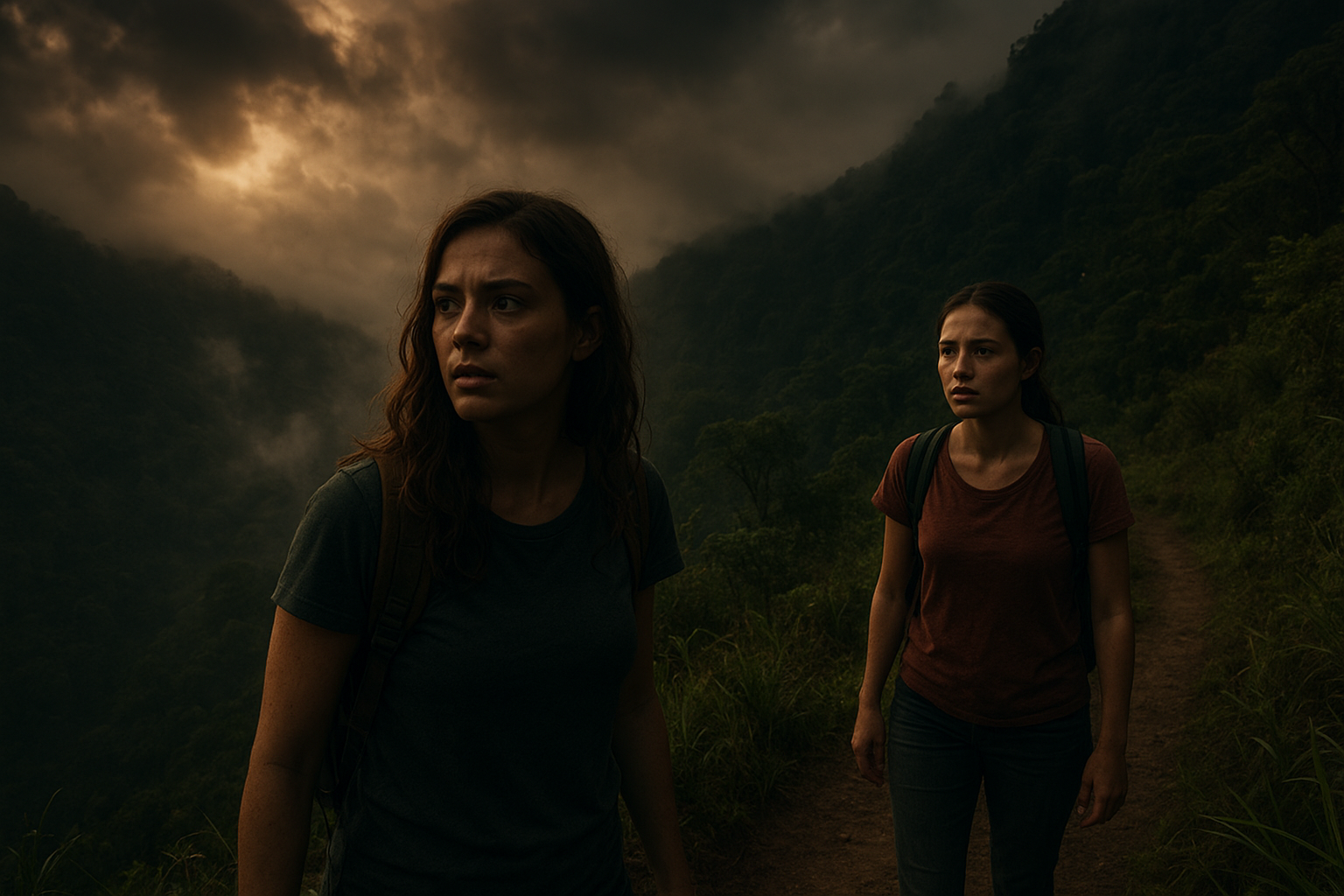
Kris Kremers and Lisanne Froon walked into Panama’s El Pianista trail expecting a normal daytime hike. They took smiling photos, followed a popular path, and seemed to have no reason to fear the mountain above Boquete. But hours later, their phones began trying to call emergency services. The calls never connected. Days passed. Then weeks. And when their backpack, camera, phones, and remains were finally found, the evidence did not close the case. It made the mystery even darker.
This case is one of many where the evidence didn’t solve the mystery—it became part of it. Strange clues, unsettling footage, and unanswered questions still remain.
👉 See more disturbing cases here
Kris Kremers and Lisanne Froon were two Dutch travelers who disappeared on April 1, 2014, after hiking the El Pianista trail near Boquete, Panama. Their phones later showed repeated failed emergency calls, and a backpack containing their belongings was found weeks later. Human remains were eventually recovered, but the exact cause of death remains disputed. The most accepted explanation is that they became lost or injured in the jungle, though many details still fuel questions about possible foul play.
What Happened to Kris Kremers and Lisanne Froon?
Kris Kremers and Lisanne Froon arrived in Panama full of the kind of excitement that comes with being young, far from home, and ready for something bigger than ordinary life.
They were from the Netherlands. They were friends. They had finished school and were traveling through Central America before the next part of adulthood began. Panama was supposed to be adventure, volunteering, Spanish lessons, and memories they would carry home forever.
By late March 2014, they were staying near Boquete, a mountain town surrounded by coffee farms, green hills, and cloud forest. It was the kind of place that looked peaceful in travel photos. Cool air. Quiet roads. Beautiful trails. Tourists came there to hike, explore, and return before dinner with muddy shoes and camera rolls full of mountain views.
On April 1, 2014, Kris and Lisanne set out for the El Pianista trail.
It did not look like a dangerous decision.
They were not heading into the jungle for a multi-day survival trip. They were going for what seemed like a daytime hike. They wore light clothes. They carried a small backpack. Inside were basic items, including phones and a camera.
At first, everything looked normal.
The camera captured them smiling along the trail. The sky was bright. The path was visible. The mountain looked beautiful. Nothing in those early photos suggested that they were scared, lost, injured, or being followed.
And that is what makes this case so chilling.
There is no obvious warning sign.
No final message saying something was wrong.
No confirmed witness who saw a clear turning point.
Just two young women walking deeper into a beautiful place that, by nightfall, would become the center of one of the most disturbing disappearance cases in the world.
The El Pianista Trail
The El Pianista trail begins near Boquete and climbs toward a high divide in the mountains.
On the Boquete side, it can feel like a regular hiking route. Tourists use it. Locals know it. The beginning does not feel like the kind of place where someone could vanish forever.
But past the summit, the land changes.
The trail becomes rougher. The jungle gets thicker. The ground becomes slippery. Streams and ravines cut through the forest. Rain can come quickly. The sounds of water and insects can make it harder to hear people calling. A wrong turn can become serious fast.
That divide matters because many questions in this case begin with one simple possibility:
Did Kris and Lisanne accidentally continue beyond the point where they should have turned around?
If they did, then the hike may have stopped being a tourist walk and became a survival situation before they fully understood what had happened.
Some disappearances leave behind clues that only make the mystery worse. If this case pulled you in, there are more stories just like it—filled with strange last sightings, confusing evidence, and unanswered questions.
Timeline of the Kris Kremers and Lisanne Froon Disappearance
March 2014: Kris Kremers and Lisanne Froon arrive in Panama from the Netherlands. They plan to learn Spanish, volunteer, and travel.
Late March 2014: They stay near Boquete, a mountain town known for hiking trails and cloud forest.
April 1, 2014: Kris and Lisanne leave for a hike on the El Pianista trail.
Afternoon of April 1: Their camera captures normal daytime photos on the trail.
4:39 p.m., April 1: One of their phones tries to call emergency services.
Minutes later: The second phone also attempts an emergency call.
April 2 onward: The women fail to return and miss an appointment. Concern grows, and search efforts begin.
April 1–April 11: Their phones show repeated attempts to reach emergency services and later intermittent use.
Night of April 8: The camera takes a strange series of flash photos in the dark jungle.
June 2014: A backpack is found near a riverbank, containing phones, the camera, sunglasses, money, and other items.
Later searches: Human remains are found in the area and linked to Kris and Lisanne.
The Emergency Calls
The first confirmed sign that something had gone badly wrong came from the phones.
At 4:39 p.m. on April 1, one of the women’s phones attempted to call 112, the emergency number used in the Netherlands and much of Europe. A few minutes later, another emergency call was attempted from the other phone.
Neither call connected.
That detail is one of the most important parts of the entire case.
People do not usually call emergency services during a normal hike unless something has happened.
Maybe one of them had slipped.
Maybe they realized they were lost.
Maybe daylight was fading, and the trail no longer looked familiar.
Maybe they had crossed beyond the summit and could not find the way back.
The calls continued over the following days, but the phones could not get a reliable signal. At first, both phones were used. Later, one battery died. The other phone was turned on at different times, as if someone was trying to save battery while checking for service.
Then came one of the strangest details.
At some point, the correct PIN was no longer entered into one of the phones.
That detail has haunted people for years.
It could mean panic. It could mean confusion. It could mean injury. It could mean one woman was trying to use the other’s phone and did not know the code. Or it could mean something darker.
The phone records do not tell us what happened.
They only show that someone was alive long enough to keep trying.
The Search in Boquete
When Kris and Lisanne did not return, concern grew quickly.
They missed an appointment the next day. A guide who was supposed to meet them realized something was wrong. Soon, search teams, volunteers, dogs, helicopters, and local authorities were involved.
But the jungle around Boquete is not an easy place to search.
It is steep. It is wet. It is dense. A person can be close and still invisible. A body, backpack, or piece of clothing can disappear under leaves, mud, rocks, or moving water.
For the families, the waiting must have been unbearable.
There was no confirmed rescue.
No clear crime scene.
No goodbye message.
No witness saying exactly where the women went after the last known images.
Just silence from a forest that seemed to be holding onto the answer.
🔎 Related Investigation:
The Backpack Discovery
More than two months after Kris and Lisanne disappeared, a local woman found a blue backpack near a riverbank.
Inside were items connected to the women.
There were sunglasses.
There was money.
There were phones.
There was a camera.
There were other personal belongings.
This discovery should have brought the case closer to an answer. Instead, it made everything feel more confusing.
The backpack was reportedly in surprisingly good condition. The items inside were not destroyed in the way many people expected after weeks in a harsh jungle environment. That led some to wonder whether the backpack had truly been exposed to the elements the entire time.
Was it carried by water?
Was it protected somehow?
Was it placed there?
Or was the condition simply less strange than it sounded because of how it was found?
Like almost everything in this case, the backpack answered one question while creating five more.
The Night Photos
The camera found inside the backpack became one of the most disturbing pieces of evidence.
The early photos from April 1 showed Kris and Lisanne hiking in daylight. Those pictures were normal. They looked like travel photos. Smiling faces. Green trail. Bright mountain air.
Then came the night photos.
On the night of April 8, the camera took dozens of flash photographs in the darkness.
Most of them showed almost nothing clearly.
Branches.
Rocks.
A slope.
Bits of ground.
Rain or moisture in the air.
One image appeared to show the back of Kris’s head.
Another seemed to show something like a marker made with plastic and branches.
The photos were taken in a quick sequence, and they have been debated ever since.
Were Kris and Lisanne trying to signal rescuers?
Were they using the camera flash to see in the dark?
Were they trying to scare away an animal?
Were they documenting their surroundings?
Or were the photos taken by someone else?
The most practical explanation is that the camera flash was being used as a signal or light source. If they heard search teams, helicopters, or voices in the distance, flashing the camera into the dark might have felt like their only chance.
But the images are so strange, and the situation is so frightening, that people continue to see them as the emotional center of the case.
Two young women, lost somewhere in the jungle, firing light into total darkness.
That image is hard to forget.
The Remains
After the backpack was found, searchers discovered human remains in the area.
Among the remains were bone fragments and a boot containing part of a foot. The remains were linked to Kris and Lisanne.
That confirmed the worst.
They had not run away.
They had not started a new life.
They had died somewhere beyond the trail.
But even then, the case did not fully close.
The remains did not provide a clean explanation for exactly how they died. There was no simple final scene. No complete recovery. No clear cause that everyone could agree on.
That is one reason the case still attracts so much attention.
It has confirmation of death, but not full explanation.
It has evidence, but not enough clarity.
It has a likely theory, but not enough certainty to silence every doubt.
What Doesn’t Add Up?
The official direction of the case has often leaned toward a tragic accident or getting lost in dangerous terrain.
That explanation makes sense in many ways.
But several details continue to bother people.
The emergency calls began the same afternoon. Something went wrong quickly enough that they tried to call for help only hours after starting the hike.
The phone use stretched across several days. This suggests at least one of them may have survived for days after the first emergency call.
The incorrect PIN entries remain unsettling. It could have an innocent explanation, but it also creates questions about who was using the phone and why.
The night photos are extremely strange. Even if they were taken as signals, the images feel desperate and confusing.
The backpack’s condition raised questions. Some people believe it looked too intact for something lost in the jungle for weeks.
The remains did not clearly explain the death. They confirmed the women were gone, but not exactly what happened between April 1 and the final moments.
None of these details prove foul play.
But together, they explain why the disappearance of Kris Kremers and Lisanne Froon never became a simple lost-hiker story.
Was It Foul Play?
Some people believe Kris and Lisanne may have encountered someone dangerous after leaving the main trail.
The foul play theory usually points to the same details: the strange photos, the backpack, the phone activity, the missing time, and the incomplete remains.
It is not impossible.
Remote areas can hide crimes. Travelers can become vulnerable. And when a case has gaps, suspicion naturally grows.
But there is a major problem with the foul play theory.
There is no clear public evidence proving that another person harmed them.
No confirmed attacker.
No verified crime scene.
No direct message.
No conclusive photo.
No official finding that proves murder.
That does not mean foul play is impossible. It means the evidence available to the public does not prove it.
The mystery survives because the accident theory fits the terrain, while the unanswered clues keep the darker theories alive.
Most Likely Explanation
The most likely explanation is that Kris Kremers and Lisanne Froon became lost or injured after hiking beyond the familiar part of the El Pianista trail.
Once they crossed into rougher terrain, a small mistake could have become deadly.
They may have taken a wrong path.
One of them may have fallen.
They may have tried to find another route back.
They may have followed water, thinking it would lead to help.
They may have survived for days, rationing battery power, trying emergency calls, and using the camera flash in the night because it was the only tool they had left.
That explanation is simple, but it is not comforting.
In some ways, it is worse.
It means there may have been no villain.
No planned crime.
No hidden conspiracy.
Just two friends trapped in a place where every decision became harder, every hour made rescue less likely, and every attempt to escape may have pushed them deeper into danger.
Still, the case refuses to feel fully solved.
Because the evidence does not tell one clean story.
It whispers several.
Why This Case Still Haunts People
The disappearance of Kris Kremers and Lisanne Froon stays with people because it begins so normally.
That is the terrifying part.
They were not doing something extreme.
They were not knowingly walking into a war zone, a storm, or a forbidden place.
They were young travelers taking a hike.
The early photos show the kind of moment anyone could recognize: two friends smiling on a trail, trusting the day, trusting the path, trusting that they would come back down.
Then the story changes.
Emergency calls.
No signal.
Silence.
Night photos.
A backpack by a river.
Bones in the jungle.
And no final answer that makes the pieces settle.
The case feels like a warning about how fast ordinary life can tilt into danger. One moment there is a camera, sunlight, and a mountain view. The next, someone is pressing a phone against the air, hoping for one bar of signal that never comes.
FAQ About Kris Kremers and Lisanne Froon
Who were Kris Kremers and Lisanne Froon?
Kris Kremers and Lisanne Froon were two young women from the Netherlands who traveled to Panama in 2014. They disappeared while hiking near Boquete.
Where did Kris Kremers and Lisanne Froon disappear?
They disappeared after hiking the El Pianista trail near Boquete, Panama.
When did they disappear?
They disappeared on April 1, 2014.
Were their phones found?
Yes. Their phones were found inside a backpack discovered weeks after they disappeared. The phones showed repeated failed attempts to call emergency services.
What were the night photos?
The night photos were a series of flash images taken by their camera on April 8, 2014. They showed dark jungle scenes, rocks, branches, and other unclear details. Many believe the flash may have been used as a signal or light source.
Were Kris and Lisanne found alive?
No. Human remains linked to the women were later found in the area.
Was their disappearance solved?
Their deaths were confirmed, but exactly how they died remains disputed. The most accepted explanation is that they became lost or injured in the jungle, but some details continue to raise questions.
Was foul play proven?
No. Foul play has been suggested by some people, but there is no conclusive public evidence proving that another person caused their deaths.
The Final Mystery
More than a decade later, the names Kris Kremers and Lisanne Froon still carry a heavy question.
How did a normal hike become a week-long nightmare?
The answer may be buried in the jungle forever.
Maybe they crossed the summit, lost the trail, and could not get back.
Maybe one of them was hurt, and the other refused to leave her.
Maybe they kept trying to call because they believed rescue was close.
Maybe on April 8, deep in the dark, they used the camera flash again and again because it was the only way to be seen.
That is the image that remains.
Not the backpack.
Not the theories.
Not even the phone records.
Just light flashing into the black jungle, over and over, as if two young women were trying to tell the world:
We are still here.
And somehow, the world still could not find them in time.
If this case caught your attention, you might want to explore more like it:
Recent disappearances that still have no answers — a collection of modern cases that remain unsolved.
🔎 Related Investigation:
🔎 If this story stayed with you, the author suggests these real cases next:
- The cold roadside disappearance that left Maura Murray’s final minutes wide open
- The passenger jet mystery that vanished into open sky and never came back
- The night Brian Shaffer walked into a bar and seemingly out of the world
Explore more Disappearances stories here: