Aum Shinrikyo Cult — The Tokyo Subway Attack Explained
8 min readApril 1, 2026
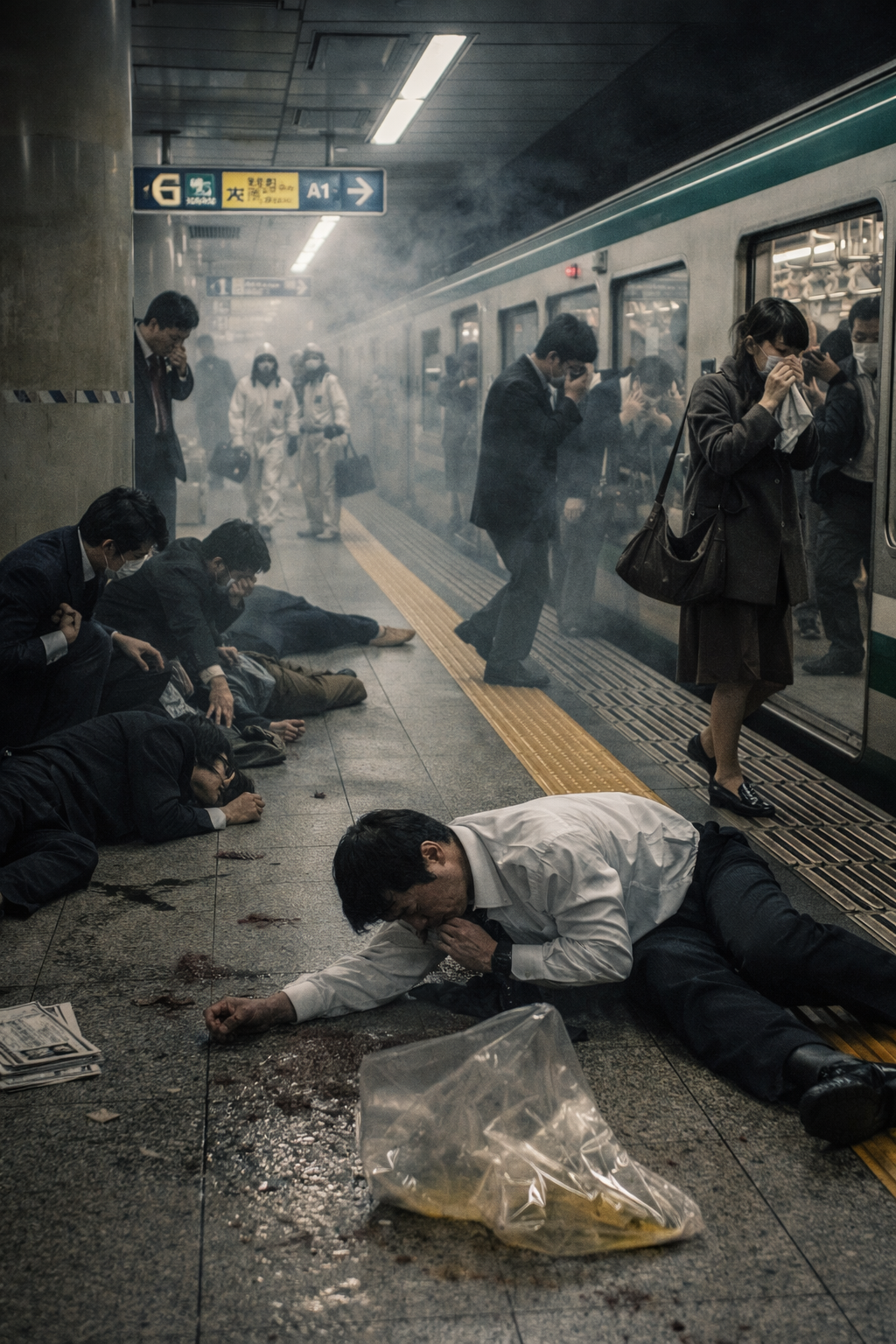
At 8:00 a.m. on March 20, 1995, millions of people were doing exactly what they had done hundreds of times before. They boarded trains, found seats, held onto straps, checked watches, and prepared for another workday in Tokyo.Less than an hour later, passengers were collapsing on station platforms, emergency crews were struggling to understand what they were seeing, and one of the safest cities in the world was facing something almost nobody had imagined—a chemical weapons attack carried out by a doomsday cult.What was the Tokyo Subway Sarin Attack? On March 20, 1995, members of the Japanese cult Aum Shinrikyo released sarin nerve agent on multiple Tokyo subway lines during the morning rush hour. The attack killed and injured numerous people, sickened thousands more, and became one of the deadliest acts of domestic terrorism in modern Japanese history. Investigators later discovered the cult had spent years developing chemical weapons under the direction of its leader, Shoko Asahara.
This story is also featured in a larger roundup of related cases.Doomsday Cults That Ended in Death — The Beliefs, Leaders, and Final Catastrophes
Tokyo’s subway system is famous for precision.
Trains arrive on time.
Platforms remain organized.
Millions of passengers move through the network every day with almost mechanical efficiency.
That Monday morning looked no different.
Office workers packed into train cars.
Students headed toward classes.
Businessmen reviewed schedules.
Nobody knew that several passengers were carrying bags filled with liquid sarin nerve agent.
The people carrying them did not look dangerous.
They did not carry guns.
They did not wear masks.
They looked like everyone else.
That was part of the plan.
Each operative boarded a different train.
Each carried a plastic package containing sarin.
Each had the same instructions.
Leave the bag.
Puncture it.
Get off the train.
The rest would happen on its own.
What Is Sarin?
Sarin is one of the deadliest nerve agents ever created.
It was originally developed for warfare.
The substance is colorless.
Often difficult to detect.
And incredibly toxic.
When inhaled or absorbed, it attacks the nervous system.
Victims may experience:
Blurred vision
Difficulty breathing
Severe sweating
Nausea
Convulsions
Paralysis
In high enough concentrations, death can come quickly.
Most ordinary citizens had never heard of sarin in 1995.
They certainly never expected to encounter it during their morning commute.
The First Signs of Trouble
At first, passengers noticed only small things.
Something smelled strange.
Eyes began to sting.
People rubbed their faces.
Some started coughing.
Others complained about dizziness.
Within minutes, conditions became far worse.
Passengers stumbled.
Vision blurred.
People collapsed onto train floors.
Confusion spread from one car to another.
Nobody understood what was happening.
At stations across the city, victims emerged from trains and fell onto platforms.
Emergency calls flooded dispatch centers.
But responders faced a major problem.
They didn’t know what they were responding to.
Was it a gas leak?
A chemical accident?
Industrial contamination?
No one realized they were witnessing a coordinated terrorist attack.
And every minute of uncertainty allowed the effects to spread further.
Who Was Aum Shinrikyo?
The group responsible did not begin as a terrorist organization.
In fact, many early followers joined searching for something entirely different.
Meaning.
Purpose.
Spiritual answers.
The movement was founded by a man named Shoko Asahara.
To followers, Asahara presented himself as more than a religious teacher.
He claimed extraordinary abilities.
He spoke about enlightenment.
He claimed special knowledge.
And eventually, he convinced many followers that he possessed unique insight into humanity’s future.
The future he described was terrifying.
According to Asahara, a global catastrophe was approaching.
Civilization would collapse.
Most people would die.
Only a chosen few would survive.
And naturally, those chosen survivors were members of his movement.
How a Cult Became Dangerous
Many destructive groups follow a similar pattern.
At first, they promise answers.
Then they demand commitment.
Eventually, they demand obedience.
Aum Shinrikyo followed that path.
Members surrendered possessions.
Relationships with family weakened.
Life increasingly revolved around the organization.
Inside the group, Asahara’s authority became absolute.
Questioning him became difficult.
Disagreeing became dangerous.
Meanwhile, the movement attracted an unusual number of highly educated followers.
Scientists joined.
Engineers joined.
Chemists joined.
Doctors joined.
That detail would later become critically important.
Because unlike many fringe groups, Aum possessed members capable of building sophisticated systems and conducting advanced research.
The cult did not simply dream about power.
It developed the technical ability to pursue it.
The Secret Weapons Program
Behind the scenes, Aum Shinrikyo began building facilities that looked less like religious centers and more like industrial laboratories.
Investigators later discovered evidence of chemical production.
Biological research.
Weapon development.
Experiments.
The organization had quietly evolved into something far more dangerous than outsiders realized.
The subway attack was not the group’s first step into violence.
Evidence later suggested earlier incidents and experiments had already occurred.
Warning signs existed.
But they were not fully recognized until after the attack.
By then, the group had already crossed a line from extremist belief into mass-casualty terrorism.
Timeline of the Tokyo Subway Attack
1980s
Shoko Asahara founds Aum Shinrikyo.
The movement gains followers throughout Japan.
Late 1980s–Early 1990s
The group becomes increasingly isolated and apocalyptic.
Secret research facilities are developed.
March 20, 1995
Aum members release sarin on multiple Tokyo subway lines.
Passengers begin experiencing severe symptoms.
Emergency services respond across the city.
Days Following the Attack
Authorities raid Aum facilities.
Chemical laboratories and evidence are discovered.
Subsequent Years
Shoko Asahara and numerous followers are convicted.
The attack becomes one of Japan’s most infamous terrorist acts.
What Authorities Found
The raids shocked investigators.
Authorities expected evidence.
They did not expect the scale.
Laboratories were discovered.
Chemical stockpiles were found.
Equipment linked to weapon production emerged.
The image of Aum as merely a strange religious group collapsed almost immediately.
The organization had spent years preparing for scenarios that existed largely in Asahara’s apocalyptic imagination.
And those preparations had become deadly reality.
For many Japanese citizens, the revelations were difficult to process.
The threat had not come from a foreign military.
It had not come from a hostile nation.
It had come from fellow citizens living inside an organization that most people barely understood.
What Doesn’t Add Up?
Several questions continue to fascinate researchers and historians.
How did warning signs go unnoticed?
The organization had attracted attention before the attack, yet few anticipated its true capabilities.
How did a religious movement develop chemical weapons?
The combination of educated members, secrecy, and resources created possibilities many outsiders underestimated.
Why were intelligent followers persuaded?
Many members were highly educated professionals.
Understanding how they became committed remains one of the most studied aspects of the case.
Could the attack have been prevented?
Some investigators believe earlier intervention might have changed the outcome.
Others argue the cult’s secrecy made prevention extremely difficult.
Most Likely Explanation
Unlike many stories on ReadTheRealStory, the central mystery here is largely solved.
Investigators know who carried out the attack.
They know how it happened.
They know who ordered it.
The deeper question is why.
The most likely explanation is that years of isolation, apocalyptic belief, absolute loyalty to a charismatic leader, and increasing paranoia pushed the organization toward violence.
The subway attack was not a spontaneous act.
It was the final result of a long process.
A process in which extreme beliefs gradually became extreme actions.
And by the time outsiders realized how dangerous the group had become, it was already too late.
Why the Tokyo Subway Attack Still Matters
The attack changed how many countries viewed domestic extremism.
It demonstrated that dangerous threats do not always come from armies or foreign governments.
Sometimes they come from small groups operating in secrecy.
Sometimes they grow quietly.
Sometimes they hide behind ordinary appearances.
And sometimes the people carrying out horrific acts believe they are doing something necessary.
That may be the most unsettling lesson of all.
The people responsible did not see themselves as villains.
Many believed they were helping fulfill a larger purpose.
History has shown repeatedly that this combination—absolute certainty, unquestioned leadership, and isolation from reality—can be extraordinarily dangerous.
FAQ
What was the Tokyo Subway Sarin Attack?
A coordinated chemical attack carried out by members of Aum Shinrikyo on March 20, 1995, using sarin nerve agent on Tokyo subway trains.
Who was Shoko Asahara?
He was the founder and leader of Aum Shinrikyo and the primary figure behind the cult’s extremist beliefs and violent activities.
What is sarin?
Sarin is a highly toxic nerve agent originally developed for warfare.
Why did Aum Shinrikyo carry out the attack?
Investigators concluded the attack was tied to the group’s apocalyptic ideology, leadership influence, and escalating extremist behavior.
Was the case solved?
Yes. Authorities identified the perpetrators, conducted raids, and successfully prosecuted many of those involved.
The Lasting Image
What makes the Tokyo Subway Sarin Attack so disturbing is how ordinary the beginning looked.
There were no explosions.
No warning sirens.
No obvious signs of danger.
Just commuters heading to work.
People standing shoulder to shoulder inside crowded train cars.
Then something invisible entered the air.
And within minutes, an ordinary Monday morning became one of the darkest days in modern Japanese history.
The trains still run today.
The stations remain crowded.
Millions continue commuting through the same city.
But the memory remains.
A reminder that some of history’s most devastating events do not begin with noise.
Sometimes they begin quietly.
With a bag left on the floor.
And a city that has no idea what is about to happen.
Watch This Story on YouTube
Prefer to watch? See the full story on our YouTube channel.