Some real stories are so strange that if you heard them in a movie, you would probably roll your eyes and call them fake. But these cases actually happened, and that is what makes them so unsettling. From rivers of beer to men who ate metal and wars lost to birds, these are the bizarre true events that sound completely fictional until the details force you to accept them.
When a City Street Turned Into a River of Beer
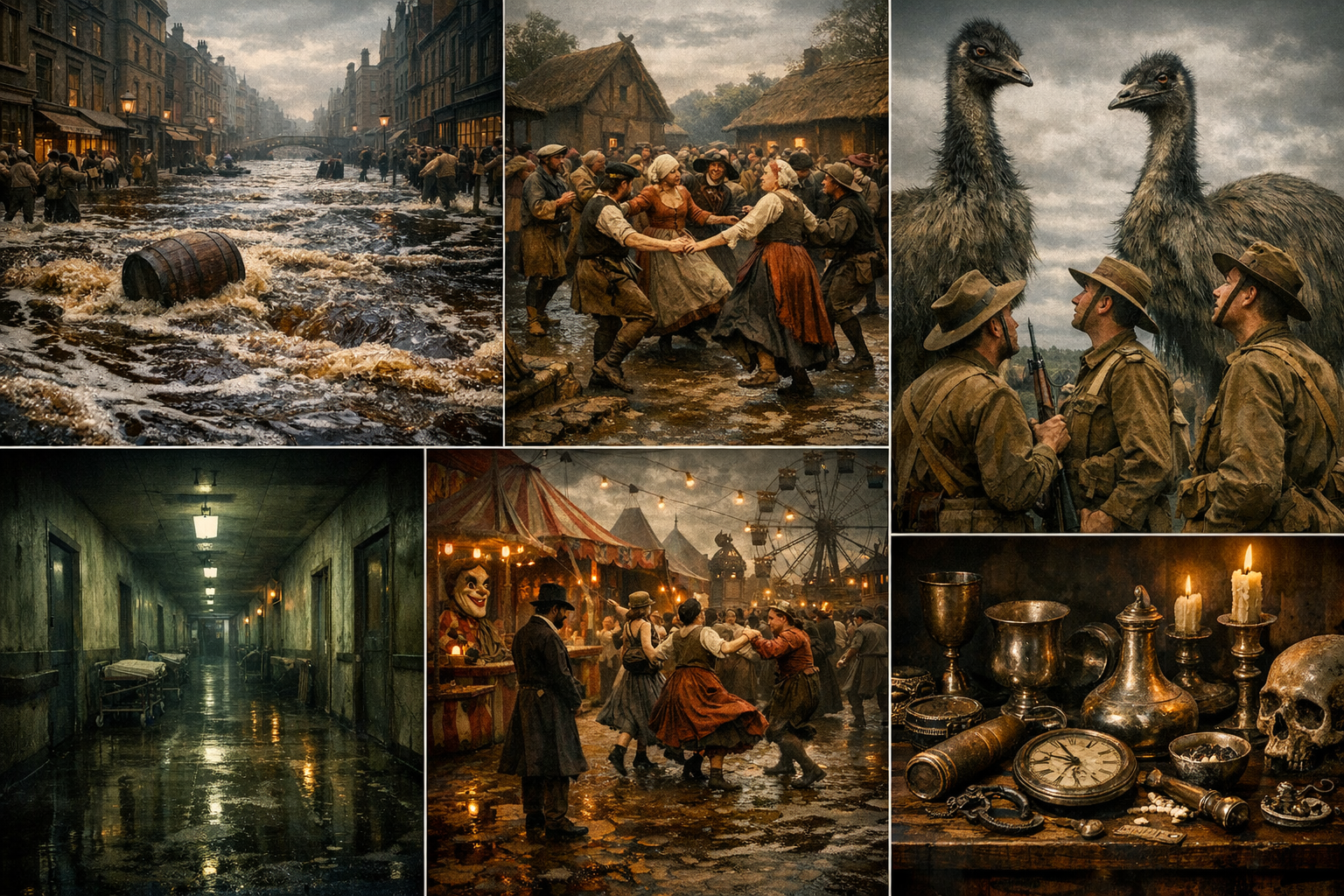
In October 1814, London was hit by one of the most absurd disasters in history. At a brewery in St. Giles, a giant vat holding massive amounts of porter burst. That explosion triggered a chain reaction, and suddenly a wave of beer slammed through the neighborhood. Houses were destroyed. Cellars flooded. People were trapped. Several people died. It sounds like the kind of story someone would invent after too many drinks, but the Great London Beer Flood was real, and it left behind the kind of image nobody forgets: a city drowning in alcohol instead of water.
What makes it feel fictional is the sheer tone of the thing. A flood is terrifying. Beer is ridiculous. Put those together and the mind resists it. But that tension is exactly why the story has survived for more than two centuries. It is a reminder that history can be both horrifying and bizarre at the exact same time.
The Town That Could Not Stop Dancing
In 1518, people in Strasbourg began dancing in the street. At first it was one woman. Then more people joined. Then the numbers kept rising, and the event turned into a full-blown public crisis. Some danced for days. Some reportedly collapsed. Some may have died. Nobody fully agrees on what caused it, which only makes the story stranger. The Dancing Plague of 1518 still reads like a hallucination, except it happened in a real city with real witnesses who had to watch the impossible unfold in front of them.
There is something uniquely disturbing about collective behavior that stops making sense. Wars, crimes, and disasters are terrible, but they still follow grim logic. A crowd dancing itself into medical danger does not. That is why this case keeps resurfacing whenever people talk about mass hysteria, unexplained behavior, or history’s most unbelievable moments.
The War Australia Somehow Lost to Birds
No serious military story should begin with the sentence, “The enemy was emus.” And yet it does. In 1932, Australia deployed soldiers with machine guns to deal with huge numbers of emus damaging farmland. The birds scattered, adapted, and kept moving. The campaign became a humiliation so memorable that it still gets retold as if it must be a joke. It was not. The Great Emu War really happened, and somehow the birds came out looking like the tactical masterminds.
Part of the reason this story refuses to die is that it reveals something people hate admitting: even organized force can look ridiculous when nature refuses to cooperate. The more official the response became, the funnier and stranger the result looked.
The Woman Who Walked Into an ER and Made Doctors Collapse
In 1994, Gloria Ramirez arrived at a California emergency room gravely ill. What happened next sounded like science fiction. Medical workers reported a strange odor. Some began feeling sick. Others fainted. A few ended up hospitalized. Theories exploded almost instantly. Was it contamination? A chemical reaction? Mass panic? Even now, the Toxic Lady case remains one of the most unsettling medical mysteries ever recorded, because the scene sounds less like an ER and more like the opening of a horror film.
This story has power because nobody expects a hospital to become the danger zone. We think of hospitals as the place where chaos gets contained. In this case, chaos seemed to spread outward from the patient herself, and that inversion is what makes the whole event so deeply eerie.
The Outlaw Who Became a Carnival Attraction After Death
Most criminals are forgotten after they die. Elmer McCurdy somehow became more famous because he stayed around. After his death in 1911, his embalmed body passed through funeral homes, sideshows, wax museums, and amusement attractions for decades. People treated him like a prop. For years, many did not even realize they were looking at an actual corpse. That is why Elmer McCurdy’s story feels too bizarre to be true. It sounds like a nasty urban legend, except it left a trail of very real institutions and very real bad decisions.
Cases like this reveal how quickly novelty can crush dignity. McCurdy was not only dead; he became an object passed around by people who kept deciding the weirdness was more useful than the humanity.
The Man Who Ate Almost Anything
There have always been stories about people with impossible appetites, but Michel Lotito took that idea into nightmare-comedy territory. Over the years he reportedly consumed metal, glass, and objects that should have shredded any normal stomach. His body tolerated things that would hospitalize almost anyone else. The result is one of those biographies you keep checking because your brain assumes you misread it. But the man who could eat anything was horrifyingly real, and his condition turned his own body into something close to a medical anomaly on display.
The detail that really gets under your skin is not just that he ate strange items. It is that he could keep doing it. Human bodies are supposed to have obvious limits. His seemed to ignore the script.
The Day Somebody Started Eating an Airplane
If Michel Lotito’s general appetite sounds exaggerated, the next part sounds like a writer showing off. He reportedly consumed an entire light aircraft piece by piece over time. Metal, rubber, and machinery became part of an extended public act that made him famous. It sounds impossible because it probably should have been. That is what makes the story of the man who ate an airplane so unforgettable. You are not just hearing about endurance. You are hearing about a person turning the impossible into a routine.
And that is the common thread in so many bizarre true stories: they do not merely break expectations once. They keep breaking them until disbelief becomes the whole point.
Cases That Still Have No Easy Explanation
Some bizarre events can at least be pinned to a clear timeline. Others remain open wounds in history. The dancing plague still sparks arguments over mass psychogenic illness, stress, religion, and environmental triggers. The Toxic Lady case still leaves room for fierce debate about chemistry, contamination, and panic. Even the Beer Flood, absurd as it sounds, raises the darker question of how quickly normal city life can become fatal when one impossible event hits at the wrong moment.
That may be the creepiest part of this whole category. The strangest stories are not always strange because they are funny. Often they stay with us because they sit in the gap between explanation and disbelief, and human beings hate that gap.
Similar Cases Solved Years Later and Stories That Only Got Stranger With Time
History has a habit of making weird stories even weirder. Elmer McCurdy’s corpse did not become legendary immediately; it became legendary because decades passed before the full truth clicked into place. The Great Emu War did not become iconic because of body counts or battlefield strategy. It became iconic because time turned bureaucratic embarrassment into folklore. Even the Great London Beer Flood became more surreal as it moved from disaster report to one of history’s strangest headlines.
That is why bizarre true events matter. They are not just curiosities. They show how reality can create scenes more vivid, more absurd, and more unsettling than fiction usually dares to risk.
In the end, the strangest true events are the ones that leave you feeling slightly cheated by reality. Fiction is supposed to be the place where impossible things happen. But sometimes history, medicine, crime, war, and pure human oddity produce stories so absurd they seem to mock the idea of plausibility itself. And that is why these cases last. They are proof that the real world does not care whether a story sounds believable before it happens.
🔎 Explore more deep-dive investigations like this:
- Dark real cases that still leave investigators staring into the void
- Cult stories so disturbing they barely feel real
- Doomsday Cults That Ended in Death — The Beliefs, Leaders, and Final Catastrophes
- Strange Sky Mysteries That Still Have No Explanation
- Creepy Broadcast and Video Mysteries — The Signals, Channels, and Uploads That Terrified the Internet
- Lost at Sea Survival Stories — Real Shipwrecks, Lifeboats, and Ocean Ordeals That Should Have Ended in Death