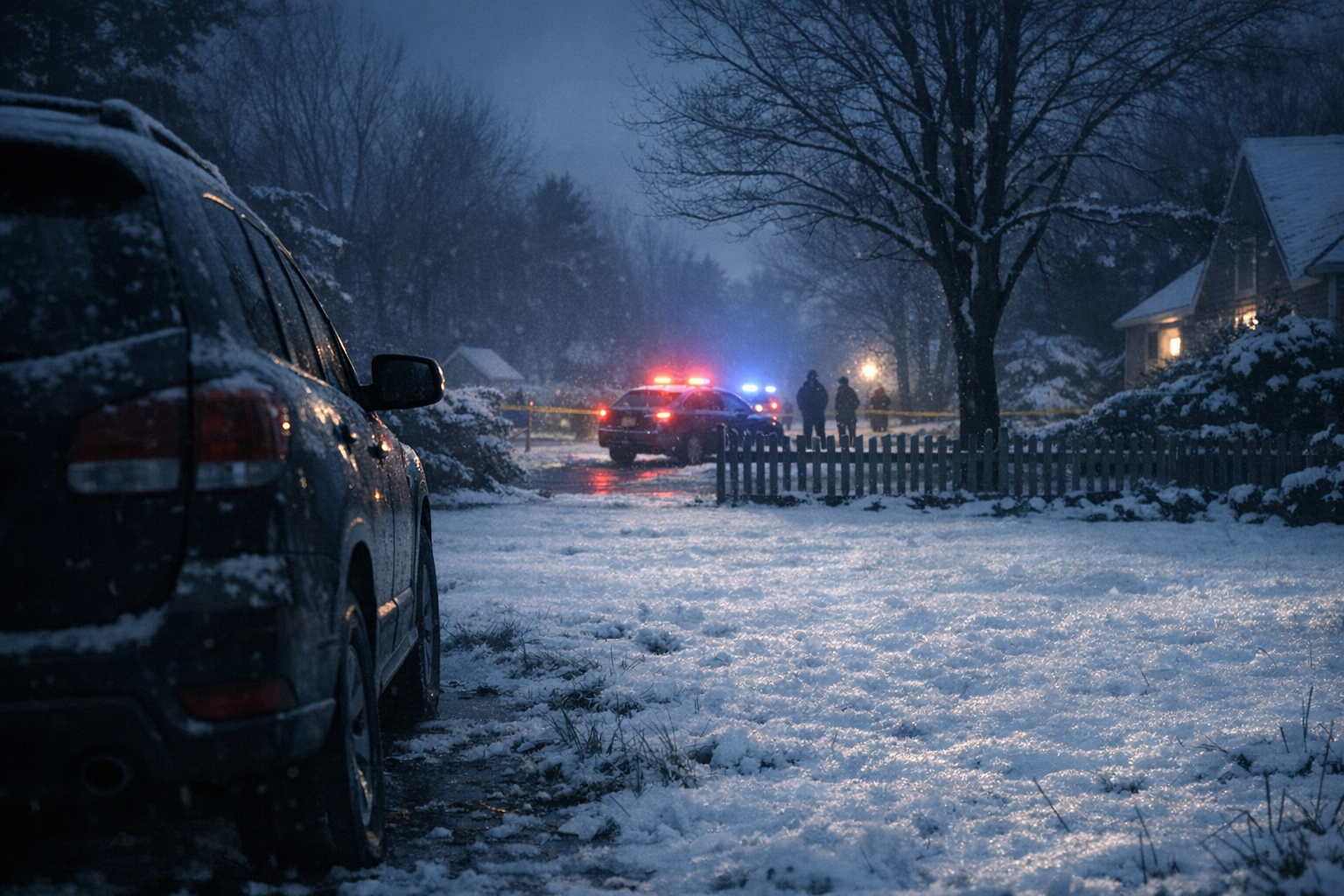
John O’Keefe was found outside a Canton home in January 2022. The criminal prosecution that followed ended on June 18, 2025, with Karen Read acquitted of the homicide charges and convicted of operating under the influence.
The embedded audio is retained from the earlier article. The written account reflects the June 18, 2025 verdict.
The Karen Read retrial brought the death of Boston police officer John O’Keefe back into the center of true crime because it was never only a question of what happened outside a Canton, Massachusetts home. It became a battle over evidence, police relationships, forensic interpretation, and whether one version of a snowy night could survive the pressure of another.
For readers following courtroom cases where public opinion and legal evidence seem to pull in opposite directions, this story sits beside other high-pressure trials in True Crime Cases Back in the Spotlight, where retrials, appeals, and new arguments can change the way a case is remembered long after the first headlines fade.
The House, the Storm, and the Body in the Snow
In the early hours of January 29, 2022, a winter storm was moving through Canton. Snow was piling up on roads, lawns, cars, and the ordinary suburban spaces that, by sunrise, would become part of a national argument. John O’Keefe had been out drinking with Karen Read and others. The night moved from one place to another, ending near a home on Fairview Road where some members of the group were gathering after the bars closed.
Then O’Keefe was found outside. He was injured, unresponsive, and exposed to the freezing weather. That image became the anchor of the entire case: a police officer on the ground, a house nearby, a storm erasing detail by the minute, and a group of people trying to explain how a night out had become a death investigation.
Prosecutors said Read struck O’Keefe with her Lexus SUV, left him outside, and later made statements that showed consciousness of what she had done. The defense argued the opposite: that O’Keefe was not killed by her vehicle, that he may have been harmed after arriving at or near the house, and that the evidence was shaped around the simplest outside suspect while other possibilities were ignored.
That split is why the Karen Read case did not behave like a normal courtroom story. It became a test of which details people trusted. A broken taillight could look like physical proof, or it could look too convenient. Injuries could be read as impact trauma, or as something that did not fit a vehicle strike cleanly enough. A chaotic statement from a panicked woman could sound like an admission, or like terror searching for an explanation.
Why the First Trial Did Not End the Story
The first trial ended in a mistrial in 2024, leaving the public with something more combustible than a verdict: uncertainty. By then, the case had already gathered a following far beyond Massachusetts. People argued about expert testimony, police conduct, phone data, witness relationships, deleted messages, search timelines, and whether investigators had looked hard enough at people connected to the home.
The retrial mattered because it forced the same central question back into open court: was John O’Keefe killed by a vehicle outside, or was the official theory missing something darker and more complicated? For true-crime audiences, that is the kind of question that refuses to stay flat. It invites timelines. It invites maps. It invites people to freeze one minute of the night, then another, trying to make the whole thing line up.
On June 18, 2025, the retrial ended with Read acquitted of second-degree murder, manslaughter, and leaving the scene after an accident resulting in death. She was convicted of operating under the influence and sentenced to one year of probation. Legally, that answered the criminal case in a major way. Emotionally, it did not make the story feel simple. O’Keefe was still dead. The public still argued about what the evidence meant. And the case remained one of the clearest examples of how a courtroom result can close charges without ending public doubt.
The Evidence Map: What Jurors Had to Weigh
The retrial forced jurors to move through several pressure points, each one capable of changing how the entire night looked.
- The taillight evidence: Prosecutors treated broken taillight pieces as a central part of the vehicle-strike theory. The defense challenged how that evidence was found, handled, and interpreted.
- The injury pattern: O’Keefe’s injuries became a major battleground because each side used expert interpretation to argue whether they fit a collision or suggested another kind of assault or fall.
- The timeline: Minutes mattered. Phone activity, arrival times, search efforts, and witness memories all became part of an effort to decide what could have happened before dawn.
- The relationships around the house: Because several people connected to the case had law-enforcement ties or personal relationships, the defense argued investigators had reasons to look away from uncomfortable possibilities.
- Read’s statements: Words said during panic and grief were treated very differently by each side. Prosecutors saw them as meaningful. The defense saw them as confusion, not confession.
That is the engine of the case. The same evidence did not simply point in one direction for everyone watching. It split into rival stories, and each story made the other side look not just wrong, but almost impossible.
What Still Does Not Add Up for Many People
The case remains divisive because the public did not only debate facts. It debated trust. Trust in investigators. Trust in witnesses. Trust in experts. Trust in what a jury can decide after weeks of testimony when so much of the night depended on people remembering what they did while a storm moved in and alcohol blurred the edges.
For supporters of the prosecution theory, the case was about accountability after a deadly encounter outside a house. For Read’s defenders, it was about a woman accused because the alternative would have forced investigators to look too closely at people with connections and influence. Between those two camps was a quieter group: people who did not know exactly what happened but could see why the case kept generating doubt.
That is also why this retrial belongs in the broader True Crime Archive. Some cases are remembered because of a confession. Some because of a missing weapon. This one is remembered because the evidence became a mirror. People looked at the same pieces and saw two different worlds.
Why the Case Became Bigger Than One Verdict
The Karen Read retrial became a national true-crime obsession because it sat at the intersection of several fears at once. A partner dead. A night no one could fully reconstruct. A police community under scrutiny. A defendant insisting the system had built the wrong story around her. And a public already trained by years of podcasts, documentaries, and livestreamed trials to examine every crack in an official narrative.
That pattern connects Read’s case to other public-opinion courtroom battles. The Casey Anthony case became a cultural earthquake because many people felt the verdict and their private conclusions did not match. The Scott Peterson case has remained in circulation because legal appeals and public belief keep colliding years later. And the Craig Coley case shows why doubt, once backed by later evidence, can completely rewrite what people thought a case was.
Read’s case is different in its facts, but similar in its emotional pressure. It asks readers to sit with the uncomfortable possibility that a courtroom can deliver an answer while the story around that answer keeps moving.
Timeline of the Karen Read Case
- January 28–29, 2022: John O’Keefe, Karen Read, and others spend the night out before the group moves toward an after-party in Canton.
- Morning of January 29, 2022: O’Keefe is found outside in the snow near the Fairview Road home and later dies.
- Investigation and charges: Prosecutors build a case around the theory that Read struck O’Keefe with her SUV; the defense argues she was wrongly blamed.
- 2024: The first trial ends in a mistrial, intensifying public debate rather than settling it.
- June 18, 2025: The retrial ends with acquittals on murder, manslaughter and leaving the scene, and a conviction for operating under the influence.
Why the Case Remains Divisive
The deepest divide is not only over one piece of evidence. It is over the frame around the case. If someone accepts the prosecution’s frame, the taillight, the vehicle, the statements, and the cold exposure form one tragic chain. If someone accepts the defense frame, those same pieces become signs of a case built too fast around the wrong person.
That is what made the retrial feel less like a repeat and more like a second attempt to define reality. Every witness mattered. Every expert mattered. Every gap in memory became a place where suspicion could grow.
Other true-crime cases have held public attention for similar reasons. The murder of Travis Alexander became inseparable from the courtroom story around it. Gabby Petito’s case showed how quickly public attention can become part of an investigation’s emotional landscape. And older mysteries like the Black Dahlia endure because unanswered questions can become larger than the original headlines.
FAQ
What happened in the Karen Read retrial?
On June 18, 2025, Karen Read was acquitted of murder, manslaughter and leaving the scene in the prosecution arising from John O’Keefe’s January 2022 death. She was convicted of operating under the influence.
Why was Karen Read accused?
Prosecutors argued that Read struck O’Keefe with her SUV after a night of drinking and left him outside in the snow. The defense disputed that theory and argued that the evidence did not prove a vehicle strike.
Why does the John O’Keefe case still get attention?
The case remains widely discussed because the evidence, investigation, witness relationships, and competing theories created a rare public split. Many people saw the same facts and reached completely different conclusions.
Is the Karen Read case over?
The criminal retrial ended in June 2025. Its acquittals resolved those charges in Read’s favor; the verdicts did not establish that the defense’s allegations against other people were true. Public debate cannot substitute for that distinction.
Research Sources
The following resources were consulted to verify and update this article.
- First Circuit: Read v. Norfolk County Superior Court
Court record of the 2024 mistrial and retrial challenge. - Boston 25: Video of the retrial verdict
Courtroom video and reporting on the June 18, 2025 verdict. - ABC News: Karen Read retrial verdict
Verdicts, probation sentence and the opposing trial arguments.
Continue exploring:
- Courtroom cases where the story refused to stay closed
- The archive of retrials, DNA turns, and unresolved true-crime questions
- The verdict that split America into two conversations
- The murder case still argued years after conviction
- Cold cases where old evidence changed the ending
More True Crime stories: