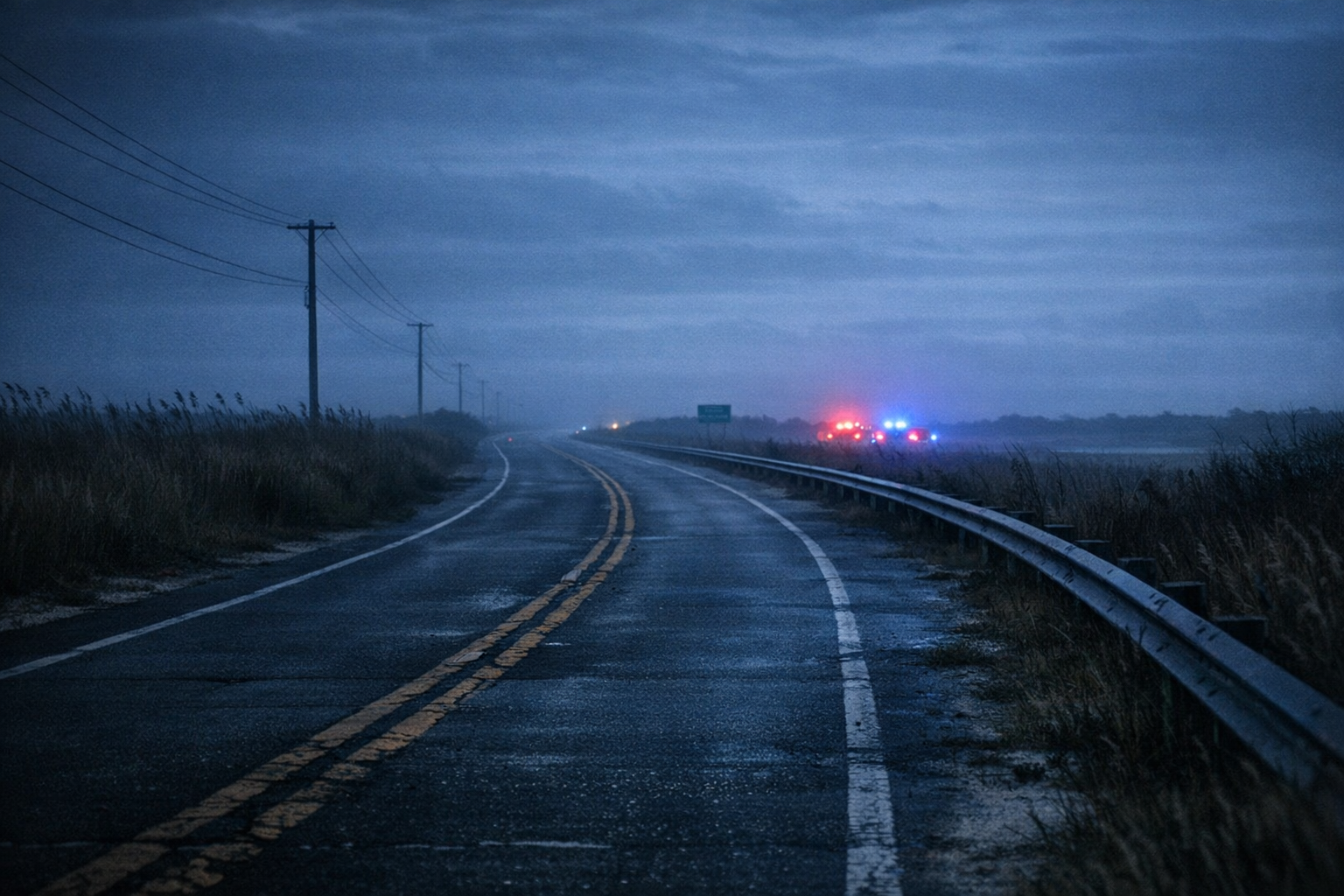
Before sunrise, Ocean Parkway looks almost empty.
The road cuts through brush and marsh on Long Island like a strip of asphalt that forgot where it was going. Wind pushes at the grass. The sand holds onto the night. And if you drove that stretch without knowing what had been found there, you might miss the feeling completely. But once you know that bodies were pulled from that quiet edge of land, the whole place changes. It stops looking like a road and starts looking like a secret.
For years, that secret had no face. Then investigators turned their attention to architect Rex Heuermann of Massapequa Park. The case moved from an unresolved investigation to charges, guilty pleas and sentencing.
The Rex Heuermann timeline matters because it sits at the center of the Gilgo Beach murders, a missing person case and homicide investigation that grew into one of the most talked-about crime stories in America. Although the broader Gilgo Beach story had already haunted the public for years, this suspect-focused timeline helps explain how an infamous cold case moved from rumor and dread to arrests, charges, guilty pleas and a prison sentence.
What makes this case especially unsettling is how ordinary Heuermann appeared on the surface. In the same way the Zodiac Killer case stayed alive through a trail of clues and unanswered pressure points, the Gilgo Beach investigation kept turning on details that seemed small until they suddenly were not.
At first, the story did not seem to point toward a suspect at all. In May 2010, a woman named Shannan Gilbert vanished after fleeing from a client’s home in Oak Beach. She ran into the night, made a frantic 911 call, and disappeared into darkness. When police later searched the area for her, they uncovered something else instead: human remains hidden in the scrub near Ocean Parkway. Then more remains. Then more.
Those discoveries changed everything. The stretch of brush near Gilgo Beach became one of the most disturbing crime scenes in the country. The victims who drew the most immediate attention became known as the Gilgo Four: Melissa Barthelemy, Maureen Brainard-Barnes, Megan Waterman, and Amber Lynn Costello. Their bodies were found close together. All four had worked as escorts. All four had vanished after arranging meetings. And all four seemed to belong to a pattern that suggested planning, control, and a killer who believed distance and time would protect him.
For the public, the case was terrifying because it felt both massive and shapeless. There were bodies found in different years. Remains connected to different places. Arguments about whether all the victims belonged to one killer. The case kept getting bigger, but it did not get clearer. That uncertainty became part of the story’s power.
Then the timeline started to tighten.
Timeline of the Rex Heuermann Investigation
- 1993–2003: Several victims later connected by investigators are killed or their remains are discovered, including Sandra Costilla, Jessica Taylor, and Valerie Mack.
- 2007–2010: Maureen Brainard-Barnes, Melissa Barthelemy, Megan Waterman, and Amber Lynn Costello disappear after arranging meetings with clients.
- December 2010: Police searching for Shannan Gilbert discover the remains of the Gilgo Four along Ocean Parkway.
- 2011: Additional remains are found, expanding the scale and complexity of the case.
- 2022: A new Suffolk County task force re-energizes the long-stalled investigation.
- July 2023: Rex Heuermann is arrested and charged in the killings of Barthelemy, Waterman, and Costello.
- January 2024: He is charged in the death of Maureen Brainard-Barnes.
- June 2024: Prosecutors add charges tied to Sandra Costilla and Jessica Taylor.
- December 2024: He is also charged in the death of Valerie Mack.
- April 8, 2026: Heuermann pleads guilty to seven charged murders and admits killing Karen Vergata, an eighth victim covered by the plea agreement.
- June 17, 2026: He receives three consecutive life sentences without parole plus a consecutive 100 years to life for the other four charged murders.
Those courtroom outcomes changed the legal status of the case. Heuermann is a convicted murderer, and his admissions identify the seven charged victims and Karen Vergata. The years before his arrest remain part of the investigation’s history, but the prosecution is no longer simply a set of unresolved accusations.
The answer is part of what makes the story so unnerving. Heuermann did not look like a man living inside a national nightmare. He was an architect. A husband. A father. A local presence. He worked in Manhattan and lived on Long Island. Nothing about that surface image matched what investigators now say was happening beneath it.
That contrast is the central question that keeps this case gripping. The fear does not come only from the crimes. It comes from the pivot points — the moments where the investigation quietly began moving toward a man who had apparently lived a normal life while one of America’s darkest murder investigations sat unsolved in the background.
One of the biggest pressure points involved phones. Prosecutors said location data helped place the suspect and victims in overlapping places at key times. That matters because the Gilgo Beach case had always carried a ghostly quality, like the killer existed only in taunting calls, disposable contacts, and empty roadside brush. A timeline built from devices and movement started turning that ghost into a person.
Then there was the physical evidence. Hair recovered with victims became part of the case. Vehicle details mattered. Witness memory mattered. Even the old description of a Chevrolet Avalanche, tied to the last known movements of Amber Costello, gained new weight once investigators began reconstructing who might have had access to that kind of vehicle at the right time. The case did not crack because of one dramatic reveal. It tightened piece by piece, each point reinforcing the last.
🔎 Related Investigation:
If this case pulled you deeper into the mystery, continue into:
🔎 Related Investigation:
If this case pulled you deeper into the mystery, continue into:
What Doesn’t Add Up About the Years Before the Arrest
- So much public attention, so little movement: The Gilgo Beach murders were nationally known for years, yet the breakthrough did not come until a newer task force revisited the evidence.
- The suspect’s ordinary public image: The fact that a local professional could move through daily life while committing murders to which he later pleaded guilty is one of the story’s most disturbing contradictions.
- The long delay between discoveries and charges: Bodies were found in 2010 and 2011, but the first arrest came in 2023.
- The scale of the investigation: Even after the first charges, the timeline kept expanding, suggesting the original public picture of the case had been incomplete.
That long delay is not just a procedural detail. It is the emotional engine of the story. Families waited through season after season of news coverage, speculation, and fresh searches. The public watched the case drift between fear and frustration. The beach stayed there. Ocean Parkway stayed there. The names of the women stayed there. But the suspect remained abstract.
When the arrest finally came in July 2023, the whole story changed shape. Suddenly, every older question was forced through a new lens. People revisited the victims. They revisited the search for Shannan Gilbert. They revisited the geography of Long Island. They revisited what it means for a serial murder case to appear cold when, in reality, it may only be waiting for investigators to connect the right set of details.
That is why the suspect timeline is stronger than a generic retelling. It shows the investigation as a series of pivots instead of a pile of horror. First the bodies. Then the years of uncertainty. Then the task force. Then the data. Then the charges widening outward. Then the guilty plea. Each step gives the case a clearer shape, and that shape is what readers have been searching for.
The convictions do not erase the long wait endured by the victims’ families. They do, however, establish a legal result that must be distinguished from the suspicions and allegations that preceded the pleas.
It also explains why the Gilgo Beach story keeps pulling attention back. The investigative record changed over time, and so did the legal result. For another case with a distinct outcome, see the Karen Read retrial and verdict: her 2025 trial ended in acquittals on the charges connected to John O’Keefe’s death and a separate impaired-driving conviction.
Key Evidence and Investigative Pivot Points
- Phone data: Prosecutors said mobile phone records helped place key people in overlapping locations.
- Victim pattern: Several victims disappeared after client arrangements, reinforcing a behavioral pattern investigators could study.
- Hair and forensic traces: Physical evidence reportedly helped connect the suspect’s household to some of the victims.
- Vehicle lead: The Chevrolet Avalanche detail associated with Amber Costello became one of the better-known investigative threads.
- Renewed task force review: The 2022 push mattered because old evidence can look different when reviewed with fresh focus and better forensic context.
Even with those developments, the case still carries a chilling unfinished feeling. Some victim identifications took years. Some remains had been discovered in different places long before the public understood how they might connect. Questions remain around the full scope of the killings and how many crimes truly belong within the same frame. A guilty plea can close legal chapters, but it does not erase the larger darkness surrounding the case.
And that is the real emotional hook behind the Rex Heuermann timeline. It is not just the story of an investigation. It is the story of how a landscape of buried evidence, missing women, delayed answers, and investigative persistence finally converged on a single person after years of dread.
Picture the contrast. One side of the story is Ocean Parkway: brush, marsh, hidden remains, the kind of silence that seems to swallow sound. The other side is fluorescent office light, architecture work, traffic, train schedules, a commuter life. The shock of the case lives in the distance between those two images. That distance is where the mystery survived for so long.
And once the timeline began collapsing that distance, the entire Gilgo Beach narrative became easier to follow and harder to forget.
Today, the case stands as one of the clearest examples of why cold investigations can still turn suddenly, even after years of apparent paralysis. It also stands as a warning about how easily normalcy can shield horror. The suspect timeline did not just name a man. It gave the public a framework for understanding how this case moved from hidden bodies on a lonely parkway to courtroom admissions that reshaped one of America’s most infamous murder investigations.
That is why this story still lands so hard. It forces a brutal realization: for years, the center of the case may not have looked monstrous at all. It may have looked like somebody heading to work.
Research Sources
The following resources were consulted to verify and update this article.
- Suffolk County District Attorney — April 8, 2026 guilty-plea announcement
Official account of seven murder pleas and the additional Karen Vergata admission. - The Suffolk Times — June 17, 2026 sentencing report
Court reporting confirms the sentences and distinguishes seven charged murders from the additional admission. - News 12 Long Island — Suffolk DA interview after Heuermann’s sentencing
Local reporting on sentencing, the evidence and remaining limits of legal closure. - New York Supreme Court / prosecution filing, hosted by Fox News — December 17, 2024 bail application
Contemporaneous prosecution account of the investigation and forensic allegations.
If this story stayed with you, the author suggests these real cases next:
- The killer who kept writing back: the Zodiac timeline that still refuses to settle
- How DNA finally unmasked the Golden State Killer after decades of fear
- The Gardner Museum heist and the 81 minutes that turned into a permanent mystery
Explore more True Crime stories here: