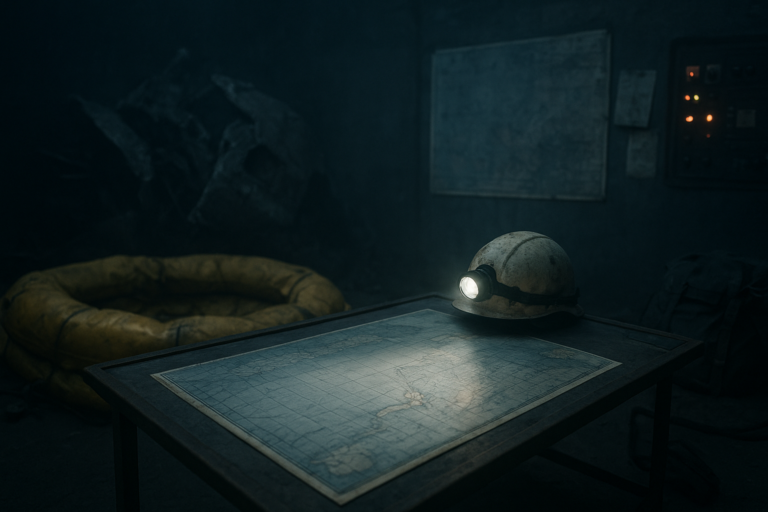
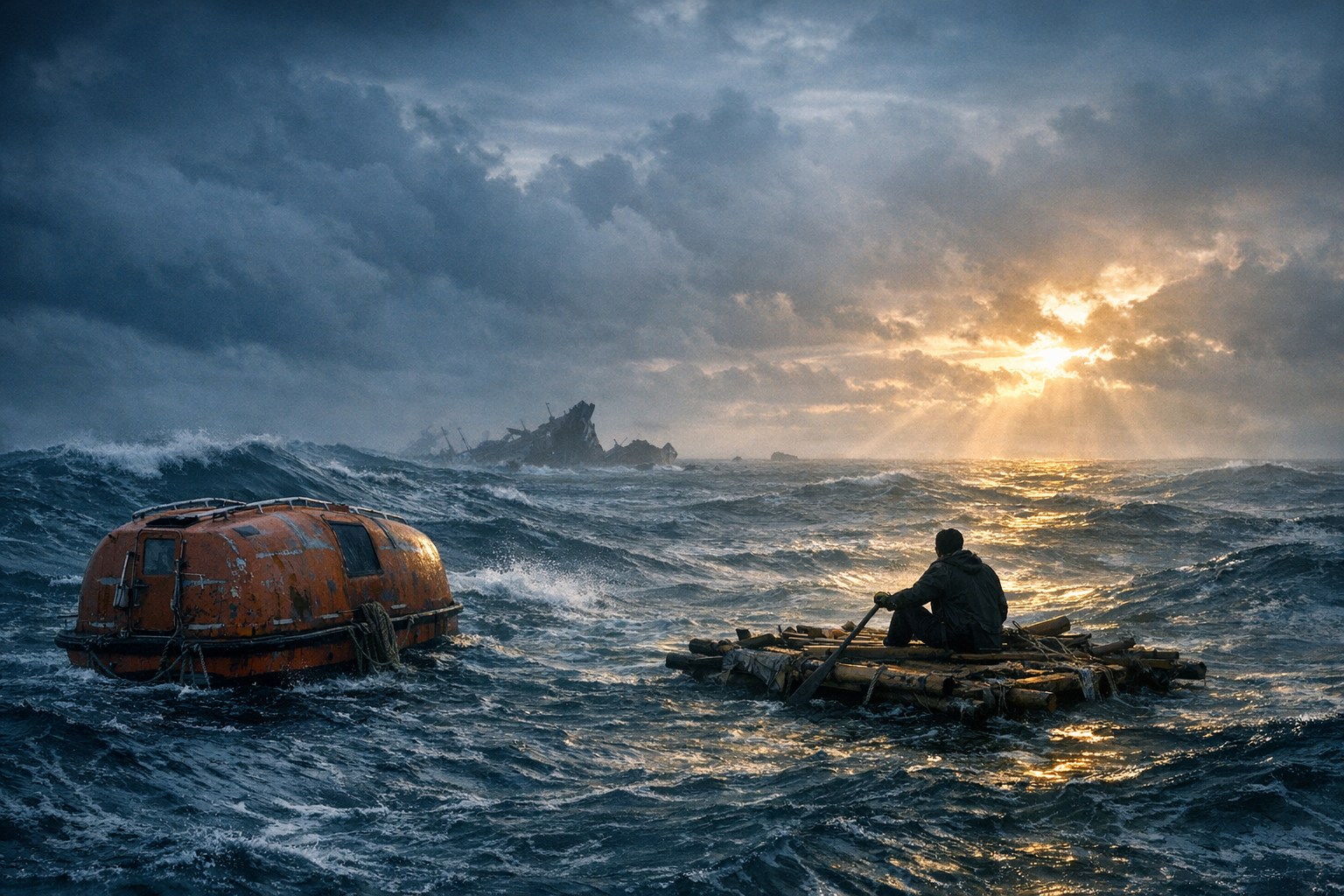
The ocean kills slowly when it wants to. That is what gives lost at sea survival stories their particular kind of dread. A mountain can trap you. A desert can strip you down. But the sea does something colder. It leaves people surrounded by motion, salt, thirst, weather, distance, and the knowledge that the horizon looks exactly the same in every direction. These are not neat adventure stories. They are ordeals built out of drifting time, failing bodies, and moments when staying alive becomes less about heroism than repetition: one more hour, one more swallow of rainwater, one more decision not to let go.
This page covers real ocean survival cases where shipwreck, drift, exposure, wreckage, isolation, and sheer duration should have ended in death but did not. Some survivors clung to rafts. Some floated in open water. Some waited in black cold for a light that might never come. Others endured the longer punishment of being alive long after rescue should have arrived.
These cases matter because ocean survival strips a story to essentials. There is nowhere to hide weakness, nowhere to fake endurance, and almost no room for comforting illusion. The ocean reduces people to thirst, cold, hunger, navigation, memory, and hope. That is exactly why readers keep following these stories from one case into the next. Each one feels distinct, but the underlying question never changes: what nearly killed them first, and what kept them alive after logic said they should already be gone?
Lost at Sea Survival Stories Organized by What Nearly Killed Them
438 Days at Sea Survival Story — The Man Lost in the Pacific Ocean
438 Days at Sea belongs near the center of any serious ocean-survival archive because it represents the most terrifying version of drift: not one brutal night or one impossible rescue window, but the slow corrosion of time itself. José Salvador Alvarenga did not merely survive a sinking or a storm. He survived being carried so long across the Pacific that ordinary human scales of time began to feel useless. Weeks became months. Hunger became routine. Rain became the difference between life and death.
The thing trying hardest to kill him was not one dramatic event. It was duration. The sea did not need a final blow. It just kept offering the same punishing conditions over and over again: salt, sun, dehydration, grief, and emptiness. What makes the case unforgettable is that the key mystery is not whether the ordeal was severe. It is how a person remains mentally intact enough to keep choosing life after so many mornings without rescue.
That is why this story still feels larger than a single man on a boat. It became a study in the psychological violence of isolation. The Pacific was not just an environment. It was an eraser, and yet the man inside it refused to disappear. Read the full case here: 438 Days at Sea Survival Story — The Man Lost in the Pacific Ocean.
Steve Callahan Survival Story — 76 Days Adrift and the Ocean That Kept Trying to Empty the Raft
Steve Callahan’s survival story shows a different version of the same ordeal: shorter than 438 days, but still long enough for survival to become technical, intimate, and relentless. His raft was not a heroic symbol. It was a failing machine between him and death, one that demanded constant repair while the Atlantic kept pressing in. He had to think in systems: water collection, fish, equipment, punctures, balance, and energy. Ocean survival here becomes a grim craft.
Thirst and exposure hover over every stage of it. Callahan was not waiting passively for luck. He was trapped in a prolonged argument with the sea, one where tiny practical choices mattered as much as willpower. The key mystery point is how human survival can depend on decisions so small they sound almost boring on paper: where to sit, what to patch, when to conserve strength, when to try again.
That mechanical, disciplined quality is exactly why the story stays with people. It proves that endurance at sea is not always cinematic in the obvious sense. Sometimes it is one person doing dull, necessary, exhausting things correctly while death keeps circling. Read the full case here: Steve Callahan Survival Story — 76 Days Adrift and the Ocean That Kept Trying to Empty the Raft.
Four Days in the Water: The USS Indianapolis
Four Days in the Water: The USS Indianapolis is one of the clearest examples of how ocean survival can become mass terror in open water. The ship’s sinking created chaos, but the ordeal that followed made the case unforgettable. Men were left floating under heat by day and darkness by night, surrounded by injuries, dehydration, hallucinations, and the dread of what moved beneath them. The ocean did not simply swallow a ship. It turned the aftermath into a test of endurance so extreme it still feels almost physically painful to imagine.
It belongs here because sharks, thirst, exposure, and delayed rescue all converge in the same ordeal. This is the ocean-survival pattern in its rawest form: the initial disaster is only the beginning. The key mystery point is not who sank the ship. It is how rescue came late enough for the sea to become the real final enemy.
That distinction matters. A shipwreck is an event. Drifting afterward is punishment. The Indianapolis survivors endured both. Read the full case here: Four Days in the Water: The USS Indianapolis.
The Three Men the Ocean Forgot
The Three Men the Ocean Forgot captures another maritime terror: being alive while the world has effectively started treating you as dead. The Pacific can make people disappear not only physically, but bureaucratically. A rescue delay becomes an existential one. Search effort fades. Assumptions harden. Meanwhile the survivors are still out there, reduced to fish, rainwater, heat, weakness, and stubborn refusal.
Isolation and time do nearly all the work. There is no need for spectacle when abandonment is the central horror. The key mystery point is not whether the ocean was dangerous; it obviously was. The question that lingers is how close survival can sit to official oblivion — how people can keep breathing while the systems meant to recover them begin to move on.
That is one reason this story feels so haunting compared with more famous wreck narratives. It is not only about endurance against nature. It is about endurance against disappearance itself. Read the full case here: The Three Men the Ocean Forgot.
The Knock in the Dark: 60 Hours Alive Inside a Sunken Ship
The Knock in the Dark turns ocean survival inside out. Instead of endless horizon and drift, it gives us the opposite nightmare: confinement, black water, pressure, silence, and a pocket of life inside metal that should already be a tomb. Harrison Okene was not watching distant rescue planes. He was trapped inside a dead ship, waiting in darkness while the sea pressed from every direction.
It belongs in this roundup because wreckage itself becomes the thing that nearly kills and briefly saves. The air pocket is not comfort. It is borrowed time. Different ocean ordeals are defined by the specific condition that nearly finishes the survivor. Here it is claustrophobic isolation and the possibility that no one will hear you before the sea takes the last breathable space.
The key mystery point is emotional rather than forensic. How does a person stay rational inside that kind of darkness? And what does time feel like when every minute could be the one that empties the air? Read the full case here: The Knock in the Dark: 60 Hours Alive Inside a Sunken Ship.
Thirty Minutes to Vanish: The Night the Baltic Tried to Keep Them
Thirty Minutes to Vanish reminds readers that some of the worst survival stories begin with the speed of collapse. The ferry did not grant people the dignity of preparation. Disaster came with tilt, metal noise, freezing water, panic, and the brutal narrowing of available choices. In cold maritime disasters, time behaves like an accomplice. It strips coordination, breath, and body heat with horrifying speed.
This case fits the archive because exposure is the real executioner once people hit the water. The key mystery point is not whether the sea was deadly. It is how little margin existed between escape and death, and how much survival depended on tiny decisions made while terrified, freezing, and disoriented.
That is why the case belongs alongside long-drift ordeals even though the timeline is shorter. Not all ocean survival is measured in weeks. Sometimes the most merciless stories happen in minutes, with cold doing the work that thirst and isolation do elsewhere. Read the full case here: Thirty Minutes to Vanish: The Night the Baltic Tried to Keep Them.
The 2011 Japan Tsunami Drifter — Two Days on a Floating Roof
The Japan tsunami drifter story is one of those cases that sounds impossible until you picture the object itself: a shattered rooftop, open ocean, and one man refusing to slip under. It is such a strange survival image because a roof belongs to land, family, and ordinary life. Once the sea takes it, the object becomes accidental wreckage and accidental lifeboat at the same time.
Wreckage is often the thin line between life and death at sea. The key mystery point is not technical. It is almost existential: how a domestic fragment of home became the only platform between one survivor and oblivion after a catastrophe large enough to erase entire neighborhoods.
What lingers is the scale mismatch. One person, one roof, one gigantic disaster, and still a rescue happened. Cases like this keep the ocean-survival archive from becoming monotone. They show that the sea does not only test sailors and soldiers. Sometimes it drags ordinary lives into open water without warning. Read the full case here: The 2011 Japan Tsunami Drifter Two Days on a Floating Roof.
Louis Zamperini Survival Story — The Olympian Who Survived War and the Ocean
Louis Zamperini’s survival story belongs in this roundup because it reveals the open ocean as only one stage of a longer ordeal. Forty-seven days adrift already sounds like a complete survival narrative. In his case, it was merely the middle act. Hunger, exposure, sharks, and hopelessness were followed by capture and wartime brutality, which somehow makes the ocean section feel even more severe rather than less.
Isolation and drift are fused to the pressure of total uncertainty. Zamperini and the men with him were not just fighting thirst. They were fighting the possibility that the sea would deliver them nowhere at all. The key mystery point is psychological: how does a person keep some internal structure intact when day after day offers no evidence that survival will matter?
That question gives the case unusual weight inside the archive. Ocean survival here is not a single miracle. It is a prolonged refusal to surrender before, during, and after the water should have finished the job. Read the full case here: Louis Zamperini Survival Story — The Olympian Who Survived War and the Ocean.
Why These Disappearances Still Don’t Make Sense — No. Why These Ocean Survival Stories Still Don’t Let Go
What these cases have in common is not simply that they happened at sea. It is that the ocean attacks people through layers. First comes the visible emergency: the sinking, the wave, the broken hull, the failed craft, the fall into water. Then comes the quieter phase, which is often worse: thirst, cold, exposure, hallucination, drifting, isolation, waiting, and the mental exhaustion of not knowing whether rescue is coming at all. The ocean is uniquely terrifying because it can turn survival into repetition. Death does not have to arrive dramatically. It can arrive by erosion.
These stories also reveal that maritime survival is never one skill. It is a stack of unstable advantages. Sometimes survival depends on a raft, sometimes on wreckage, sometimes on body heat, sometimes on rainwater, sometimes on someone hearing a noise through steel, and sometimes on rescue passing close enough to notice what should be too small to see. Luck matters. So does discipline. So does pain tolerance. So does the ability to keep doing small necessary things after panic has already burned through the body.
Another pattern links these cases: the sea strips away narrative comfort. On land, survival stories often move toward a destination — a road, a cabin, a town, a search line, a visible edge. At sea, there may be no meaningful direction at all. That makes the horizon feel less like freedom than mockery. People can be alive in full daylight and still functionally invisible. That is why drifting stories hit so hard. They make rescue feel both imaginable and impossibly far away at the same time.
And that is the deeper reason these ocean ordeals hold attention. They force readers into a confrontation with scale. One body against weather. One raft against current. One shrinking pocket of air against tons of water. One search aircraft against a blue expanse big enough to hide entire ships. The survivors in these stories did not overcome the sea in any triumphant sense. Most of them endured long enough for the sea to fail at finishing them.
Conclusion
The most haunting lost at sea survival stories are not just rescue stories. They are stories about what happens before rescue — when thirst becomes structure, when night feels endless, when the body starts negotiating with pain, and when hope stops feeling noble and starts feeling like labor. That is what ties these cases together whether the survivor drifted for months, floated for days, clung to wreckage in freezing water, or waited in a submerged pocket of darkness for one human hand to reach through.
It shows the pattern underneath them: how shipwreck, drift, sharks, exposure, wreckage, isolation, and time become recurring engines of survival. Once readers see that structure, the cluster becomes harder to leave. One story naturally leads to the next because each one answers the same brutal question from a different angle.
And the answer is never clean. Survival at sea is messy, primitive, technical, lonely, and often ugly. That is exactly why it stays memorable. The ocean does not care about courage, but again and again these cases show people finding one more hour anyway.
🔎 If this story stayed with you, the author suggests these deeper investigations next:
- Plane crash survival stories where impact was only the beginning
- The earlier lost-at-sea archive built around lifeboats, wreckage, and open-water endurance
- The wider survival archive covering ocean ordeals, buried survivors, crashes, and wilderness escapes
Explore more Survival Stories stories here: