The first night inside Tham Luang did not feel like a rescue story yet. It felt like a mistake that kept getting worse. Twelve boys from the Wild Boars soccer team and their assistant coach had gone into the cave the way kids go into places that seem half-forbidden and half-magical—laughing, wet shoes slapping stone, flashlight beams darting over the walls. Then the rain came down outside, the tunnels began swallowing runoff, and somewhere behind them the way back vanished under brown water. By the time they understood what had happened, the mountain had already decided they were not leaving on their own.
The Thai cave rescue, also known as the Tham Luang cave rescue, became one of the most searched survival stories in the world because it was almost impossible at every stage. Thirteen people were trapped deep underground, monsoon water kept rising, oxygen kept falling, and even veteran cave divers said the route in and out felt lethal.
It still stands beside other unforgettable ordeals in The Survival Stories Archive, but this one carried a different kind of pressure: the entire world was watching a clock nobody could see.
On June 23, 2018, the boys rode to the cave after practice in Chiang Rai province, northern Thailand. They were between 11 and 16 years old. With them was assistant coach Ekkapol Chantawong, a young man whose calm would later become one of the most important details in the entire case. Nothing about the plan sounded historic. They were just going in for a short adventure. They had been near the cave before. They expected to come back out, wipe the mud off, and go home before anyone really worried.
At first the boys kept going deeper because the cave was familiar enough to feel exciting, not threatening. Their lights bounced off slick limestone. Water pooled around their ankles. Voices echoed through chambers and tight passageways. Then the weather outside shifted from nuisance to trap. Rainwater rushed into the cave system, flooding the route behind them. When they tried to turn back, the path out was already closing. What had been a tunnel was now current. What had been a muddy exit was now a submerged obstacle course of blind corners, narrow gaps, and rising panic.
So they did the only thing that made sense in a place where every bad option still looked better than drowning. They moved farther in.
They climbed toward higher ground and eventually reached an elevated muddy shelf nearly two and a half miles from the entrance, a place later known around the world simply as the ledge where they were found. That strip of higher ground became their entire world: no beds, almost no food, no daylight, and no way to know if anyone was anywhere close to reaching them. The cave walls dripped enough water to keep them alive. That was the good news. The bad news was that everything else was running out—battery, warmth, strength, certainty.
Outside, parents found the boys’ bicycles near the cave entrance. From that moment, the story changed from private fear to public emergency. Local rescuers, Thai Navy SEALs, and international specialists all converged on the cave, and the operation became a race against flooding, distance, and a cave system that did not forgive mistakes.
Timeline of the Thai Cave Rescue
- June 23, 2018: The Wild Boars team and Coach Ekkapol enter Tham Luang after practice and become trapped by floodwater.
- June 24–July 1: Thai rescue teams, Navy SEALs, and international cave divers work through flooded tunnels with poor visibility and strong currents.
- July 2: British divers Rick Stanton and John Volanthen find all 13 alive on a ledge deep inside the cave.
- July 6: Former Thai Navy SEAL Saman Gunan dies while placing oxygen tanks along the route.
- July 8–10: The extraction begins. Four boys are rescued on day one, four more on day two, and the final boys plus their coach are brought out on day three.
The hardest part to imagine is the waiting. Inside the cave, time was almost meaningless. There was no sunrise to reset hope and no nightfall to mark endurance. Just darkness, damp air, and the sound of water moving through the mountain. Ekkapol urged the boys to stay still, conserve energy, and control their breathing. Reports later described him using meditation techniques to keep them calm. That matters because panic was not just emotional danger here. It was survival math. Panic burns oxygen. Panic burns strength. Panic makes children make fast decisions in places where one fast decision can kill everyone.
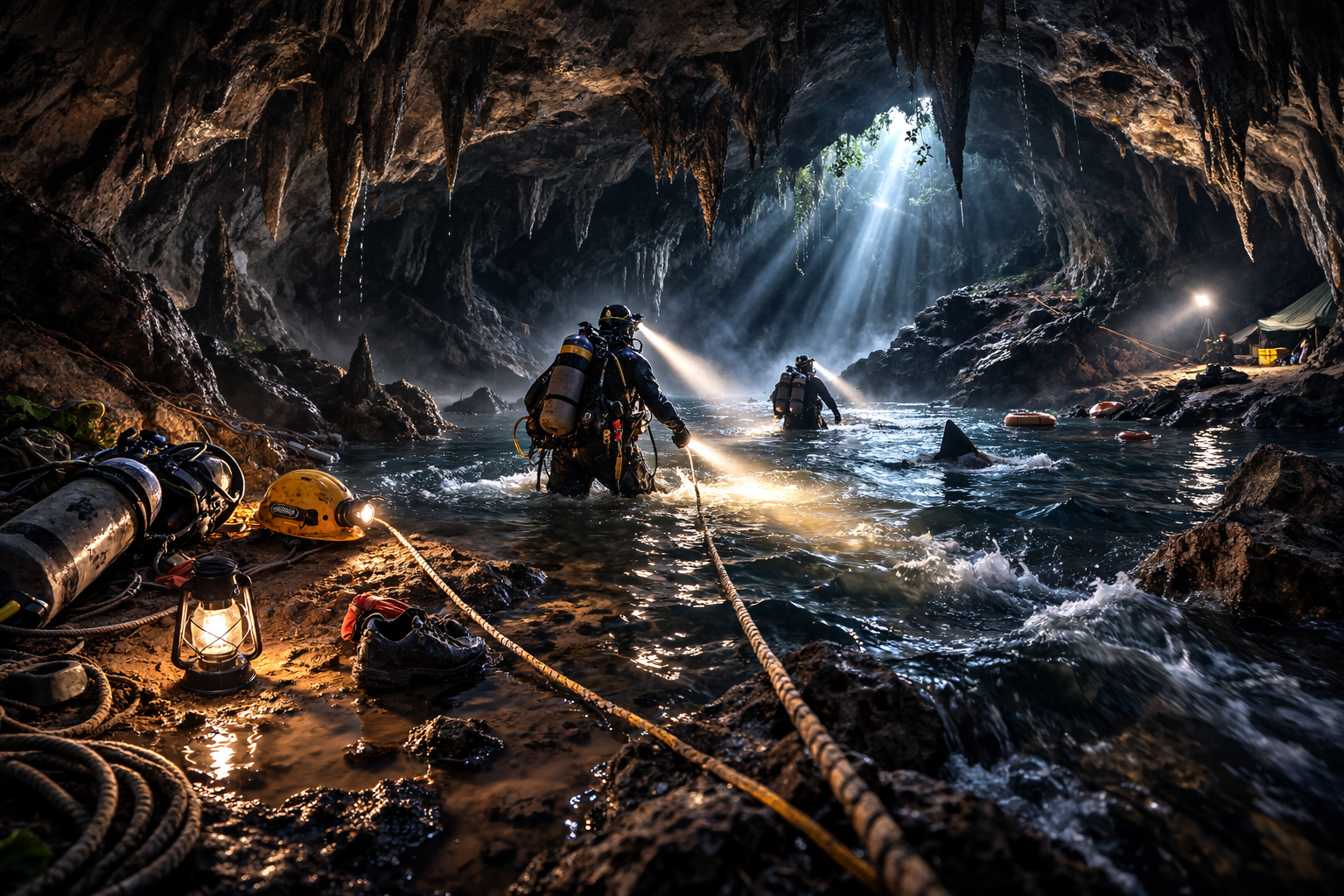
Above ground, the rescue teams were facing a different kind of pressure. The route to the boys was not a straight line. It was a flooded maze with sections so tight divers had to angle their bodies and feel their way forward by guideline. Visibility was often near zero. Mud and debris turned the water opaque. In some places, the passage narrowed so badly that air tanks scraped rock. This was not open-water diving. It was underwater navigation through a stone throat.
That is one reason the discovery on July 2 felt so unreal. British divers John Volanthen and Rick Stanton pushed farther than others had managed and suddenly saw faces in the dark. When one diver asked, “How many of you?” a boy answered, “Thirteen.” The reply heard around the world—“Brilliant”—was not triumph. It was relief mixed with a new realization. They had found them. Now they had to bring them back.
What Didn’t Add Up Until You Saw the Rescue Conditions
- Why not wait for the water to go down? Because monsoon season could keep the cave flooded for months, and oxygen levels inside the chamber were already dropping.
- Why not teach the boys to dive their way out? Because the route was dangerous even for elite cave divers. Asking weakened children to make that trip awake introduced huge panic risk.
- Why was the world so tense even after they were found alive? Because discovery solved the mystery of where they were, not the problem of how to move them through miles of flooded stone.
- Why did one death change everything? Because when Saman Gunan died placing tanks, it proved the route could kill trained rescuers before the boys ever entered it.
The operation became even more urgent after oxygen inside the chamber fell and the weather threatened to get worse again. Every plan sounded reckless because every real option was reckless. Drill from above? Too uncertain. Wait for the water to recede? Too slow. Send children through the cave awake? Too dangerous. The eventual plan felt almost unthinkable: anaesthetise each boy, fit him with a full-face mask, and guide him out one by one through the flooded cave.
Then came the death that made the whole world understand just how narrow the margin really was. On July 6, former Thai Navy SEAL Saman Gunan died while placing air tanks along the route. He ran out of oxygen on the return dive. His death cut through the hopeful headlines and exposed the real shape of the mission. This was not a clean heroic operation. It was a gamble inside an environment that punished even expertise. If one strong, trained rescuer could die on that path, what chance did frightened children have without perfect handling?
That is why the final extraction reads less like a conventional rescue and more like a controlled passage through nightmare terrain. Beginning July 8, divers took the boys out in stages. Each child wore a full-face mask. Each was kept unconscious under anaesthesia. In narrow points, divers had to keep the masks secure, monitor breathing, and move through spaces barely built for one adult, let alone one adult guiding an unconscious child. In some sections, tanks had to be maneuvered carefully around stone. In others, current and mud turned the route into a feel-your-way crawl under water.
Key Evidence, Risks, and Why the World Could Not Look Away
- Flooding: The cave system became a moving barrier. Rising water did not just block the entrance; it transformed tunnels into submerged choke points.
- Oxygen: Rescue planners knew the boys could not safely wait forever. Reduced oxygen changed the timeline from difficult to urgent.
- Diver risk: The death of Saman Gunan proved the route itself was one of the central dangers in the story.
- Mental control: The boys’ ability to stay still and conserve strength may have been as important as any hardware sent in from outside.
- Global scale: International divers, engineers, medics, military personnel, and volunteers all became part of one rescue clock.
One boy emerged alive. Then another. Then another. Four were brought out the first day. Four more came the next. The final group, including Coach Ekkapol, came out on July 10. Thirteen people entered that cave. Thirteen people left it alive. That is still the part that sounds least believable, because the closer you look at the details, the more the story seems designed to end badly.
But what made the Thai cave rescue a global vigil was not just the danger. It was the way the story gathered people into one shared waiting room. Parents sat outside the mountain. Volunteers pumped water and moved supplies. Divers from different countries trusted one another in darkness where trust had to be exact.
That is also why this case keeps resurfacing in conversations about survival. Like Disaster Survival Stories and 438 Days at Sea, it forces the same question: how long can human beings hold together when the environment stops behaving like something survivable? In Tham Luang, the answer was a mix of discipline, expertise, improvisation, and luck so narrow it almost looks unreal in hindsight.
Years later, the cave remains a physical place people can visit. But the deeper version lives in memory: the ledge, the darkness, the rising water behind them, and the first glimpse of faces in a diver’s light. The rescue worked, but it never stops feeling close to failure. That may be why it still grips people.
FAQ
What happened in the Thai cave rescue?
In June 2018, twelve boys from the Wild Boars soccer team and their assistant coach became trapped inside Thailand’s Tham Luang cave after monsoon rain flooded the tunnels behind them. They survived for nine days on a ledge deep underground before international cave divers found them and carried out a dangerous multi-day rescue.
How long were the boys trapped in the cave in Thailand?
The group was trapped for about 18 days in total. They entered the cave on June 23, 2018, were found alive on July 2, and the final members of the group were rescued on July 10.
Why was the Thai cave rescue so dangerous?
The route out involved long flooded tunnels, near-zero visibility, strong currents, tight rock passages, and dropping oxygen inside the chamber where the boys were waiting. The danger was so severe that former Thai Navy SEAL Saman Gunan died during the operation.
Is the Thai cave rescue still considered one of the greatest survival stories?
Yes. The case is still widely seen as one of the most remarkable survival and rescue stories ever documented because it combined extreme environmental danger, international teamwork, and the successful rescue of all 13 trapped people.
Why does the Thai cave rescue still get so much attention?
It still gets attention because it unfolded like a real-time documentary with children trapped underground, rescuers racing worsening conditions, and a world waiting for updates. The story feels both intimate and enormous at the same time.
Research Sources
The following resources were consulted to verify and update this article.
- British Cave Rescue Council — A tense but joyful outcome for the cave rescue at Tham Luang Nang Non Cave
The July 10, 2018 briefing from the rescue organization records the successful extraction of all twelve boys and their coach. - British Cave Rescue Council — Tham Luang Nang Non Cave, Thailand – Update 5
The July 6, 2018 statement confirms former Thai Navy diver Saman Kunan’s death and describes the danger of the flooded passages. - Association of Anaesthetists — Richard Harris: Tham Luang cave rescue
Rescue anaesthetist Richard Harris explains the decision to anaesthetise the children, the full-face masks, and the practical risks of extraction. - ABC News — Boys say they dug holes in cave to try to save themselves
Reporting from the survivors’ first press conference records their explanations of the flooding, drinking cave-wall water, and conserving energy.
🔎 If this story stayed with you, the author suggests these real cases next:Explore more Survival Stories here: View all Survival Stories →
- Other rescues where ordinary days turned into brutal survival clocks
- Real trapped-and-rescued cases where the only sign of life was a faint sound
- A Pacific ordeal that stretched survival past the edge of reason
- The wider survival archive for readers who fall down these real-story rabbit holes
Watch This Story on YouTube
Prefer to watch? See the full story on our YouTube channel.