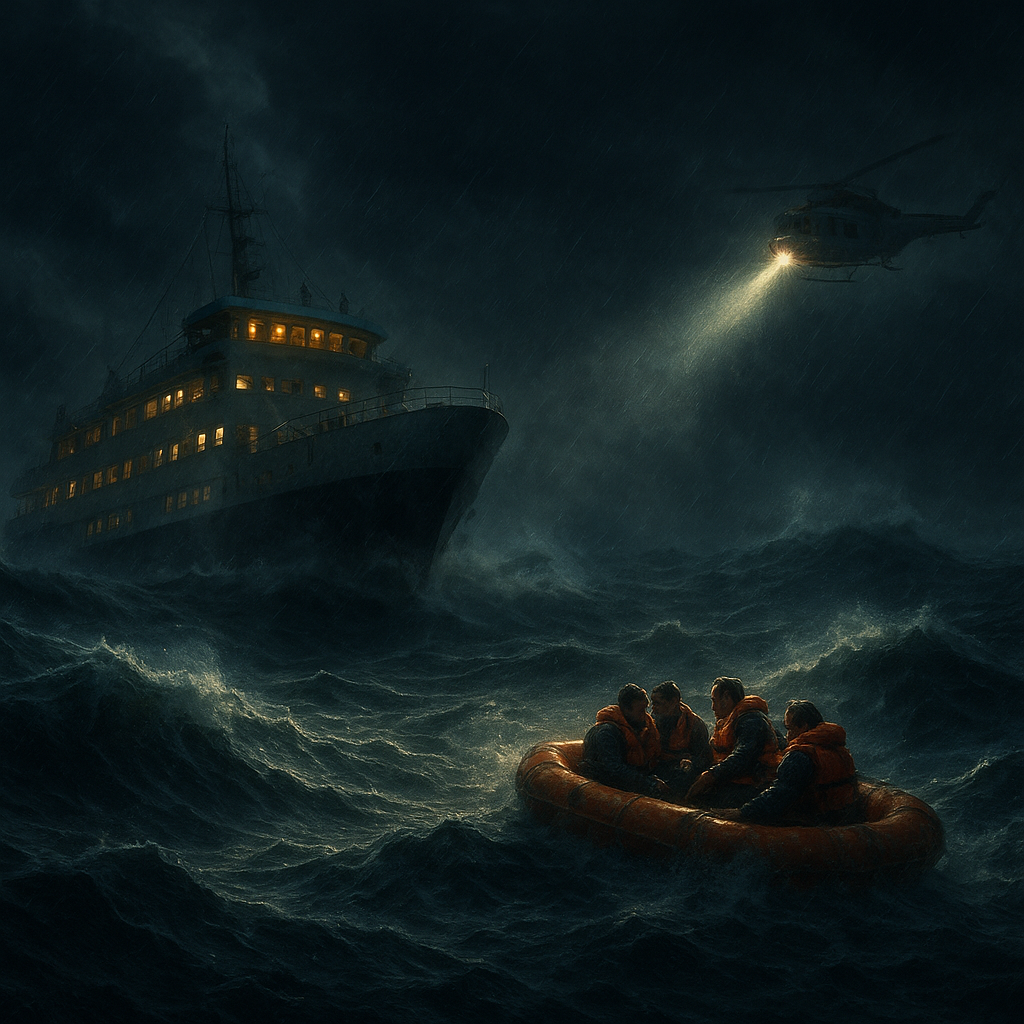
Just after one in the morning, the people still awake on the Estonia felt a sound move through the ship that did not belong to an ordinary storm. It was metal under strain, a deep shudder from the bow, the kind of noise that makes you look up even before you understand why. For a few minutes the ferry still looked like a night crossing between capitals: cabins, hallways, bars, sleeping passengers, trucks locked below. Then the list began, and in less than an hour one of Europe’s deadliest peacetime maritime disasters was swallowing almost everyone still trapped inside.
The Estonia ferry disaster is one of the most haunting survival stories in modern maritime history because it combined speed, darkness, cold water, and pure structural failure. On 28 September 1994, the ferry sank while traveling from Tallinn to Stockholm with 989 people on board. Only 137 survived, and the story still matters because the final half hour was not just a shipwreck. It was a race through tilting steel, blocked passageways, and Baltic water cold enough to kill within minutes.
Stories like this also belong beside the site’s broader Survival Stories Archive, because the Estonia disaster was not a slow ordeal stretched across weeks. It was the opposite: a compressed, violent survival window where almost every decision had to be made immediately or not at all.
The Final Half Hour Inside the Estonia
Then, shortly after 1:00 a.m., several passengers and crew began hearing heavy bangs from the bow. Investigators would later conclude that the ship’s bow visor, the huge front structure that protected the opening to the vehicle deck, had been taking punishing force from the waves. When that system failed, water gained access to the car deck behind it. On a roll-on/roll-off ferry, that is one of the worst things that can happen. Water does not stay contained. It spreads fast across the open deck, shifts violently with the ship’s movement, and tears stability away with terrifying speed.
At first, many people did not understand the scale of what was happening. They understood the symptoms. A sharper list to starboard. Objects sliding. Furniture moving when it should not. Doors behaving strangely. People waking up in cabins and realizing the floor angle was wrong. That early confusion matters, because it helps explain why the disaster became so lethal so quickly. Survival on the Estonia was not just about courage. It was about how long it took each person to grasp that this was no ordinary storm motion.
Once the list steepened, the ferry turned into a trap. Hallways became slanted channels. Stairwells became climbing problems. Passengers trying to move upward encountered people falling downward, luggage breaking loose, and doors that became harder to open as the angle increased. A ship is supposed to organize human movement. In those minutes, the Estonia did the opposite. It turned every route toward open deck into an obstacle course built out of steel, panic, gravity, and darkness.
That is part of what makes this case so harrowing compared with longer ocean ordeals like 438 Days at Sea. Salvador Alvarenga’s story is about endurance after disaster. The Estonia story is about surviving the disaster itself, while the structure around you is failing in real time.
Survivor testimony from the sinking has a brutal consistency to it. People described trying to climb rather than walk. They described seeing others pinned, sliding, or unable to rise once the angle became too steep. Some made it to open deck and found that even escaping the interior did not solve the problem. Lifeboats on one side were effectively unusable because of the list. Inflatable rafts became critical. Wind and wave spray made communication difficult. And all of this was happening in darkness on a ship that was continuing to lose stability.
Timeline of Events
- 27 September 1994, about 7:15 p.m.: Estonia departs Tallinn for Stockholm, slightly behind schedule.
- After 1:00 a.m. on 28 September: passengers and crew report loud metallic noises from the bow area.
- About 1:15 a.m.: investigators believe the bow visor fails and the loading ramp is compromised, allowing water onto the vehicle deck.
- Within minutes: the ship develops a severe starboard list, making movement inside the ferry extremely difficult.
- 1:22 a.m.: a mayday is transmitted as the situation rapidly deteriorates.
- Roughly 1:30 to 1:50 a.m.: the list worsens, more passengers fight their way to open deck, and the ferry becomes increasingly impossible to evacuate.
- About 1:50 a.m.: the ship disappears from radar.
- By around 2:03 a.m.: the Estonia has sunk.
- Afterward: helicopters and nearby vessels begin pulling survivors from rafts and the freezing Baltic, but the cold and sea conditions make the rescue window brutally short.
If you strip away the scale for a moment and focus only on those timestamps, the horror becomes clearer. The useful evacuation window was measured in minutes. Many people were asleep when the first sounds came. Many others were trapped before they could understand the route to safety. That is why the word sinking can almost be misleading here. It sounds gradual. What happened on the Estonia was more like a sudden collapse of certainty. First the ship was a ferry. Then it was a tilted maze. Then it was a raft launch point. Then it was gone.
How Survivors Described the Sinking
One of the most important things older versions of this story often lose is the physical reality inside the ship. The Estonia was not only sinking. It was becoming unusable as a human environment.
- The tilt changed everything: once the list became steep, ordinary walking turned into climbing, crawling, or hauling yourself upward with both hands.
- Darkness made orientation harder: as systems failed and panic spread, even familiar hallways became hard to read.
- Loose objects became hazards: luggage, furniture, and anything not secured could slide violently across cabins and passageways.
- The cold turned the sea into a second disaster: escaping the ship did not mean safety. It meant entering water cold enough to strip strength and coordination fast.
- Rescue depended on small margins: reaching a raft, staying conscious, being seen by a helicopter, or holding on long enough for hoisting could be the difference between life and death.
That final point is what gives the case its lingering sting. The ordeal did not end when the ferry disappeared. For the 137 people who lived, the next battle happened in the water.
In that sense, the Estonia belongs in the same conversation as The Three Men the Ocean Forgot, where survival depends on what happens after the world has already broken.
What Doesn’t Add Up for Many People
The official investigation concluded that the bow visor failed under wave stress, compromising the ramp and letting water flood the vehicle deck. That explanation remains the central finding. But the disaster has continued to attract public doubt for years, partly because of the scale of the loss and partly because large maritime failures rarely satisfy people emotionally once so many bodies are never recovered.
- The speed of the catastrophe still shocks people: it feels difficult to accept that a major passenger ferry could be functionally doomed so quickly.
- Later debate kept the story alive: renewed investigations and allegations about secret cargo or cover-ups helped turn grief into decades of suspicion.
- But suspicion is not proof: the strongest evidence still points back to catastrophic failure at the bow and the deadly vulnerability of the open vehicle deck.
That last distinction matters. The case carries enough mystery around the margins to keep arguments alive, but the emotional force of the story does not depend on conspiracy. It is already devastating in its plainest form: a passenger ferry encountered rough seas, a critical structure failed, and hundreds of people had almost no time to save themselves.
For readers drawn to disasters where one structural failure turns ordinary travel into a countdown, the same survival pattern appears in stories like the man who missed SilkAir Flight 185 by minutes. The scale is different, but the aftershock is similar. Lives divide into before and after based on a sliver of time.
Why the Estonia Disaster Still Hits So Hard
Part of it is the numbers. Nine hundred eighty-nine people on board. One hundred thirty-seven survivors. Eight hundred fifty-two dead. But the numbers only matter because they point back to human moments: someone in a cabin trying to wake a relative, someone on a stairwell pulling on a rail, someone on deck deciding whether to jump, someone in the water trying to keep a face above the waves.
That combination makes the Estonia disaster feel almost engineered to haunt people. Even now, decades later, the story resists becoming historical wallpaper. It still feels present tense. You can picture the list. You can picture the stairwells. You can picture the sudden understanding that the ship itself is no longer a place where rules hold.
And that is why the final half hour matters so much. Not because every second can be reconstructed perfectly, but because the emotional truth of the disaster lives there. In those minutes, survival stopped being about destination, luggage, schedules, or ordinary travel. It became simpler and more brutal than that: get up, get out, hold on, stay awake, last until someone finds you.
Some survivors did. Most did not. That imbalance is what gives the story its aftershock. The Baltic did not spare many people that night. But the ones who made it through left behind one of the starkest maritime survival stories in modern Europe, a story built not on myth but on the narrow, freezing margin between escape and disappearance.
FAQ
What happened to the Estonia ferry?
The Estonia sank in the Baltic Sea on 28 September 1994 while traveling from Tallinn to Stockholm. The official investigation found that the bow visor failed in rough seas, water flooded the vehicle deck, and the ferry rapidly lost stability and capsized.
How many people survived the Estonia disaster?
Out of 989 people on board, 137 survived. The rest either went down with the ship or died from drowning and exposure in the freezing Baltic during the rescue window.
Why did the Estonia sink so fast?
The key problem was water reaching the vehicle deck of a roll-on/roll-off ferry. Once water spread across that open space, stability collapsed quickly, and the severe list made evacuation far more difficult almost immediately.
Is the Estonia disaster still controversial?
Yes. The official explanation centers on bow visor failure and flooding, but the scale of the tragedy, the short rescue window, and later public debate helped keep alternative theories alive for decades.
Why does the Estonia ferry disaster still get attention?
Because it combines engineering failure, a terrifyingly short timeline, and the human reality of people trying to escape through darkness and steeply listing corridors. It does not feel distant. It still feels immediate.
🔎 If this story stayed with you, the author suggests these real cases next:
- Shipwrecks and ocean ordeals where the rescue window was terrifyingly small
- The fisherman who drifted so long the Pacific became his whole world
- Three men adrift in the Pacific after the world seemed to forget them
- The flooded cave rescue where every hour tightened the clock
- The man who missed a doomed flight by minutes and had to live with it
Explore more Survival Stories here: