
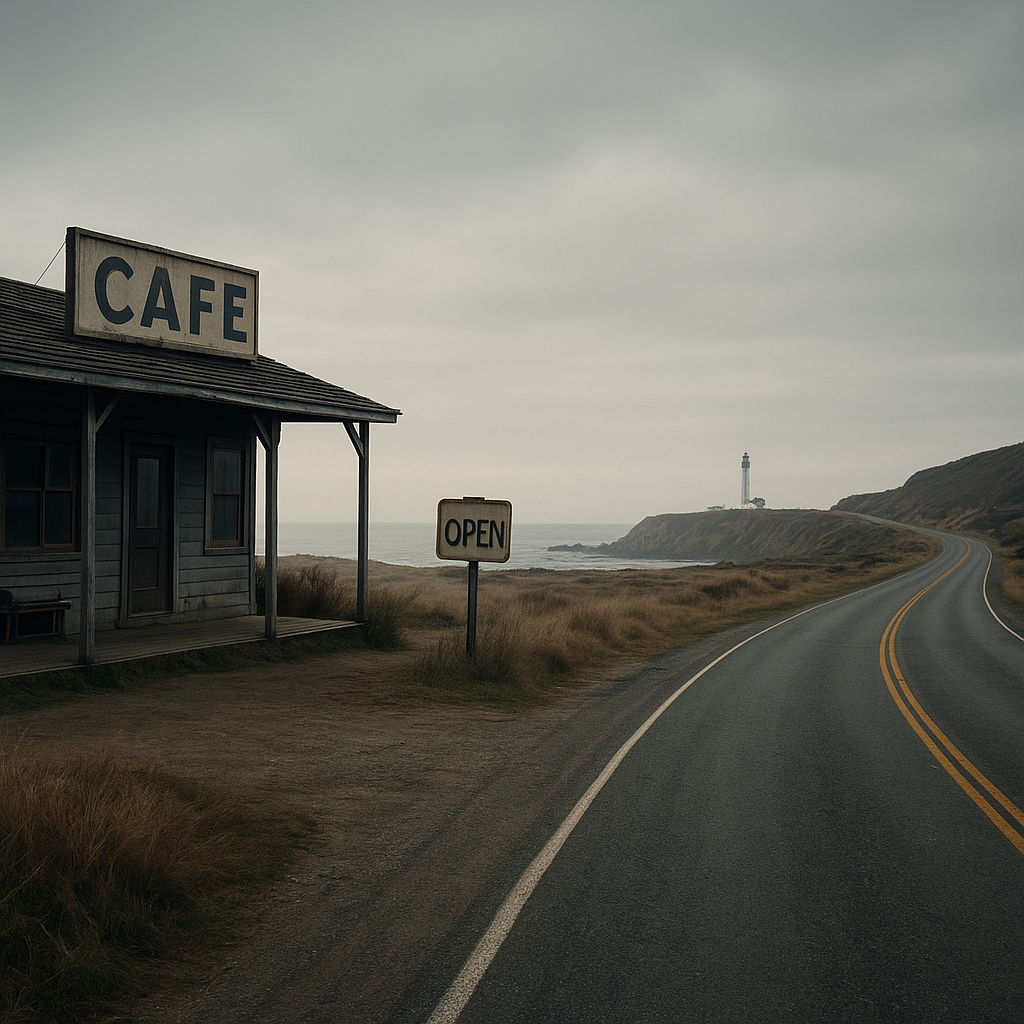
By the time anyone realized Asha Kreimer was really gone, the morning had already started to feel wrong in a way nobody could explain.
She had walked into the Rollerville Cafe near Point Arena in a gray hoodie and black jeans, but no shoes. She had barely slept in days. The people around her were already worried because she seemed to be drifting further away from reality. Then, in the middle of breakfast, she stood up from the table, followed a friend toward the restroom, and somehow vanished before anyone understood that this was the moment everything was about to fall apart.
There was no scream. No dramatic chase. No witness saying they saw her run down the road. Just a small gap in attention, the kind that opens and closes every day in ordinary places. When that gap closed, Asha Kreimer was gone.
Asha Kreimer’s unsolved disappearance remains one of the strangest missing person cases in Northern California because it combines a public setting, a visible crisis, and a timeline that seems like it should have produced answers. More than a decade later, this missing person case still matters because she disappeared in daylight, around other people, and the trail still dissolved almost immediately.
Cases like Jennifer Kesse’s broad-daylight disappearance stay with people for the same reason: the place feels too public for a person to simply vanish, which only makes the silence afterward feel colder.
The Morning Everything Slipped
Asha Kreimer was 26 years old. She had dual American and Australian citizenship and had reportedly been living in Mendocino County with her boyfriend. By the time she disappeared on September 21, 2015, the people closest to her were already frightened by how quickly her behavior had changed.
Reports on the case say Asha had gone several days without sleep. She was described as incoherent, paranoid, and detached from what was happening around her. In the days leading up to her disappearance, she was taken to a hospital for evaluation during what appeared to be a serious mental health crisis. But she was released, and instead of being kept under treatment, she was placed back in the care of people who were already struggling to keep her safe.
That detail hangs over the whole case. Because when you reconstruct the final known timeline, Asha’s disappearance does not really begin at the cafe. It begins earlier, with a system that failed to place a hard barrier between a vulnerable person and the open world around her.
After her release, Asha was with her boyfriend and a visiting friend. The group headed south and stopped at the Rollerville Cafe near Point Arena. It should have been an ordinary pause in the day. A meal. A reset. Maybe a chance for everyone to settle down after a chaotic stretch of sleeplessness and fear.
Instead, it became the last confirmed place Asha Kreimer was seen.
Witness accounts say she was still acting strangely inside the cafe. She reportedly did not speak to the waitress. She did not eat. She seemed withdrawn and disconnected. Then her friend got up to go to the restroom. A few seconds later, Asha followed.
But when the friend returned, the story broke open. She said she never saw Asha in the bathroom at all.
That is one of the eeriest details in the entire case. If it is accurate, then Asha may have changed direction almost instantly. A few steps. One decision. One unnoticed turn. And that was enough to remove her from the timeline everyone else thought they were sharing.
Timeline of Asha Kreimer’s Disappearance
- Days before September 21, 2015: Asha reportedly goes multiple days without sleep and begins showing signs of a severe mental health crisis.
- September 20: She is taken to a hospital in Fort Bragg for evaluation, but is later released instead of being kept for treatment.
- After release: She remains with her boyfriend and a visiting friend, with reports suggesting continued confusion and instability.
- Morning of September 21: The group stops at the Rollerville Cafe near Point Arena.
- Mid-morning: Asha appears distressed, reportedly does not eat, then gets up and follows her friend toward the restroom.
- Moments later: Her friend says she never saw Asha in the restroom. Asha is no longer at the table and cannot be found nearby.
- Later: Her jacket is reportedly found along the road toward the Point Arena Lighthouse, but no confirmed trace of Asha is found.
That timeline is short, and that is exactly why it is so disturbing. There is very little room for her to disappear, and yet that narrow window has never been closed.
What Does Not Add Up in the Point Arena Timeline
- The setting was public. Asha did not vanish from deep wilderness or a dark roadside at midnight. She disappeared from a cafe stop in the daytime, near people who knew she was in distress.
- The restroom detail creates a false trail. Everyone seems to have assumed she went where her friend went. But if she never entered the restroom, the key moment may have been misunderstood from the start.
- She was not prepared to leave for long. Reports indicate she did not have shoes, identification, money, or possibly even her phone. That makes a planned disappearance difficult in any ordinary sense.
- The jacket discovery raises questions without answering them. A jacket found near the road toward Point Arena Lighthouse suggests movement after the cafe, but it does not explain whether she wandered there alone, accepted a ride, or encountered danger.
- Possible sightings never became proof. Like many missing person cases, the story includes later reported sightings, but not the kind of verified evidence that can lock a timeline into place.
That is what keeps this case alive. There are enough fragments to imagine several outcomes, but not enough evidence to fully defend any one of them.
The Road, the Lighthouse, and the Fear of Exposure
Point Arena is beautiful in the way some coastlines are beautiful when they also feel merciless. The air is open. The roads can feel exposed. The ocean nearby is not just scenery. It is a force. When Asha’s jacket was later found along the road toward the Point Arena Lighthouse, it added a vivid image to the case, but also a dangerous temptation: to assume that image must explain everything.
Maybe it does not.
A jacket on a roadside can mean panic. It can mean confusion. It can mean a person was overheating, disoriented, or trying to move faster. It can also mean the object was separated from the person in a way that says almost nothing about the final outcome. People hear “lighthouse road” and immediately imagine cliffs, water, and a tragic ending. But imagination is not evidence.
Still, the geography matters. If Asha was already in a fragile state, walking barefoot in that area would have been difficult and dangerous. The farther she moved from the cafe, the more vulnerable she became. Every minute without intervention made it easier for the environment, chance, or another person to take control of what happened next.
This is where the case becomes larger than a single unexplained disappearance. It becomes a story about how thin the line is between being seen and being protected. Asha was not invisible. She was in public. She was with people. Her distress was visible enough that others had already been trying to manage it. And still, when the decisive moment came, visibility turned out not to be the same thing as safety.
Key Evidence and Clues
- Confirmed last setting: the Rollerville Cafe near Point Arena, where Asha was with her boyfriend and a friend.
- Critical condition of disappearance: she was reportedly barefoot and without the basic belongings needed to travel independently.
- Mental health context: multiple reports describe a severe crisis, prolonged sleeplessness, confusion, and behavior that worried the people around her.
- Jacket recovered later: a gray jacket was reportedly found along the road toward Point Arena Lighthouse.
- Unverified later reports: possible sightings and suggestions that she may have taken an assumed identity have circulated, but none have resolved the case.
Each clue matters. None of them is enough. That tension is familiar in unresolved disappearances. It is why cases like Mekayla Bali’s disappearance remain so absorbing: the timeline seems visible at first, but the moment that should bring clarity only opens into more uncertainty.
The Most Likely Explanation People Still Debate
There are a few broad theories in Asha Kreimer’s case, but each comes with serious limits.
One theory is accidental death after wandering away in a disoriented state. This has weight because of her reported crisis, the lack of shoes, the roadside jacket, and the dangers of the coastal area. If Asha kept walking in confusion, she may have ended up somewhere difficult to search or recover. The problem is that extensive searches did not produce the kind of physical evidence many people would expect.
Another theory is suicide. Some people focus on the lighthouse-road detail and the possibility that she moved toward the cliffs or ocean. But that theory still depends on assumptions the evidence does not firmly establish. A jacket being found in that direction is not proof of intent or proof of a final location.
A third theory is that she encountered another person after leaving the cafe. In a public disappearance involving a vulnerable person alone and barefoot, opportunistic harm cannot be dismissed. But there is no publicly known evidence strong enough to lock that theory in either.
A fourth theory is voluntary flight under mental distress. Some later reporting mentioned the idea that she could have taken on another identity. It is not impossible. People in crisis can move unpredictably. But disappearing for years without money, ID, shoes, or a clear support system makes that outcome hard to picture, even if it cannot be ruled out completely.
So the hardest truth is this: the most likely explanation may still be that Asha wandered away in an acute mental health crisis and entered a chain of events that became fatal very quickly. But “most likely” is not the same thing as “proven,” and that gap is exactly why the case still pulls people back in.
Why This Case Still Gets Attention
Some disappearances stay in public memory because the victim was famous. Others because there is shocking video, dramatic evidence, or an obvious suspect. Asha Kreimer’s case is different. It lingers because the whole thing feels preventable.
A woman in visible distress was not hidden from the world. She moved through a hospital, a home, a car, and a cafe. Her crisis was not secret. And yet at the moment when protection mattered most, she slipped through every layer that should have caught her.
That is why the story keeps resurfacing in discussions of unresolved disappearances. Not because it offers flashy mystery, but because it forces a brutal question: how can someone be so visible, so clearly vulnerable, and still disappear so completely?
There is no neat ending here. No body recovered. No confirmed sighting that closes the map. No final piece of evidence that snaps the timeline into place. Just a barefoot woman in a roadside cafe, a friend walking toward a restroom, a few lost seconds, a jacket near the road, and years of silence after that.
Maybe the answer lies somewhere between those moments, in a path briefly taken and never reconstructed correctly. Or maybe it lies farther away, in some later encounter or overlooked witness memory that never got connected to the morning it belonged to.
But until that missing piece appears, the disappearance of Asha Kreimer remains one of those cases that feels impossible for a simple reason: it happened in plain sight, and plain sight was not enough.
If this story stayed with you, the author suggests these real cases next:
- The woman who vanished in broad daylight and left almost no trace behind
- The teen disappearance timeline filled with strange movements and missed chances
- The final-night mystery where every answered question seemed to create a new one
Explore more Disappearances stories here: