The Manson Family: How Belief Turned Deadly in Los Angeles
9 min readApril 1, 2026
Just after midnight, a car rolled up a long, dark drive in Benedict Canyon, and for a few quiet seconds Los Angeles still felt like Los Angeles. The city below was full of lights, pool parties, and people who believed the night belonged to them. Then the engine cut off, footsteps moved through the brush, and a house that seemed far removed from ordinary fear became one of the most infamous crime scenes in American history.
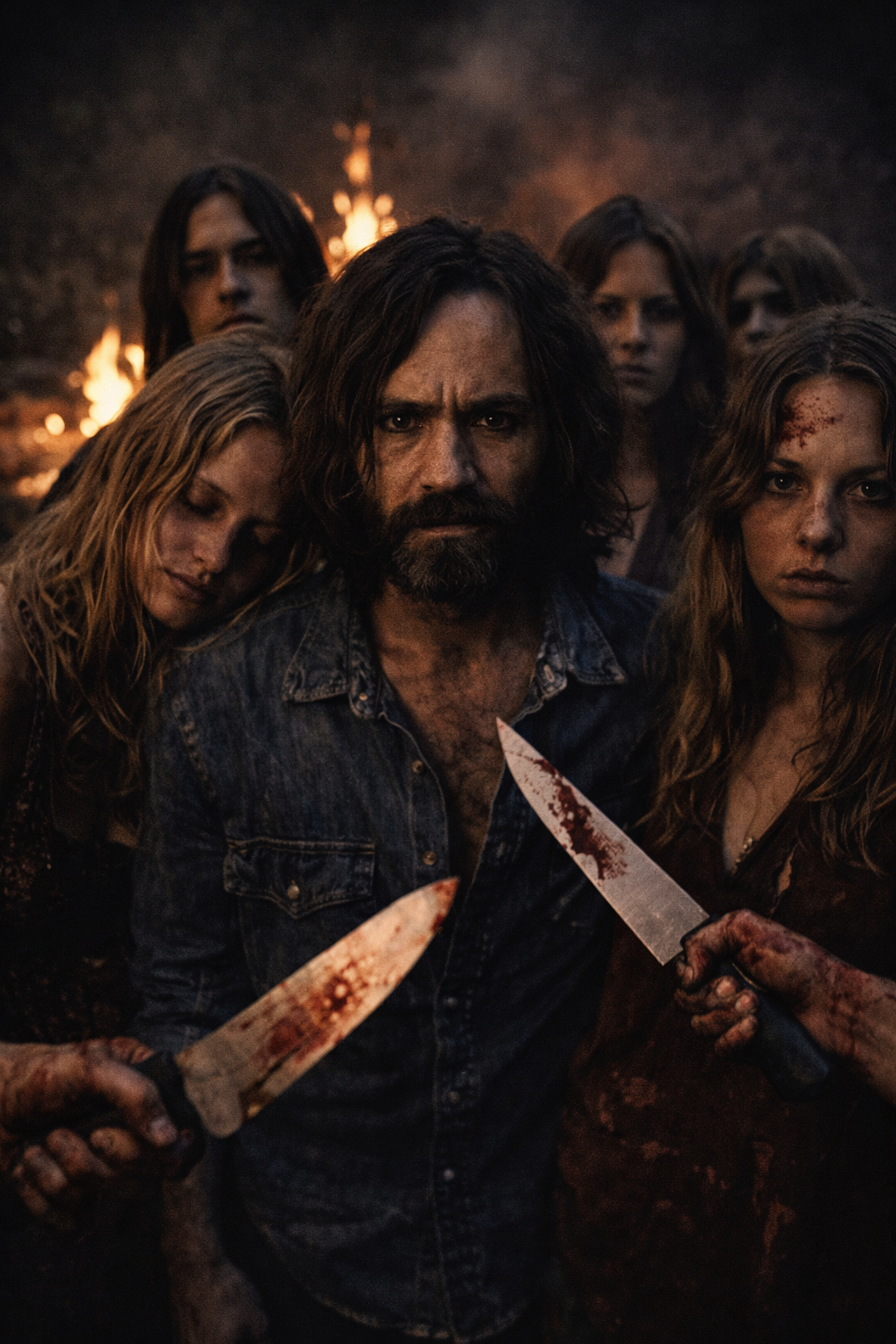
The terror that followed was not random in the way it first appeared. It came out of a closed world that had been forming for months around Charles Manson—a world built on charisma, isolation, humiliation, prophecy, and obedience. By the time violence arrived at Cielo Drive, the hardest part had already happened. A small group of people had been taught to stop hearing their own conscience.
The Manson Family case still matters because it was never just about one killer or one terrible night. It remains one of the clearest examples of how a manipulative leader can turn loneliness, idealism, and a hunger for belonging into something lethal. It also sits inside a larger history of belief-driven violence, the same dark pattern that appears in stories like Doomsday Cults That Ended in Death.
Long before the murders made headlines, Manson understood how to make people feel seen. He had spent much of his life in institutions and prison, but after his release in 1967, he drifted into California’s counterculture at exactly the right moment. Young people were searching for new identities. Many were suspicious of authority, drawn to communal living, and willing to believe that the old rules had failed them. Manson stepped into that opening and offered a new language for meaning.
He did not begin by talking about murder. He talked about freedom, awakening, and the idea that the outside world was fake. He could be soft-spoken, strangely attentive, and skilled at reading insecurity. For people who felt unwanted elsewhere, that kind of attention could feel almost supernatural. He told followers that they mattered. Then, little by little, he redefined what mattering meant.
The group that gathered around him eventually became known as the Manson Family. Many of the followers were very young. Several came from middle-class backgrounds and had arrived in California looking for a version of liberation that felt bigger than jobs, school, and ordinary family life. Instead, they entered a tightening circle where Manson controlled conversation, movement, sex, sleep, punishment, and status.
At Spahn Ranch outside Los Angeles, the Family created the appearance of a lawless commune. Days blurred into nights. Drugs were common. Boundaries were deliberately weakened. Manson encouraged followers to surrender their identity to the group and to him. Once someone accepted that he could define reality better than they could, nearly everything else became easier to demand.
That mechanism shows up in other cult stories too, including the polished manipulation at the center of NXIVM, the secretive self-help group that hid coercion behind personal growth. The language changes. The setting changes. But the emotional trap often looks familiar: first you are told you are special, then you are taught that obedience is proof of that specialness.
When the Message Turned Dark
What makes the Manson story so disturbing is not only that the Family became violent, but how gradually the moral collapse seems to have happened from the inside. Manson wrapped himself in fragments of religion, apocalypse, music, racial paranoia, and theatrical mysticism. He spoke about a coming upheaval, often described through his twisted reading of the phrase “Helter Skelter.” In his telling, a catastrophic race war was approaching, society would collapse, and the Family had a chosen role in what came next.
Outside the ranch, these ideas sounded unhinged. Inside the ranch, they arrived after months of conditioning. Followers had already learned to treat contradiction as weakness. They had already watched Manson reward surrender and punish doubt. By the time he framed violence as destiny, he was not starting from zero. He was speaking into minds he had spent months reshaping.
That is why the case still unnerves people decades later. It was not driven by one moment of rage. It came from a system. The Family had become a closed environment where fantasy replaced judgment, and where brutality could be dressed up as purpose.
The Night the Fantasy Reached Cielo Drive
On the night of August 8, 1969, several Family members left Spahn Ranch and drove into Los Angeles. Their destination was 10050 Cielo Drive, the house associated with Sharon Tate and Roman Polanski. Inside were Sharon Tate, who was heavily pregnant, Jay Sebring, Abigail Folger, Wojciech Frykowski, and others on the property. What happened there became one of the most shocking crimes of the era.
The horror of that night is easy to reduce to a list of names and injuries, but that misses why the case hit with such force. The victims were not targeted through any ordinary chain of conflict most people understand. To the wider public, the attack seemed to come from nowhere. It felt like nightmare logic invading a glamorous city that had convinced itself it was immune to that kind of darkness.
And then, before Los Angeles had even processed the first scene, more violence followed. On the next night, Leno and Rosemary LaBianca were killed in their home. If the Tate murders had already shattered any illusion of safety, the LaBianca murders widened the fear. Doors locked earlier. Rumors spread faster. The city felt altered, not just saddened.
Timeline of Events
1967: Charles Manson is released from prison and begins attracting followers in California.
1968: The group grows and settles for a period at Spahn Ranch, where Manson’s control deepens.
Early to mid-1969: Manson’s rhetoric turns increasingly apocalyptic, violent, and paranoid.
Night of August 8-9, 1969: Family members carry out the murders at Cielo Drive.
Night of August 9-10, 1969: Leno and Rosemary LaBianca are murdered.
Late 1969 onward: Investigators piece together the Family’s role, leading to arrests, trials, and global attention.
What Doesn’t Add Up Until You Understand Cult Control
For many people, the central question is still the same: how could followers do this for him? The answer is not that they were born monsters, and it is not that Manson possessed some supernatural power. What changed them was environment, repetition, and control.
Isolation: The Family created distance from ordinary reality, making outside moral standards feel weak or irrelevant.
Identity breakdown: Individual judgment was replaced by group identity and loyalty to Manson.
Prophetic framing: Violence was recast as something historical or necessary, not personal or evil.
Incremental obedience: Followers were not asked to leap immediately into the worst act imaginable. Control tightened step by step.
That slow erosion of conscience is part of what connects the Manson Family to other extreme groups, from Aum Shinrikyo and the Tokyo subway attack to the abuse allegations that defined Children of God. The settings look different, but the pattern repeats: a leader claims special truth, isolates followers, and turns moral surrender into a test of loyalty.
Why the Investigation Took Time
Part of the early confusion came from how bizarre the crimes looked. The scenes felt theatrical, symbolic, and disconnected from familiar motives like robbery or revenge. Investigators were staring at violence that seemed designed not only to kill, but to communicate something. The problem was that the message made sense only inside the Family’s closed belief system.
Once the case began to point back toward Spahn Ranch and Manson’s followers, the public had to confront something more unsettling than a standard murder case. The danger had not come from a hidden intruder acting alone. It had come from a social ecosystem—an intimate world of manipulation where belief itself had been weaponized.
The trials only deepened that unease. The behavior of Manson and several followers in court made the whole thing feel like evidence of an entire reality gone wrong. Many people came away with the same unsettled feeling: they understood what happened, but not how human beings could be bent that far.
Why This Case Still Holds People
Some crimes stay in the public mind because they are unsolved. The Manson Family case is different. It stays alive because the basic facts are known, yet the psychological core still feels difficult to accept. People keep returning to it because it forces a question most of us do not like asking: under the wrong pressure, how much of a person can be taken apart and rebuilt?
It also marked the end of a certain cultural fantasy. The late 1960s had been wrapped in language about peace, expansion, and new ways of living. The Manson murders exposed how easily the aesthetics of liberation could hide domination, coercion, and cruelty. That collapse of innocence is one reason the story never really faded.
If the broader cult pattern is what draws readers in, the site’s roundup of disturbing cult stories that actually happened shows how often the same emotional machinery reappears. Different leaders promise transcendence in different voices. The result, far too often, is the same narrowing tunnel of fear and control.
The Most Likely Explanation
The simplest honest explanation is also the hardest one to sit with: Charles Manson did not need to physically commit every murder to shape them. He built a worldview that made violence imaginable, then acceptable, then necessary in the minds of followers who had surrendered too much of themselves to him. The crimes were not an accidental eruption. They were the final expression of a system he had been building for months.
That does not erase individual responsibility from the people who carried out the killings. But it explains why the case belongs in any serious discussion of cult violence. Manson created an atmosphere where cruelty could be interpreted as destiny, and where loyalty mattered more than conscience. Once that happens, catastrophe is no longer unthinkable. It is only waiting for an order, a signal, or a night when nobody turns back.
And that is why the story still feels cinematic in the darkest possible way. It begins with sun-faded California mythology—music, freedom, communes, youth—and ends with blood on the walls of expensive homes. It is a story about charisma curdling into command, about belonging turning into submission, and about how the most dangerous closed worlds rarely look dangerous at first.
FAQ
What happened to the Manson Family?
The Manson Family was a cult-like group led by Charles Manson in California during the late 1960s. Several members carried out the Tate-LaBianca murders in August 1969, and the group unraveled as investigators linked the crimes back to Manson and his followers.
Did Charles Manson personally kill Sharon Tate?
Charles Manson was not convicted as the person who physically carried out the Tate murders, but prosecutors argued successfully that he directed and orchestrated the violence through his control over followers.
Why is the Manson Family case still so famous?
The case still gets attention because it combined celebrity victims, extreme violence, and the disturbing reality of cult manipulation. Even with the facts established, people remain haunted by how belief and obedience were turned into murder.
Was the Manson Family a cult?
It is widely described as one. The group revolved around a controlling leader, isolation from outside reality, manipulation, and a belief system that overrode personal judgment.
Why do people still study Charles Manson?
People study Manson because the case reveals how charismatic control works in real life. It is not just a crime story; it is a warning about influence, vulnerability, and how dangerous closed belief systems can become.