The ship was still moving when they found it.
Not fast. Not with purpose. Just enough to make the sight worse.
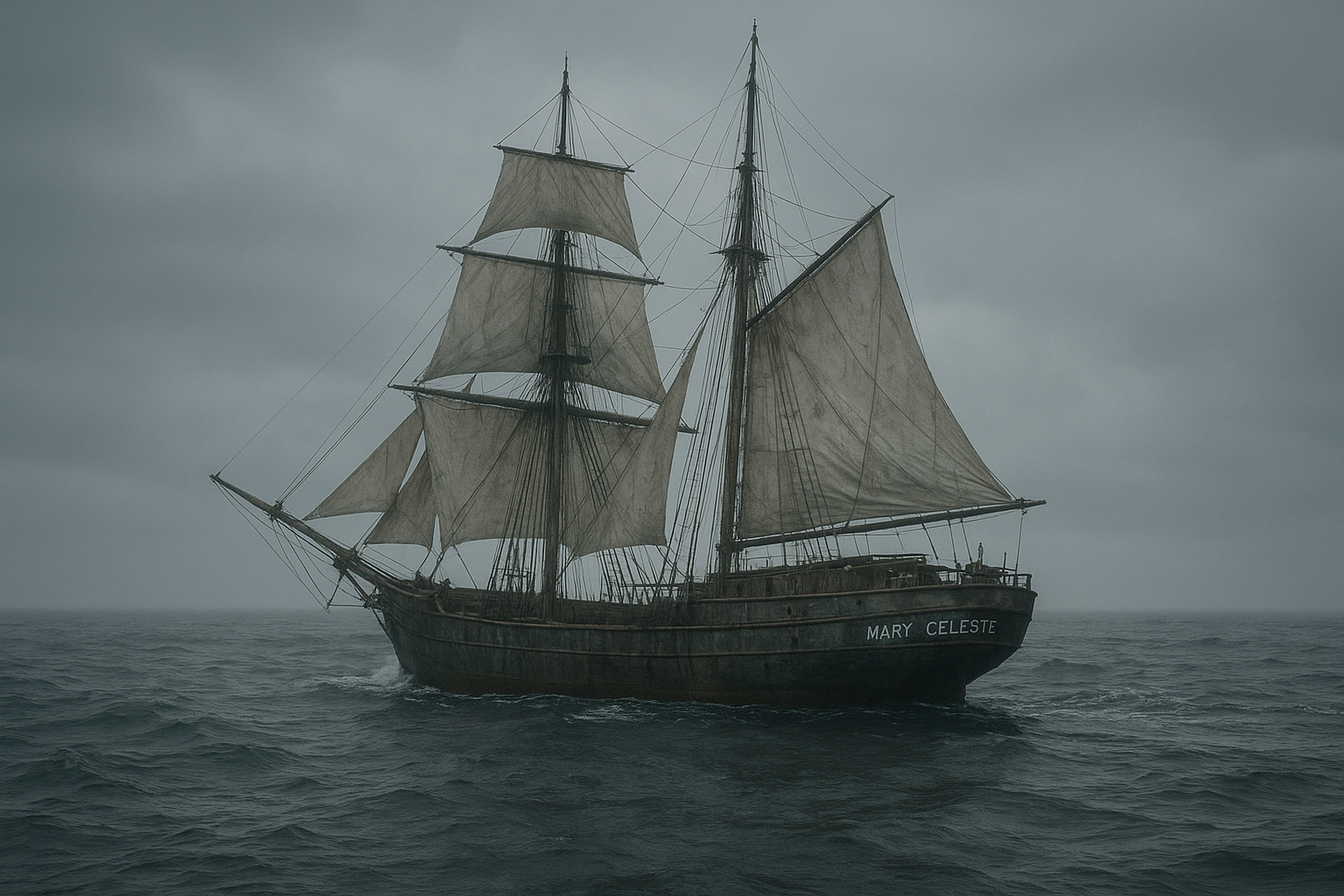
On December 4, 1872, the crew of the Dei Gratia saw a brigantine drifting near the Azores in a way that made experienced sailors stop and stare. Her sails were set badly. Her motion looked wrong. She was not sinking, not burning, not shattered by a storm. She was simply there, wandering over cold Atlantic water as if the people in charge of her had stepped away and never come back.
When a boarding party climbed aboard, they found one of the most haunting scenes in maritime history. The Mary Celeste was deserted. Her cargo was still in the hold. Her stores were still there. The ship herself was damaged, but not destroyed. Yet Captain Benjamin Briggs, his wife Sarah, their young daughter Sophia, and the seven-man crew were all gone.
The Mary Celeste mystery still matters because it sits in that maddening place between a plausible explanation and a final answer. It remains one of history’s most famous ghost ship stories not because the vessel disappeared, but because it did not. It stayed behind and kept floating.
That same chill runs through the Lost Colony of Roanoke mystery: evidence that ordinary life was there, and then an absence so complete it feels impossible.
The Day the Sea Handed Over an Empty Ship
The moment that made the Mary Celeste immortal was the boarding itself. The vessel had sailed from New York Harbor on November 7, 1872, bound for Genoa, Italy, carrying more than 1,700 barrels of industrial alcohol. On board was Benjamin Briggs, an experienced and cautious captain with every reason to avoid reckless decisions. He was sailing not only with a crew, but with his family.
Sarah Briggs came with him. So did their two-year-old daughter, Sophia. Their son had been left on land for school. Nothing about the voyage was supposed to become legend. It was a merchant crossing, dangerous only in the ordinary way sea travel was dangerous in the 19th century.
Then, nearly a month later, the ship reappeared without a single soul aboard.
The details that matter most are these: the lifeboat was gone, some sails and rigging were damaged, water had entered the vessel, and some navigation-related items were missing. But the cargo remained. Food and water remained. The ship did not look comfortable, but it did not look like a floating tomb either. It looked survivable.
That is what makes the case so hard to close. This was not a ship reduced to splinters. It was a ship that seemed to have been abandoned in the middle of a decision.
Who Was on Board?
Benjamin Briggs matters because he changes the logic of the mystery. He was not known as a reckless captain, and a man sailing with his wife and child is harder to imagine leaving a workable ship unless he believed the danger on board was immediate.
That emotional fact sharpens everything. A captain may risk cargo. He may risk himself. But leaving the deck with his family suggests he thought staying would be worse.
The seven crew members also matter more than the legend usually allows. They were real sailors with a destination ahead of them, not side characters in a ghost story. Whatever happened to the Mary Celeste consumed nine adults and one child. That scale of disappearance is part of what gives the ship its eerie power even now.
Timeline of the Mary Celeste Mystery
- November 7, 1872: The Mary Celeste leaves New York Harbor for Genoa, Italy, carrying industrial alcohol.
- Late November 1872: The voyage continues east across the Atlantic. The last known log entry places the ship near the Azores.
- December 4, 1872: The Dei Gratia spots the vessel drifting strangely and sends a boarding party.
- On boarding: The ship is found deserted. The cargo remains aboard, but the lifeboat is missing and everyone on board is gone.
- After recovery: The ship is brought to Gibraltar, where official inquiries and public suspicion turn the case into an international sensation.
- Years later: Theories multiply, and retellings add legend to a case that never truly stopped feeling unfinished.
What Was Found—and What Was Missing
The power of the case lives in the split between trouble and survivability.
There was water in the bilge, but not enough to explain blind panic. The cargo had not been looted. Personal effects remained on board. At the same time, the lifeboat was gone, and important navigational items such as the chronometer and sextant were missing. That suggests the people who left did not simply vanish in chaos. They appear to have left on purpose.
But why would an experienced captain choose an open boat over a ship that still floated?
That question is the entire mystery in one line.
What Doesn’t Add Up
- The ship was abandoned, but not destroyed.
- The cargo remained aboard, which weakens piracy.
- Navigational tools were missing, which suggests a planned departure.
- The lifeboat was gone, which points toward evacuation.
- No confirmed trace of the missing people ever returned.
Every theory solves one piece and leaves another exposed. That is why the story survives. The evidence does not point cleanly in one direction. It points toward pressure, uncertainty, and a choice made under bad conditions.
Theories: Mutiny, Pirates, Weather, or Cargo Fumes?
Suspicion first touched the crew of the Dei Gratia because salvage money creates an easy motive for gossip. But the evidence for murder aboard the ship has always been thin. The scene did not strongly support a violent takeover.
Piracy sounds dramatic, but pirates usually take what matters. The Mary Celeste did not look stripped or profitably raided. Mutiny is possible in the abstract, yet it asks too many extra questions. Why overthrow a captain and then abandon a still-usable ship? Why leave so little behind?
Weather is more believable, but it still does not fully explain why an open boat seemed safer than the vessel itself.
The strongest theory is the one built around the cargo. The ship was carrying industrial alcohol, and some barrels were later believed to have leaked. If fumes built below deck, Briggs may have feared an explosion. In that moment, a temporary evacuation could have felt like the cautious move. He may have intended to keep the boat near the ship until the danger passed.
If that happened, then the most important event in the case may have been brutally small: a rope parting, a swell shifting, a gust creating distance faster than anyone expected. The Mary Celeste would have become a drifting shape. Then a retreating one. Then an unreachable one.
If maritime disappearance legends pull you in, the old fear behind the Bermuda Triangle mystery lives in the same emotional territory: not just that the sea can kill, but that it can swallow the explanation too.
Evidence vs. Legend
The case became famous so quickly that myth began attaching itself to fact almost immediately. Later retellings added dramatic details like untouched meals, bloodstains, or theatrical signs of violence. Some of those claims were exaggerated. Some were invented. Fiction also helped blur the picture, especially after sensational retellings turned the ship into a permanent symbol of the unexplained.
But the real story never needed decoration. A real vessel was found adrift. A real captain, his family, and a real crew were gone. No final witness ever explained why.
That is part of what connects the case to the enduring pull of the Somerton Man mystery. The facts are strong enough to hold attention, but the uncertainty around them creates the space where legend keeps growing.
Why the Mary Celeste Still Haunts People
Some mysteries survive because the violence is horrific. The Mary Celeste survives because it feels like a frozen decision.
There was likely a final hour when everything still seemed manageable. Briggs may have believed he was protecting his family. The crew may have believed they would be back on deck soon. No one in that moment would have thought the ship itself would become the survivor and the people would become the missing part of the story.
That reversal is what keeps the case alive. The vessel did not vanish into legend. It sailed straight into it.
And that is why the Mary Celeste still belongs beside pages like Ancient Mysteries That Still Can’t Be Explained. There is enough evidence to suggest an answer, and not enough to make peace with one.
FAQ
What happened to the Mary Celeste?
The ship was found abandoned in December 1872 near the Azores with its cargo still on board and its lifeboat missing. No confirmed explanation has ever proved exactly why Captain Benjamin Briggs, his family, and the crew left the vessel.
Was the Mary Celeste a real ghost ship?
Yes, the Mary Celeste was a real merchant brigantine, but “ghost ship” is only a nickname. The mystery comes from the ship being discovered deserted while still broadly seaworthy.
What is the most likely explanation for the Mary Celeste mystery?
Many historians consider temporary abandonment caused by fear of an alcohol-fume explosion to be one of the strongest theories. It explains the missing lifeboat and navigational tools, though it still does not prove what happened after the people left the ship.
Why does the Mary Celeste mystery still get attention?
Because the image is unforgettable: a functioning ship, a vanished crew, and no final witness. It feels like history paused in the middle of an emergency and never resumed.
Continue exploring:
- The vanished colony that left only one carved word behind
- The unidentified man on the beach whose secrets outlived his name
- The shipwreck machine that looked centuries too advanced for its world
- The artifact covered in symbols that historians still cannot read with confidence
More Historical Mysteries stories:
Watch This Story on YouTube
Prefer to watch? See the full story on our YouTube channel.