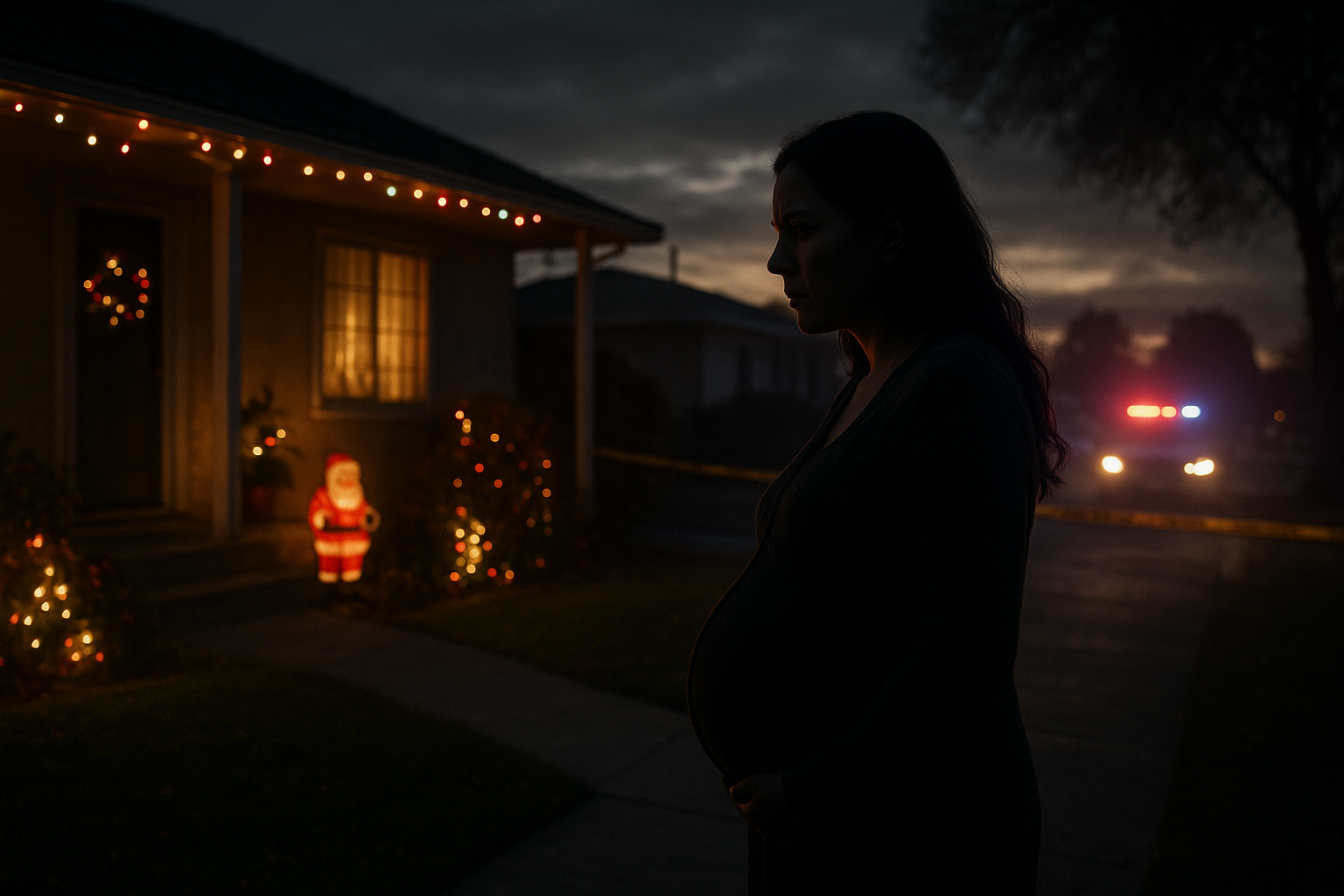
Christmas Eve in Modesto should have sounded like wrapping paper, phone calls, and last-minute errands. Instead, by afternoon, one house on Covena Avenue had gone strangely quiet. Laci Peterson was eight months pregnant, her son Conner was almost here, and the ordinary holiday morning that was supposed to lead into family plans became the beginning of a search clock no one could stop.
The Scott Peterson case is the story of Laci Peterson’s disappearance, the murder trial that followed, and the evidence that still divides people more than two decades later. It matters because the case sits at the uncomfortable place where grief, media pressure, circumstantial evidence, and courtroom certainty all collided in public.
If you are drawn to cases where a verdict does not end the debate, the same courtroom tension runs through the Karen Read retrial, another case where public opinion, evidence questions, and legal strategy became part of the story itself.
The Holiday Morning That Became a Search
On December 24, 2002, Laci Peterson was 27 years old and preparing for the birth of her first child. To friends and family, she was warm, excited, and close to the life-changing moment she had been waiting for. Christmas was one day away. The nursery was real. The name Conner had already made him feel present before he was ever born.
Scott Peterson, her husband, later told investigators he had gone fishing alone at the Berkeley Marina. He said when he returned home, Laci was gone. The family dog had reportedly been found wandering with its leash still attached, a small domestic detail that made the whole morning feel wrong. A dog on a leash without its owner suggests interruption. It suggests someone stepped out for a normal reason and never made it back.
At first, people wanted the simple answer. Maybe Laci had taken a walk. Maybe someone had seen her. Maybe there was a misunderstanding, a delay, a medical emergency, anything that would allow the day to end with relief. Volunteers searched neighborhoods, parks, fields, and waterways. Flyers went up. Family members pleaded for help. Every hour that passed made the silence heavier.
Suspicion Moved Toward Scott
In the earliest days, Scott did not look like the monster many people imagine at the center of a murder case. He was clean-cut, calm, and controlled. But calm can become a dangerous thing in front of cameras. Some viewers saw shock. Others saw distance. In a case already being watched nationally, every expression became evidence in the court of public opinion.
Then investigators learned about Amber Frey. Scott had been having an affair, and Frey said he had presented himself as a man who had lost his wife before Laci was publicly reported missing. That detail changed the emotional temperature of the case. The missing pregnant wife was no longer the only story. Now there was a secret relationship, recorded phone calls, and a husband whose private life did not match the image he had shown the public.
None of that, by itself, proved murder. Affairs are not murder weapons. Strange behavior is not a confession. But the Peterson case became powerful because each detail seemed to press against the next: the fishing trip, the timing, the marina, the affair, the things Scott said, and the way his explanations were received by investigators and the public.
The Discovery in the Bay
For months, hope thinned but did not fully disappear. Then in April 2003, remains were found along the San Francisco Bay shoreline. They were identified as Conner and Laci Peterson. The location mattered because it was not far from the area where Scott said he had gone boating on the day Laci vanished.
The search was over, but the legal battle had only begun. Prosecutors did not have a clean eyewitness account of a murder. They did not have a dramatic video showing what happened inside the Peterson home. What they had was a circumstantial case: a pattern of timing, behavior, statements, and physical location that they argued pointed in one direction.
The defense saw it differently. They argued that Scott was being punished for being unfaithful, emotionally odd, and publicly disliked. They pointed to the lack of direct forensic proof showing exactly how and when Laci died. They challenged the idea that suspicion could fill every gap.
Timeline of Events
- December 24, 2002: Laci Peterson disappears from Modesto, California, while eight months pregnant.
- Late December 2002: Search efforts expand, and Scott tells investigators he was fishing at the Berkeley Marina.
- January 2003: Amber Frey publicly reveals her relationship with Scott and cooperates with investigators.
- April 2003: The remains of Conner and Laci are found along the San Francisco Bay shoreline.
- April 18, 2003: Scott Peterson is arrested.
- 2004: Scott is convicted of murdering Laci and Conner.
- Later appeals: His death sentence is overturned, but his murder conviction remains, and he is resentenced to life without parole.
Key Evidence and Clues
The case against Scott Peterson was built like a slow closing circle rather than a single lightning strike. Prosecutors focused heavily on his trip to the Berkeley Marina, because Laci and Conner were later found in the bay. They also emphasized his affair with Amber Frey, especially the allegation that he had described himself as having lost his wife before Laci disappeared.
They pointed to behavior that seemed detached or deceptive. They argued that his private calls, public statements, and travel choices showed a man trying to manage two lives while one of them was collapsing. To jurors, the question was not whether one detail proved everything. It was whether all of the details together created a picture too specific to ignore.
The defense tried to break that picture apart. They argued that the physical evidence was not as direct as the prosecution made it feel, that public hatred of Scott had become overwhelming, and that investigators narrowed in on him too quickly. That tension is why the case still gets discussed alongside other high-profile trials like the Menendez brothers resentencing, where old facts keep being re-examined through new legal and cultural lenses.
What Doesn’t Add Up for Some People
The public split around the Scott Peterson case is not only about sympathy. It is about how people weigh absence. There was no single courtroom moment where the crime appeared in full. No one could point to one video, one confession, or one clean forensic answer and say: here is the entire story.
Instead, the case asked jurors to decide whether the surrounding evidence was enough. For many people, it was. The marina location, the affair, the statements to Amber Frey, and Scott’s behavior formed a chain that felt devastating. For others, the same chain left too much room between the links. They saw a man who looked guilty, acted badly, and lied — but they questioned whether that answered every legal question beyond a reasonable doubt.
That is what keeps the case alive. Not because Laci and Conner’s deaths are unclear in their tragedy, but because the route from suspicion to certainty still makes people argue about what a jury should require.
The Trial That Turned Into a National Obsession
By the time Scott Peterson went to trial, the case was already bigger than the courtroom. Laci’s photograph had become familiar across America. Her pregnancy made the story feel even more devastating. The holiday timing gave it a haunting contrast: celebration outside, horror inside.
Prosecutors presented Scott as a man trying to escape marriage and fatherhood. The defense presented him as an unfaithful husband turned into a murderer by media appetite and investigative tunnel vision. The jury convicted him in 2004, and for many observers, the verdict felt like the only ending the facts could support.
But legal endings do not always quiet emotional arguments. Appeals, resentencing, documentaries, and new rounds of public discussion have kept the Peterson case in the national memory. It remains one of those true crime stories where people come back not only to ask what happened, but to ask how certainty is built when the most important moments were never directly seen.
Why This Case Still Gets Attention
The Scott Peterson case still receives attention because it feels like ordinary life collapsing from the inside. There was no stranger in a dark alley, no obvious warning before the holiday, no clean moment where the family could see danger coming. There was a home, a marriage, a baby on the way, and then an absence that grew darker with every new revelation.
It also belongs to a larger group of cases where the courtroom and the public do not move at the same speed. Readers who follow these legal pressure points often end up in the True Crime Archive, where unresolved murders, DNA breakthroughs, retrials, and divided verdicts sit side by side.
At the center, though, are Laci and Conner. The arguments around Scott Peterson can become loud, but the human core of the story is quieter and worse: a young woman about to become a mother vanished on Christmas Eve, and the child everyone was waiting to meet never got the chance to arrive.
FAQ
What happened to Laci Peterson?
Laci Peterson disappeared from Modesto, California, on Christmas Eve 2002 while eight months pregnant. Her remains and the remains of her unborn son, Conner, were found months later along the San Francisco Bay shoreline.
Why was Scott Peterson convicted?
Scott Peterson was convicted largely on circumstantial evidence. Prosecutors pointed to his fishing trip near the area where the bodies were later found, his affair with Amber Frey, his statements, and his behavior before and after Laci disappeared.
Is Scott Peterson still in prison?
Yes. His death sentence was overturned, but his murder conviction remains. He was resentenced to life in prison without the possibility of parole.
Why does the Scott Peterson case still divide people?
The case divides people because it was emotionally powerful but did not include one simple piece of direct evidence showing the murder as it happened. Some believe the circumstantial case was overwhelming. Others argue that public pressure and gaps in the evidence still deserve scrutiny.
Why is the case still famous?
It remains famous because it combined a devastating family tragedy, a missing pregnant woman, a secret affair, intense media coverage, and a trial that forced people to debate how guilt is proven when the central act is unseen.
Continue exploring:
- A retrial where evidence questions and public opinion collided
- The family murder case still being re-argued decades later
- True crime cases pulled back into the spotlight by appeals and new evidence
- Cold cases where old evidence changed everything years later
- Another family crime where the public image cracked on camera
More True Crime stories: