
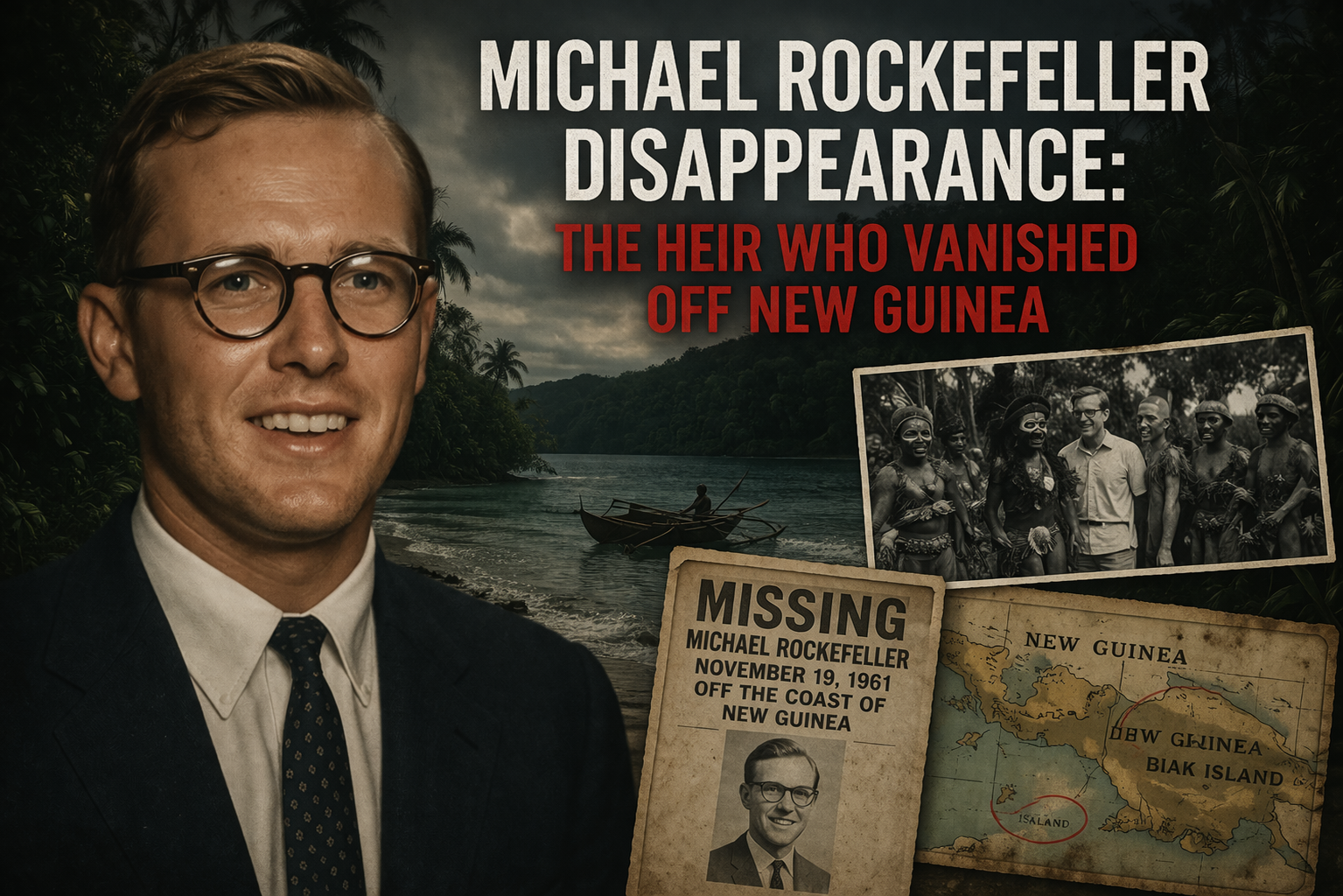
On November 19, 1961, Michael Rockefeller slipped into shark-filled waters off the coast of Dutch New Guinea and began swimming toward land. He was young, wealthy, educated, and confident he could survive the distance. Those were the last confirmed moments anyone ever saw him alive. What happened after that has become one of the most haunting disappearance mysteries in modern history.
For more than sixty years, investigators, journalists, and explorers have argued over the same terrifying question: did Michael Rockefeller drown before reaching shore, or did he survive the swim only to encounter something far worse waiting in the jungle beyond the beach?
Some believe the ocean claimed him.
Others believe he actually made it to land.
And the deeper people dig into the story, the harder it becomes to know which explanation is more disturbing.
Michael Rockefeller’s Final Timeline
- 1961: Michael Rockefeller travels to Dutch New Guinea to study and collect Asmat tribal art.
- November 18, 1961: His catamaran capsizes several miles off the southern coast.
- Two local guides swim for help: Michael and anthropologist René Wassing remain stranded on the overturned craft.
- November 19, 1961: Michael tells Wassing, “I think I can make it,” and begins swimming toward shore.
- That is the last confirmed sighting of him.
- Weeks later: Massive searches fail to recover a body or belongings.
- 1961: Michael Rockefeller is declared legally dead.
Michael Rockefeller was only twenty-three years old when he disappeared, but he already carried one of the most recognizable names in America.
He was the youngest son of Nelson Rockefeller, the future governor of New York and one of the most powerful men in the country. The Rockefeller family name was connected to unimaginable wealth, politics, oil, influence, and old American power. Michael could have spent his life inside that world comfortably.
Instead, he kept moving toward places that felt wild, distant, and difficult to explain.
People close to him described him as intelligent, curious, adventurous, and deeply fascinated by cultures most Americans knew almost nothing about. That curiosity eventually drew him halfway across the world to Dutch New Guinea, the western half of the island now known as Papua.
At the time, much of the region still felt almost unreachable to outsiders.
Dense jungle swallowed entire coastlines. Mangrove swamps stretched for miles. Rivers twisted through thick rainforest beneath crushing heat and violent storms. Some villages could only be reached by water. Crocodiles moved through the muddy shoreline. The ocean currents along the southern coast were notoriously dangerous.
And deep within that environment lived the Asmat people, whose artwork had already begun astonishing anthropologists and collectors around the world.
Michael became obsessed with their carvings.
Towering spirit poles. Ceremonial shields. Wood sculptures that seemed to carry grief, warfare, ancestry, and spirituality inside them. He believed the outside world had barely begun to understand what existed there.
That belief would eventually lead him directly into one of history’s most famous disappearances.
The Boat Capsized Miles From Shore
On November 18, 1961, Michael Rockefeller and Dutch anthropologist René Wassing were traveling along the southern coast near the Asmat region aboard a narrow wooden catamaran.
Two local teenage guides traveled with them.
The boat was overloaded with supplies and riding low in rough water. Waves kept slamming against the hull. Then the ocean finally won.
The catamaran capsized several miles offshore.
Suddenly the four men were stranded in open water, clinging to the overturned craft while currents slowly carried them farther along the coast.
At first, the situation probably still felt survivable.
The shoreline was visible.
That mattered psychologically. Land always feels closer than it really is when you can see it.
But hour after hour passed with no rescue.
The heat became brutal. Saltwater dried across their skin. The current kept dragging them through dangerous waters known for sharks and crocodiles.
Eventually the two teenage guides decided to attempt the swim to shore and search for help.
They disappeared into the water.
That left Michael Rockefeller and René Wassing alone on the overturned catamaran drifting in silence beneath the sun.
This disappearance remains one of the most debated missing-person mysteries ever recorded.
👉 See more disappearances that make no sense
“I Think I Can Make It”
The hours stretched into another day.
Still no rescue arrived.
The ocean current continued pulling the men farther away from where they originally capsized. Every hour meant more exhaustion, less energy, and a lower chance of survival.
At some point on November 19, Michael made a decision that would define the entire mystery forever.
He looked toward shore and reportedly said:
“I think I can make it.”
Then he tied two empty gasoline cans around his waist for flotation and slipped into the water.
He started swimming toward land.
That was the last confirmed sighting of Michael Rockefeller alive.
René Wassing remained behind with the overturned craft until rescue crews finally reached him the next day.
Michael was gone.
The Search That Found Nothing
Once news spread that a Rockefeller had disappeared off the coast of Dutch New Guinea, the search exploded into an international story.
Aircraft scanned the coastline.
Boats searched the water.
Dutch authorities organized massive operations through mangroves, river mouths, beaches, and villages across the Asmat region.
Nelson Rockefeller used every connection and resource available trying to find his son.
But despite the scale of the search, investigators found almost nothing.
No body.
No clothing.
No equipment.
No confirmed trace of Michael Rockefeller ever surfaced.
And that silence became the foundation of the mystery.
Because if Michael drowned in the ocean, the sea could easily have erased him forever.
But if he actually reached shore…
Then something else may have happened after the swim ended.
Why Some People Doubt the Official Drowning Theory
Officially, investigators concluded that Michael most likely drowned while attempting to swim the roughly twelve miles to shore.
It is a completely plausible explanation.
The waters were extremely dangerous.
Currents in the area were powerful enough to exhaust even strong swimmers. Sharks and crocodiles were common along the southern coast. A body lost there may never resurface.
But doubts started almost immediately.
Partly because Michael was athletic, determined, and using flotation devices.
Partly because local rumors began spreading soon after the disappearance.
And partly because of what was already happening along that coastline before Michael ever arrived.
The region was tense.
In the years before Michael disappeared, violent clashes had occurred between Dutch colonial patrols and Asmat communities. Men had been killed. Villages remembered those deaths. Resentment toward outsiders existed beneath the surface long before Michael entered the region.
That context matters because many of the later stories followed the same disturbing pattern.
According to multiple accounts collected over the years, Michael may have survived the swim and reached shore near villages connected to earlier violence with colonial authorities.
If that happened, some believe he unknowingly walked into a deadly situation.
The Rumors That Refused to Die
Over the decades, missionaries, journalists, researchers, and explorers all returned with similar whispers from the region.
Some claimed villagers privately admitted Michael reached land.
Others described stories that he was attacked shortly after emerging from the water.
One version says he was speared.
Another says he was beaten.
Some accounts grew even darker, claiming ritual cannibalism followed the killing.
Those stories became impossible to separate from the legend surrounding the case.
But they also created a major problem for investigators.
How much of it was true?
How much was rumor?
And how much reflected the way outsiders already imagined tribal cultures at the time?
That uncertainty is what keeps the case suspended between history and myth.
The drowning theory fits perfectly.
But so does the possibility that Michael survived the ocean only to encounter danger onshore.
And without physical evidence, neither explanation has ever completely defeated the other.
What Investigators Could Never Prove
The deeper researchers dug into the case, the stranger it became.
Some later witnesses claimed villagers described killing a white outsider around the same period Michael vanished.
Others insisted those stories changed repeatedly depending on who was asking questions.
There were claims that Dutch officials privately believed Michael reached shore but chose not to publicize unverified tribal accounts.
Some researchers believed fear prevented villagers from speaking openly.
Others believed outsiders simply heard what they expected to hear.
That is what makes the mystery so difficult.
Every theory feels possible.
Every explanation contains gaps.
And every version depends on fragments of testimony from one of the most isolated regions on Earth during the early 1960s.
In the end, investigators could never prove whether Michael Rockefeller died in the water… or beyond it.
🔎 Related Investigation:
If this case pulled you deeper into the mystery, continue into:
The Most Likely Explanation
Most historians still believe Michael Rockefeller probably drowned during the swim to shore.
Statistically, it is the strongest explanation.
The distance was enormous. The water conditions were brutal. Exhaustion alone could have killed him long before he reached land.
But the reason the alternative theory refuses to disappear is because the known facts never completely closed the door on it.
No body was recovered.
No belongings washed ashore.
No final evidence ever settled the case.
And when mysteries are left open long enough, people continue walking back through them searching for answers.
Why Michael Rockefeller’s Disappearance Still Haunts People
What makes this case unforgettable is not just the mystery itself.
It is the image of Michael Rockefeller alone in the water during those final moments.
A young man from one of the richest families in America drifting beside an overturned boat near an unfamiliar coastline thousands of miles from home.
No security.
No power.
No rescue.
Just ocean, jungle, exhaustion, and a distant strip of land that may or may not have offered survival.
Then those final words:
“I think I can make it.”
It sounds hopeful when you first hear it.
But the longer you think about it, the more it feels like the final sentence spoken by someone running out of options.
And somewhere between the open sea and the dark shoreline ahead of him, Michael Rockefeller disappeared into one of history’s most enduring mysteries.
🔎 Related Investigation:
🔎 Related Investigation:
🔎 If this story stayed with you, the author suggests these real cases next:
- She stepped onto a cruise ship deck and seemed to vanish with the sunrise
- The tourist who sprinted out of an airport and was never seen again
- A crash on a dark road led to one of America’s most haunting missing-person cases
Explore more Disappearances stories here: