When John White stepped back onto Roanoke Island in August 1590, he was not arriving at a frontier settlement. He was arriving at a silence.
Three years earlier, he had left behind more than one hundred colonists, including his pregnant daughter Eleanor Dare and the granddaughter he had not yet met. Now the shoreline was still. No voices. No cooking fires. No watchmen. Just the uneasy feeling that life had been here recently enough to leave marks, and long enough ago for those marks to feel almost staged.
The Roanoke Colony disappearance still matters because it sits at the crossroads of early American history and one of history’s most enduring vanishing cases. What happened to the Lost Colony of Roanoke remains unsolved not because there are no clues, but because the few clues that survived – a dismantled settlement, a missing distress cross, and one carved word – point toward several possible endings instead of one clear answer.
If the feeling of a person simply stepping out of history gets under your skin, the same chill lives in the Ettore Majorana disappearance, where another human life seems to slip away while leaving just enough behind to keep the argument alive.
The Return to an Empty Settlement
White had never meant to stay away so long. In 1587, the English governor sailed to Roanoke with settlers who were supposed to help establish a lasting English foothold in the New World. Men, women, and children crossed the Atlantic together, which tells you something important right away: this was not meant to be a temporary outpost. It was supposed to become a life.
But almost from the start, the colony was unstable. The settlers were left on Roanoke Island instead of the Chesapeake area they had hoped to reach. Supplies were limited. The environment was unfamiliar. Relations with nearby Indigenous groups were tense and fragile. The land itself was beautiful in the way dangerous places often are. Marshes shifted with the tide. Forests pressed in. Waterways that looked useful in daylight could become traps after dark.
Even so, the settlers tried to begin. Shelters went up. Food was counted and stretched. Every tool mattered. And in the middle of that uncertainty, Eleanor Dare gave birth to Virginia Dare, the first English child born in the Americas. For a brief moment, that birth must have felt like proof that the colony could root itself into the place.
But hope does not fill a storehouse.
Before long, the colonists were desperate enough to ask White to sail back to England for supplies. He did not want to go. His family was there. His daughter was there. His granddaughter was there. But there was also a hard reality: if he stayed, the colony might simply starve in place. So White left with a plan that must have sounded reasonable at the time. He would return quickly. If the settlers moved, they would carve their destination into wood. If they were forced away under danger, they would add a Maltese cross.
Then history intervened. England was pulled toward war with Spain. Shipping was disrupted. Vessels were seized. White struggled for passage while months turned into years. By the time he was finally able to return in 1590, the child he had left behind as an infant would have been old enough to speak.
That delay is one of the reasons Roanoke still feels so brutal. The mystery does not begin with a colony simply vanishing. It begins with a man trapped by war while his family waits on the far side of an ocean, then ends with that same man arriving too late to learn whether they had suffered, adapted, fled, or survived.
The Clue Carved Into Wood
When White and his men reached Roanoke Island, they did not find the kind of scene people expect from disaster. There were no bodies. No signs of a last stand. No smoking ruins. In some ways, that made the emptiness worse.
The settlement looked abandoned, but not in panic. Buildings appeared to have been taken down carefully rather than destroyed in one violent attack. That matters. It suggests planning, time, and intention. Then came the clue that turned Roanoke from a colonial failure into a permanent historical obsession.
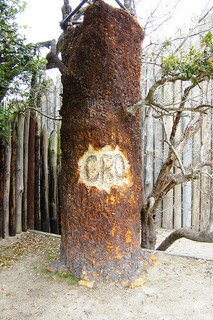
The word CROATOAN had been carved into a post. Elsewhere, the shorter CRO appeared on a tree.
That message seemed to fit the plan White had made with the settlers before leaving. Croatoan referred to a nearby island, now Hatteras Island, associated with an Indigenous community that had earlier been seen as relatively friendly to the English. If the colonists had been able to relocate by choice, Croatoan was one of the most logical destinations. And White noticed something else that mattered almost as much as the word itself: there was no Maltese cross. No distress mark. No obvious sign that the message had been carved under immediate attack.
For a moment, the mystery may have felt almost solvable. If the settlers had gone to Croatoan, White only needed to follow. But weather worsened, his crew resisted the risk, and he was forced away before he could investigate properly.
That is the moment Roanoke hardens into something almost unbearable. The colony did not vanish into perfect darkness. It left behind a direction. But the direction was never fully tested when it still might have led to answers.
The Timeline That Makes the Disappearance So Haunting
- 1584: English explorers first survey the Roanoke region and begin reporting on its strategic potential.
- 1585: An earlier English colony is established on Roanoke but fails and is eventually abandoned.
- 1587: John White leads a new group of more than 100 settlers to found a lasting colony; the settlers are left at Roanoke Island instead of the Chesapeake.
- August 1587: Virginia Dare is born, becoming the first English child born in the Americas.
- Late 1587: White returns to England to get supplies after the settlers plead for help.
- 1588-1590: War pressures, especially the conflict with Spain and the Armada crisis, delay White’s return far longer than intended.
- August 1590: White comes back to Roanoke and finds the settlement deserted, with CROATOAN carved into a post and CRO carved into a tree.
- After 1590: No verified recovery of the colonists ever occurs, and the Lost Colony enters history as an unresolved disappearance.
What Doesn’t Add Up
The case sounds simple when reduced to a single famous image: a missing colony and one carved word. But the closer you look, the more unstable that simplicity becomes.
- If the settlers relocated successfully, why did no clear follow-up record survive? A movement to Croatoan makes practical sense, but the documentary trail never cleanly closes behind it.
- If they were attacked, why does the site look dismantled rather than violently overrun? The absence of wreckage or obvious massacre evidence does not fit the most dramatic versions of the story.
- If they split into smaller groups, where are the traces? Archaeologists have found suggestive artifacts, but not a single discovery strong enough to settle the case.
- If the carved message was meant to help, why is it still so ambiguous? CROATOAN looks like a direction, but without White reaching the destination, it also became a dead end.
That is why Roanoke belongs emotionally alongside modern vanishings like the Brian Shaffer disappearance. The centuries are different, but the emotional structure is the same: a final known point, a set of plausible paths, and then a blank space large enough to swallow certainty.
The Most Likely Explanation
The strongest explanation is still the least theatrical one: the colonists probably did not disappear in a single night. They most likely moved, fragmented, and were absorbed, killed, scattered, or transformed over time.
The relocation theory remains persuasive for obvious reasons. The carved word points toward Croatoan. The missing distress cross suggests they were not trying to signal immediate catastrophe. The colony’s careful dismantling implies deliberate departure. And, most importantly, an isolated English settlement in a dangerous environment had every practical reason to seek support from people who actually knew how to survive there.
That does not mean the story ends neatly with peaceful assimilation. It may have begun as relocation and then become something harder. Some settlers could have joined allied Indigenous communities. Others may have died from disease or hunger before stabilizing. Some may have moved farther inland. Others may have been separated by weather, conflict, or failed decisions. In other words, Roanoke may not have had one ending. It may have had several smaller endings that history blurred together.
That possibility matters because it changes the emotional shape of the case. People imagine Roanoke as a magic trick – now you see them, now you do not. But the more realistic version is sadder. It suggests not a clean disappearance, but a long unraveling that nobody recorded well enough to preserve.
And that kind of uncertainty is what links Roanoke to mysteries like the Mary Celeste mystery and the Somerton Man code. In all three cases, the surviving clue is real. It is tangible. It feels as if it should solve everything. Instead, it keeps the door open just enough for history to stay unsettled.
Why the Lost Colony Still Gets Under People’s Skin
Roanoke lingers because it contains a very specific kind of fear: the fear that people can still be lost even after they have left instructions.
White did not return to ash. He returned to evidence of intention. That is what makes the case so unnerving. Somebody tried to leave an answer. Somebody expected to be followed. Somebody likely believed the message would be enough. And still, between storms, delay, distance, and the sheer fragility of records, that answer slipped away.
There is also the family wound at the center of the story. White was not a detached administrator returning to inspect a failed settlement. He was a father and grandfather returning to find out what happened to the people he loved. That personal dimension gives the mystery a pulse. You can almost feel him scanning the shoreline, looking for movement, telling himself the carved word means hope, not loss.
That emotional afterimage is part of why the story still fits naturally inside wider disappearance archives like The Unsolved Disappearances Archive. Roanoke is older than every modern case in that collection, but it hits the same nerve: the final trace should help, and somehow it only deepens the silence.
FAQ
What happened to the Roanoke Colony?
No one knows for certain. The most likely explanation is that the colonists relocated, probably toward Croatoan, and were then absorbed, scattered, or lost over time rather than wiped out in one single event.
Why is the Roanoke Colony called the Lost Colony?
It is called the Lost Colony because John White returned in 1590 to find the settlement abandoned and the colonists gone, with no confirmed record of what ultimately happened to them.
What did CROATOAN mean at Roanoke?
CROATOAN was the word carved into a post at the deserted settlement. It likely referred to Croatoan Island, now Hatteras Island, and may have been meant as a message showing where the colonists had gone.
Was there evidence the Roanoke colonists were attacked?
There is no clear proof of a sudden massacre at the settlement itself. White did not report obvious signs of rushed destruction, which is one reason historians often favor relocation over a single violent ending.
Why does the Roanoke mystery still matter?
It matters because it sits at the beginning of English America and because the evidence is just strong enough to suggest an answer without ever closing the case. It feels less like a legend than a real disappearance history never finished explaining.
Continue exploring:
- The beachside death that left behind a coded scrap and no certain identity
- The ghost ship that kept floating after everyone aboard was gone
- The college-night vanishing that seems to break reality at the exit
- A larger archive of vanishings that leave one clue and too many theories
More Disappearances stories: