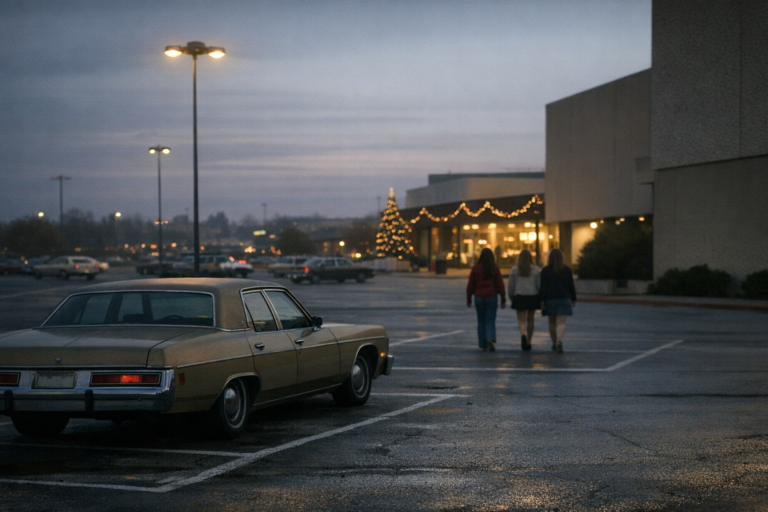

The scream came first.
Then the dead line. Then a young man dropping his phone, running out the door, and tearing through the quiet streets of Clinton, Missouri because he knew, with the kind of certainty most people only feel in nightmares, that something terrible had just happened.
For a moment, it looked like he might actually catch it. The truck. The man. The answer. He saw the pickup coming toward him, heard Angela Hammond yell his name, spun his car around, and chased the vehicle into the dark. But then his transmission gave out, and the taillights disappeared.
That is the detail that keeps this case alive in people’s heads. Angela Hammond did not simply vanish into a fog of uncertainty. Her unsolved disappearance feels almost solvable, like the truth was right there on the road for a few seconds and then slipped away.
Angela Hammond is at the center of one of Missouri’s most haunting missing person cases because her abduction happened in real time, with her fiancé listening on the other end of the call. The case still matters because the eyewitness account, the pickup-truck clues, and the later mistaken-identity theory all suggest this may not have been a random mystery at all.
In April 1991, Angela “Angie” Hammond was 20 years old, engaged, and four months pregnant. She was living in Clinton, a small town where people knew each other, where late-night drives and payphone calls did not feel like the beginning of a national cold case. That normal small-town setting is part of what makes her story hit so hard. Nothing about the place looked like the kind of stage where a woman could be taken and never seen again.
On the evening of April 4, Angela spent time with family, then dropped off her fiancé, Rob Shafer, who was babysitting his younger brother. Later that night, she called him from a payphone near the Food Barn store in the center of town. At first, the call sounded ordinary. She told him she was tired and planned to head home instead of meeting up again. Then she mentioned something unsettling.
A green pickup truck had been circling the area.
At first, it did not sound like a full-blown emergency. Small towns are full of odd little moments people brush off. A truck goes by twice. A stranger looks a little rough. Someone parks too close. It is the kind of thing you notice, mention out loud, and then try to laugh away. That seems to be how Angela and Rob treated it at the start. The driver looked dirty, she said. Bearded. Wearing glasses and overalls. At one point he got out with a flashlight, as if he were looking for something.
But the mood of the call changed when the truck pulled in beside the payphones and lingered.
Rob later said Angela asked the man whether he needed to use the phone. He reportedly said he would try again in a minute. That detail has always been chilling because it feels like the last thin layer of normal behavior before the entire scene broke open. If he was acting, he was acting well enough to keep Angela from panicking right away. If he had already chosen her, then the performance may have been part of the approach.
Not long after that, Rob heard Angela scream.
Cases built around a final phone call almost always stay with readers because the timeline feels painfully intimate. That is one reason this story still belongs beside the Brandon Swanson disappearance, where one last live conversation left just enough detail to make the silence afterward feel even worse. In both cases, someone close to the victim was left listening, helpless, while the final known moments slipped out of reach.
Rob ran out of the house, got into his car, and drove toward the payphone. He was only blocks away. On the way, he saw an older green pickup heading in the opposite direction. Someone inside yelled, “Rob!” It was Angela. He turned around and chased the truck, but his transmission had been damaged during the fast reversal. After about a mile or two, his car failed, and the pickup vanished into the night.
That failed chase is one of the reasons the Angela Hammond case never feels distant. Most unsolved disappearances contain a gap so large that the imagination fills it. This one contains motion, sound, and direction. There was a truck. There was a voice. There was pursuit. The case feels less like a disappearance swallowed by time and more like an answer that was almost physically touched.
Timeline of Events
- Evening of April 4, 1991: Angela Hammond spends time with family and later drops off her fiancé, Rob Shafer.
- Around 11:15 to 11:45 p.m.: Angela calls Rob from a payphone in Clinton, Missouri, and mentions an older green pickup truck circling the area.
- During the call: The truck parks near the booth. Angela describes the driver as dirty-looking, bearded, wearing glasses and overalls, and carrying a flashlight.
- Moments later: Rob hears Angela scream. The line goes dead.
- Immediately after: Rob races toward the payphone, passes a green truck, hears Angela cry out from inside, turns around, and gives chase.
- Within the chase: Rob’s transmission fails, and the truck escapes.
- Afterward: Angela’s car is found abandoned at the payphone location, but Angela is never found.
- Years later: Investigators publicly discuss a mistaken-identity theory involving another young woman named Angela who may have been the original target of a threat.
This case has never faded because it carries both cinematic immediacy and long-term uncertainty. It is not just that Angela disappeared. It is that so many pieces of the event were visible, specific, and memorable, yet still failed to produce a resolution.
The truck itself became the center of the hunt. Witnesses described an older model green Ford pickup, possibly from the late 1960s or early 1970s, with a decal or mural covering the back window—often described as an outdoor scene or a fish jumping out of water. Authorities reportedly checked an enormous number of registered trucks looking for a match. None led to a clean answer.
That alone would be enough to keep the case open in the public imagination. But the mystery grows darker when you look at what else was happening in Missouri around that time. Other cases involving women disappeared into the conversation, including Cheryl Ann Kenney and Trudy Darby. Investigators considered whether a wider pattern might exist. Was Angela taken by the same kind of offender? Was the truck linked to more than one crime? Those questions added gravity, but not certainty.
Then the case took a turn that changed how people looked at the entire abduction.
Decades later, investigators discussed a theory that Angela Hammond may have been abducted by mistake.
According to that line of inquiry, another family in Clinton had received a threatening note involving their daughter, who was also named Angela. The theory suggests that someone may have intended to take that other Angela and instead seized Angela Hammond because the names and appearances were close enough to create a tragic confusion. If that theory is true, the abduction was not random at all. It was targeted—but targeted at the wrong person.
That possibility is what keeps the case feeling modern even now. Old disappearances often survive online because they contain one unforgettable image. In Angela’s case, there are several: the payphone, the flashlight, the truck mural, the shouted name from the passenger side, the dead transmission. But the mistaken-identity angle gives all of those details a new shape. It turns the case from a terrifying opportunistic abduction into something colder and more deliberate.
🔎 Related Investigation:
If this case pulled you deeper into the mystery, continue into:
🔎 Related Investigation:
If this case pulled you deeper into the mystery, continue into:
🔎 Related Investigation:
If this case pulled you deeper into the mystery, continue into:
What Doesn’t Add Up
- The truck was memorable: An older green pickup with a window-spanning mural is not a generic vehicle, yet it still was never conclusively identified.
- The abduction was heard and then partially seen: Rob heard the scream, then saw the truck and heard Angela’s voice. That is more than many cold cases ever have.
- The target may not have been Angela Hammond: If the mistaken-identity theory is correct, investigators are dealing with a planned crime whose intended victim survived without ever knowing she was the target.
- The case feels both random and specific: The attack happened in a public place, but the behavior of the suspect suggests intention and patience, not simple impulse.
- Several theories compete without fully closing the loop: Serial offender, local predator, mistaken identity, or some overlap with other Missouri crimes all remain part of the discussion.
The problem with the mistaken-identity theory is not that it sounds impossible. In some ways, it sounds chillingly plausible. The problem is that it arrives in a case already crowded with haunting facts. People can picture the original abduction clearly enough without adding another layer. Once that second layer enters, the case becomes even harder to settle in the mind.
If Angela was the intended victim, then the truck circling the block starts to look like surveillance. The flashlight starts to look like stalling behavior or a confidence move. The approach to the payphone starts to look rehearsed. But if she was not the intended victim, then the entire crime becomes even more horrifying, because it means a young woman may have been taken for reasons that had nothing to do with her own life at all.
And in both versions of the story, the same brutal fact remains: she was there one minute, speaking to someone who loved her, and gone the next.
Why This Case Still Gets Attention
Angela Hammond’s disappearance still draws readers, podcast hosts, and investigators back for a few specific reasons.
- It contains one of the most dramatic last-contact sequences in any missing person case.
- The suspect vehicle was distinctive enough that people feel it should have been solved.
- The pregnancy adds emotional weight without becoming the whole story.
- The mistaken-identity angle gives the case a second mystery rather than a neat explanation.
- The setting—a lit payphone in a familiar town center—makes the danger feel uncomfortably close to ordinary life.
That last point matters more than it may seem. Some cases stay famous because they happened in remote woods, on highways, or in giant cities where anonymity makes sense. Angela Hammond vanished in a place that should have felt visible. She was not hiking alone in the backcountry. She was not on an overseas trip. She was on the phone in town. That makes the abduction feel like a rupture in normal life rather than a descent into obvious risk.
People are not just looking for the basic facts. They are trying to understand what most likely happened. Did the suspect know the area? Was the truck local? Did investigators come within inches of identifying the right person? Was the abduction linked to another Missouri case? Or was the real key hidden all along inside the mistaken-identity theory?
No one can answer those questions with certainty yet. But the strongest through-line in the case is this: Angela’s disappearance does not feel like a mystery built from absence. It feels like a mystery built from almosts.
Almost enough description. Almost enough eyewitness evidence. Almost enough pursuit. Almost enough pattern. Almost enough theory.
And that may be the cruelest part.
Because when a case has no shape at all, people eventually accept that it may never be solved. But when a case feels this close—when the suspect’s truck seems just one tip away from recognition, when the final moments seem so vivid you can practically hear them—hope never really dies. It just becomes heavier with time.
That is why Angela Hammond’s story still stays with people long after they have forgotten the date or the exact street names. They remember the scream into the receiver. They remember Rob’s car failing in the chase. And they remember the possibility that the whole thing may have started with a name, a wrong assumption, and a young woman who was never meant to be in that truck at all.
More than three decades later, the case still asks the same awful question.
Not only who took Angela Hammond.
But whether the truth has been hiding for years inside one small-town mistake that no one could take back.
🔎 Related Investigation:
🔎 Related Investigation:
🔎 If this story stayed with you, the author suggests these real cases next:
- The morning disappearance that left behind a timeline investigators still can’t shake
- The broad-daylight vanishing that turned one missing woman into a lasting mystery
- The photo-driven cold case where one image kept hope alive for years
Explore more Disappearances stories here: