By the time the first students were driving through the rain toward Creekside Church of Christ, the building had already been awake for nearly an hour.
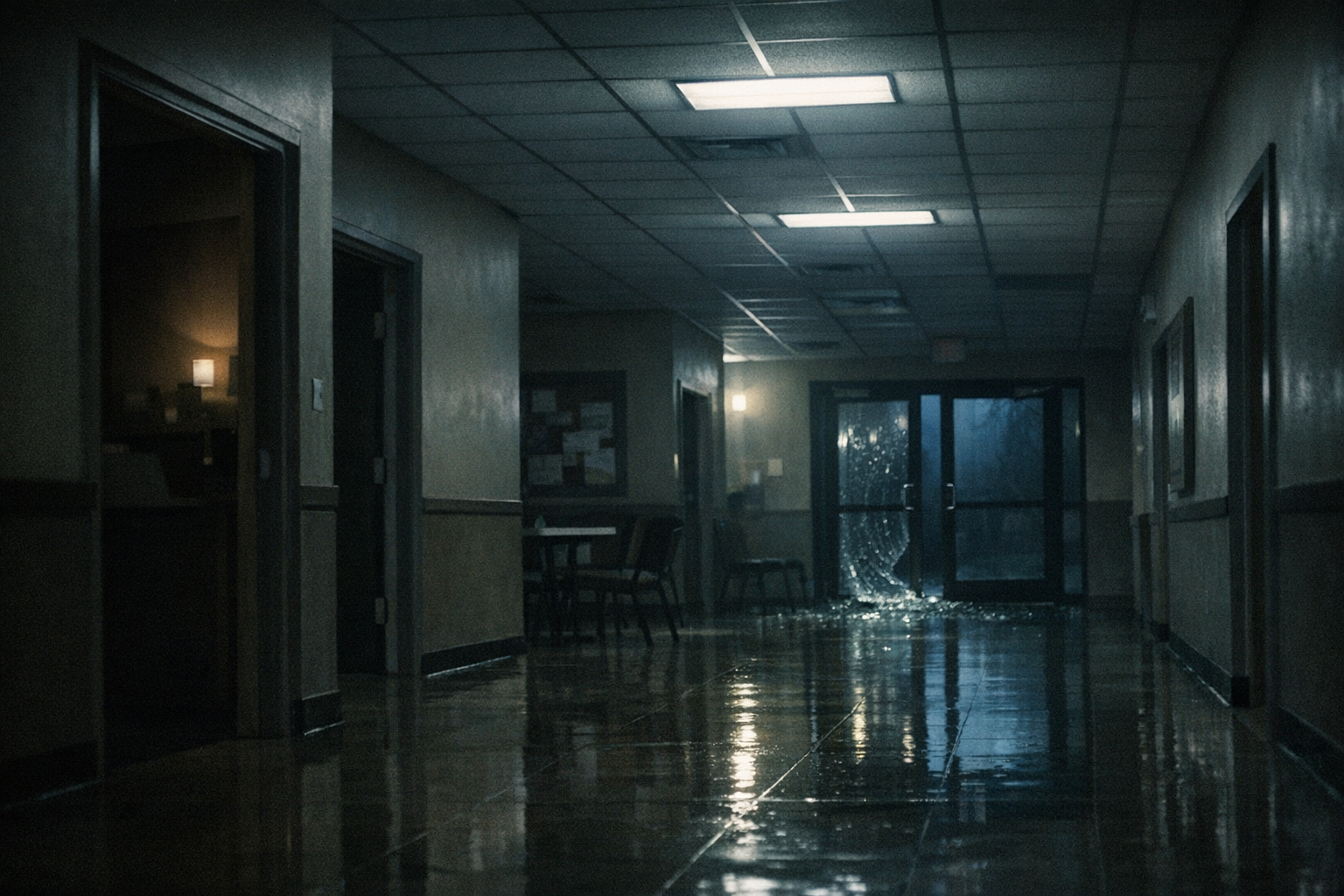
Not with music or conversation. Not with folding mats laid out for an early-morning workout. But with the slow, wandering movement of someone dressed in black tactical gear, moving through empty church hallways as if they had nowhere else to be.
They opened doors. They damaged windows. They drifted from corridor to corridor with an unsettling calm. Then, sometime before 5 a.m., Terri “Missy” Bevers walked into that same building and never walked back out.
Missy Bevers is at the center of one of Texas’s most haunting unsolved murders — a case wrapped in surveillance footage that millions of people have studied frame by frame for years. More than a decade later, the mystery still grips people because the killer appears to be right there on camera, yet the most important question — who that person actually was — remains unanswered.
That tension is what keeps the case alive. The evidence feels like it should be enough. But somehow, it never quite gets there.
It belongs in the same eerie category as these disappearances caught on camera, where footage deepens the mystery instead of solving it.
Missy was 45 years old, a wife, a mother of three, and a Camp Gladiator fitness instructor known for leading workout classes before sunrise. On the night of April 17, 2016, storms were moving through North Texas. Because of the rain, she told her class they would meet inside the church instead of outside in the parking lot.
It was a small change. Ordinary. Practical.
But it also meant she would arrive alone inside a dark building where, investigators believe, a killer may already have been waiting.
That’s where the case stops feeling like a normal homicide and starts feeling like something far stranger.
The surveillance footage released by police is what pulled the country into the story. It does not show someone panicking or rushing through a break-in. It shows patience.
The person in the video moves slowly through the church wearing a helmet, gloves, heavy vest, and police-style tactical clothing. They carry tools. At times, they appear to use a pry bar or hammer to damage doors and windows. They move with a strange confidence, as if they are comfortable inside the building.
That is the first thing that never sat right with investigators or the public.
If this was a burglary, it was an unusually calm one. There was no clear rush to steal valuables. No frantic smash-and-grab behavior. And when Missy was later found dead, reports indicated her belongings had not been taken.
Over time, the burglary explanation began to feel less like a motive and more like a disguise the crime was hiding behind.
Investigators have suggested the tactical outfit may have been intentional misdirection — a way to make the scene appear like something it wasn’t. That possibility changes the entire tone of the footage. If the gear was not just concealment but performance, then every movement inside that church starts to feel deliberate.
Every broken window begins to look staged.
And every second in that hallway starts to feel less random and more like a countdown.
Timeline of the Missy Bevers Case
- Night of April 17, 2016: Missy tells her Camp Gladiator class that severe weather will move the workout indoors at Creekside Church of Christ in Midlothian, Texas.
- Around 2:00 a.m.: A vehicle later highlighted by police is seen in a nearby SWFA Outdoors parking lot. Investigators later ask for help identifying the driver, though they never publicly confirm the person as the killer.
- About 3:50–4:00 a.m.: Church surveillance captures an unknown person in police-style tactical gear wandering through the building and damaging property.
- About 4:18 a.m.: Missy arrives at the church to prepare for the 5:00 a.m. fitness class.
- Shortly after 5:00 a.m.: One of her class participants arrives and discovers Missy inside the church.
- Morning of April 18, 2016: Police begin investigating what quickly becomes one of Texas’s most discussed unsolved murder cases.
- Years later: The case remains active, with Midlothian police, the Texas Rangers, and other agencies continuing to review tips and forensic evidence.
The timeline matters because it strips the case down to its most disturbing reality.
The killer was already inside the building before Missy arrived.
This was not a sudden confrontation in a parking lot or a random encounter on the street. Someone was inside that church, moving through the hallways, waiting while the rain fell outside.
That alone makes the crime feel targeted.
Maybe not in the dramatic movie sense of revenge or obsession. But targeted in the colder sense: someone knew enough about Missy’s schedule, the building, or both to be there before dawn.
Over the years, there were also reports that investigators examined unusual communications in Missy’s life, including messages described publicly as “creepy and strange.” Nothing released publicly has tied those reports to an arrest or formal accusation, and that distinction matters.
This case has generated endless speculation online.
Speculation is easy.
Proof is the hard part.
And that is exactly where the frustration begins.
Because the most famous part of the Missy Bevers case is also the least satisfying: the footage feels like evidence that should solve everything, but somehow never does.
People obsess over the walk.
The slight outward swing of the right leg. The slow stride. The loose, heavy movement. For years, viewers have tried turning that gait into an identity. Some people believe the figure is male. Others insist it is female. Some think the person was injured. Others argue the tactical gear simply altered the movement.
Investigators have repeatedly warned people against becoming too confident about those conclusions, and they are probably right to do so.
A grainy surveillance video is not the same thing as a fingerprint.
Still, the gait matters — not because it definitively identifies the killer, but because it created one of the most haunting visual signatures in modern true crime.
The person in that footage does not simply look disguised.
They look blurred on purpose.
🔎 Related Investigation:
If this case pulled you deeper into the mystery, continue into:
🔎 Related Investigation:
If this case pulled you deeper into the mystery, continue into:
What Doesn’t Add Up in the Missy Bevers Murder
- The suspect’s behavior inside the church: The person appears to wander rather than steal.
- The tactical outfit: Was it meant purely to hide identity, or to create authority and hesitation if someone encountered them?
- The timing: The suspect was already inside before Missy arrived, strongly suggesting planning.
- The lack of a public breakthrough: In a case involving surveillance footage and years of analysis, why has no decisive identification emerged?
- The nearby vehicle: Police publicly asked for help identifying it, yet the public still does not know how central it truly is to the case.
- The illusion of certainty: Millions feel like they have “seen” the killer, but visibility may have complicated the investigation more than it helped.
The deeper people go into this case, the more the footage seems to work against clarity.
Video can create a dangerous kind of confidence. People believe if they stare at it long enough, they will decode the posture, the movement, the body shape, the stride — and eventually pull a name out of motion.
But footage can trap you.
It can make you feel close to the answer while you are actually still very far away.
That may be the unique horror of the Missy Bevers case.
In many unsolved murders, the missing piece is hidden completely. Here, the missing piece appears to be walking openly down a hallway beneath fluorescent lights.
And somehow, the more the world watches, the less solid that figure becomes.
There is also the setting itself.
A church before dawn already carries an eerie atmosphere: long hallways, echoing rooms, storm weather, and complete silence. The suspect in the footage does not run through that silence.
They drift through it.
And then Missy arrives.
That moment transforms the video from unsettling into devastating.
She showed up early for work. That was all. She was preparing equipment for a fitness class — doing the kind of ordinary tasks people never imagine could place them directly in the path of a killer.
Investigators have released very little publicly about the exact confrontation, and that silence is understandable. But it leaves one terrible possibility hanging over the case:
Did Missy immediately realize this person did not belong there?
Or did the police-style gear buy the killer a few critical seconds of trust or hesitation?
That possibility may be one of the most chilling parts of the entire story.
It would also explain why the disguise mattered so much. The tactical outfit may not have been just concealment.
It may have been strategy.
And still, even with years of public attention, the case refuses to settle into a clean answer.
Missy’s husband was publicly confirmed to be out of state at the time of the murder. Her father-in-law also became the subject of public speculation after reports involving a bloodied shirt, but investigators later stated testing supported an innocent explanation involving dog blood rather than human blood.
Over time, names, theories, and rumors have repeatedly surfaced online.
None have solved the case.
That is why the clearest way to view the Missy Bevers murder is through the narrow set of facts investigators can actually prove:
Someone was inside that church before dawn.
That person was captured on surveillance video.
Missy arrived while they were still there.
She was killed.
And no arrest has yet closed the distance between that footage and a courtroom.
Why the Missy Bevers Case Still Fascinates People
The Missy Bevers murder continues to resurface because it sits at the crossroads of two irresistible things: visible evidence and unanswered meaning.
The footage is unforgettable, but it never delivers the payoff people expect. Instead, it traps viewers in a loop:
Watch the video.
Focus on the walk.
Notice the doors.
Think you see something important.
Realize you still cannot prove it.
Start over.
That loop is exactly why the case remains evergreen across documentaries, Reddit threads, YouTube breakdowns, and true crime discussions years later.
It also fits alongside cases like Jennifer Kesse’s disappearance and Brian Shaffer’s vanishing, where surveillance footage feels painfully close to the answer while never fully reaching it.
But Missy Bevers may be the purest example of that frustration.
In the Jennifer Kesse case, the key figure is partly obscured by a fence. In the Brian Shaffer case, the mystery revolves around whether he somehow escaped camera coverage entirely.
In Missy’s case, the figure is fully visible.
The world can watch them move for minutes at a time.
And somehow, they still remain unidentified.
That is what makes the case linger in people’s minds.
Not just the murder.
Not just the disguise.
But the feeling that the killer left behind a moving portrait instead of an identity.
More than ten years later, investigators continue to describe the case as active. Tips are still reviewed. Evidence is still examined. State and federal agencies have remained involved.
That matters.
Because this is not just an internet mystery people obsess over online.
It is still an open homicide investigation.
And maybe that is the clearest way to understand why the story remains so haunting.
Missy Bevers did not become part of a mystery because there was no evidence.
She became part of one because the evidence the world received was bizarrely incomplete — too visible to ignore, yet still too limited to solve the crime.
The church footage transformed her murder into something modern and deeply unsettling:
A case people feel they have almost solved for years, without ever truly solving it.
🔎 Related Investigation:
🔎 If this story stayed with you, the author suggests these real cases next:
- Cases where haunting footage only made the mystery worse
- The disappearance caught on camera that still torments investigators
- The man who entered a crowded nightlife district and seemingly vanished without a trace
Explore more True Crime stories here: