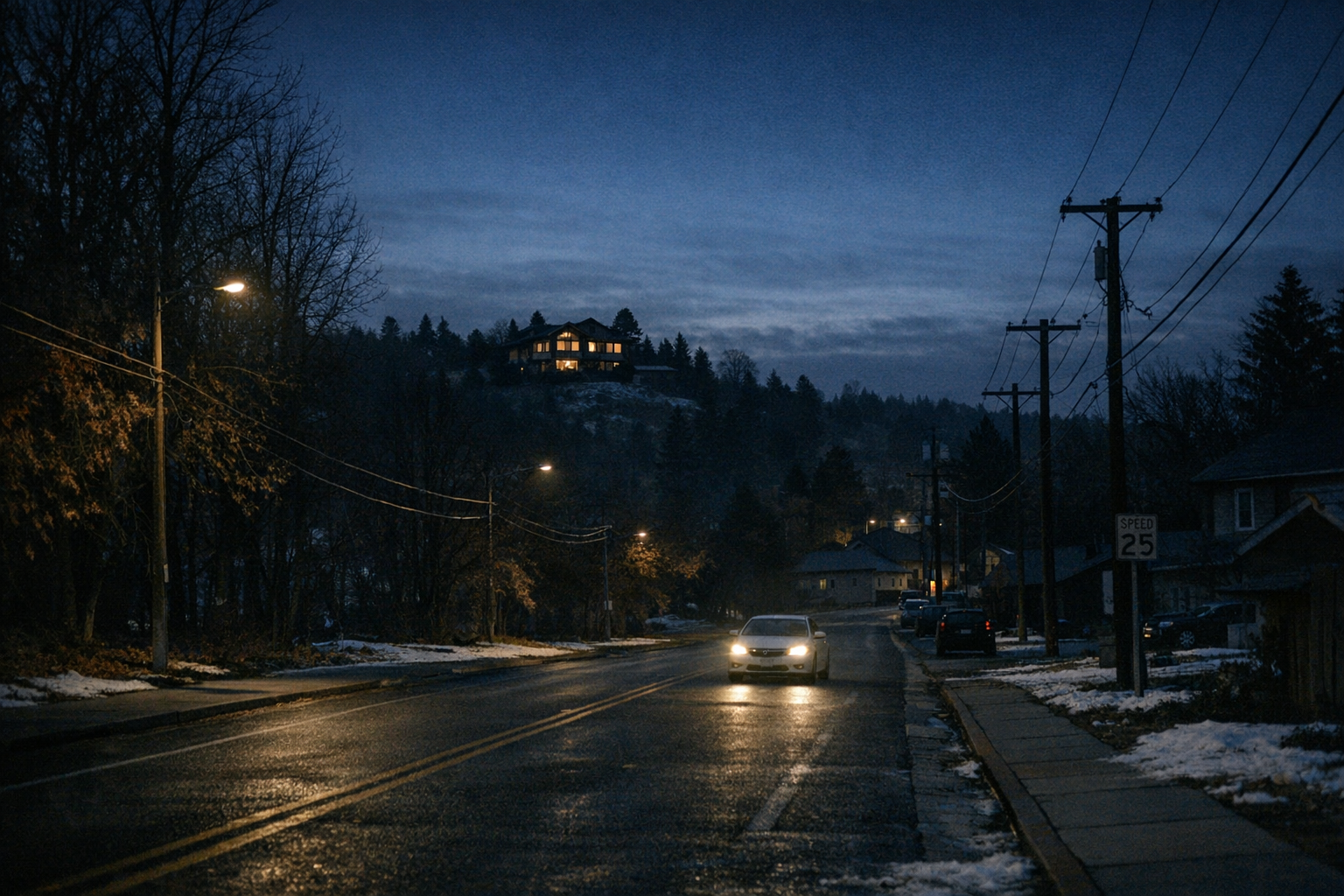
At about 4:04 a.m. on November 13, 2022, investigators’ reconstruction placed a white sedan back in the King Road neighborhood in Moscow, Idaho. Four students were killed inside a rental house that morning. Two roommates survived.
Bryan Kohberger is permanently tied to a widely reported modern true crime case: the 2022 University of Idaho murders. While this was not an unsolved disappearance, the case matters because it became a national obsession built on movement data, phone records, surveillance footage, and the terrifying question of how four students could be attacked in a crowded college area in such a short window.
The Bryan Kohberger timeline still matters because the story never lived only in the courtroom. It lived in the timestamps. It lived in the route. And it lived in the feeling that one ordinary Saturday night in Moscow, Idaho, somehow broke into two different worlds before sunrise: the one before the murders, and the one after.
That obsession with minute-by-minute reconstruction is part of why readers who follow timeline-driven cases also tend to stay with stories like the site’s breakdown of the Rex Heuermann timeline, where the route itself became a kind of evidence trail.
On the surface, the night looked normal. Madison Mogen and Kaylee Goncalves had visited downtown Moscow and the Grub Truck before returning home around 2 a.m. Xana Kernodle and Ethan Chapin had been at a fraternity party and were back at the King Road house around 1:45. By around 2 a.m., everyone who mattered in this story was either home or almost home.
That is what makes this case hit so hard. There was no dramatic warning. No broken pattern anyone could see from across the room. Just college kids ending a Saturday night the way thousands of college kids do, unaware that in a few hours their names would be repeated on every major news network in America.
But outside that routine, another pattern was taking shape. Investigators later focused on a digital and movement timeline that suggested the killer’s path was not random. Surveillance cameras, cell phone records, and vehicle sightings would become the spine of the entire case. And at the center of that map was Bryan Kohberger, a criminology PhD student living in Pullman, Washington, only a short drive away.
Timeline of Events
- 1:45 a.m. — Xana Kernodle and Ethan Chapin arrive back at the King Road house.
- About 1:56 a.m. — A driver reported giving Madison Mogen and Kaylee Goncalves a ride from downtown Moscow to the house.
- 2:26–2:52 a.m. — Several unanswered calls are made from Kaylee and Madison’s phones.
- Around 4:00 a.m. — Xana receives a DoorDash order.
- 4:04 a.m. — A white Hyundai Elantra is seen returning to the area after multiple earlier passes.
- 4:12 a.m. — Xana is believed to be awake and using TikTok on her phone.
- About 4:17 a.m. — Nearby security audio reportedly captures whimpering, a loud thud, and a dog barking.
- 4:20 a.m. — The white sedan is seen leaving the neighborhood at speed.
- 11:58 a.m. — A 911 call requests aid for an unconscious person.
- December 30, 2022 — Bryan Kohberger is arrested in Pennsylvania.
- July 2025 — Kohberger pleads guilty; on July 23, he receives four consecutive life sentences without parole and ten years for burglary.
The reason the Bryan Kohberger timeline still dominates public attention is that it feels almost mechanical. Not emotionless, because the horror is obvious. Mechanical because so much of the case was reconstructed through systems that do not sleep and do not forget: phone pings, camera views, traffic patterns, timestamps.
According to public reporting, investigators believed a white Hyundai Elantra had made repeated passes near the house before the attack. Those sightings helped investigators reconstruct the route; the footage alone does not establish what the driver was thinking. The car was reportedly seen again around 4:04 a.m. and then leaving the area roughly sixteen minutes later. In a case where the killing window was brutally short, those minutes became everything.
Inside the house, the sequence was chaotic and incomplete. One surviving roommate later described hearing noises she first dismissed, then hearing someone say words to the effect of “there’s someone here.” Later she reported hearing crying and a male voice saying, “It’s okay, I’m going to help you.” When she opened her door again, she said she saw a masked man dressed in black walking past her toward the sliding glass door.
That moment became one of the case’s most haunting details. Not because it answered the mystery, but because it showed how close horror can come to being seen clearly and still leave behind gaps. The case was always about more than who. It was about how this could happen so fast, so quietly, and in a house with people still inside.
Follow the difference between an ordinary college night and the narrow strip of minutes where everything changed. People are not only looking up Bryan Kohberger as a person. They are trying to reconstruct the night itself.
🔎 Related Investigation:
If this case pulled you deeper into the mystery, continue into:
🔎 Related Investigation:
If this case pulled you deeper into the mystery, continue into:
What Doesn’t Add Up — and Why People Still Fixate on It
- The narrow window: Four victims were attacked in a period investigators placed roughly between 4:00 and 4:25 a.m.
- The repeated vehicle passes: Investigators treated the sightings as part of the movement timeline, rather than a direct record of motive.
- The surviving roommates: Public fascination exploded around what was heard, what was seen, and why emergency help came later in the morning.
- The digital trail: Phone records and movement data turned the case into a timeline-first investigation instead of one built mainly on confession or eyewitness certainty.
- The motive question: Even after a guilty plea, the case still feels emotionally unfinished because motive never became as clear as the route.
That last point matters more than people admit. In many major murder cases, the public can eventually settle into a story: jealousy, money, rage, revenge. Here, the route became clearer than the reason. People could follow the road, the timestamps, and the evidence trail. But they were still left staring at the same dark gap in the middle of the case: why this house, why these victims, and why that night?
That is where the unresolved motive remains significant. Interest in Bryan Kohberger never depended only on courtroom dates. It survived because searchers kept returning to the same suspect-centered puzzle. They wanted the movement map. They wanted the digital trail. They wanted to understand how an ordinary night turned into a nationally reported murder case.
As investigators built the case, the digital evidence appears to have done what human memory could not. Surveillance footage reportedly traced a white Elantra through repeated passes and a fast departure. Cell phone data helped narrow patterns of travel. A knife sheath recovered at the scene became another major pillar of the prosecution’s case. Each piece did not just add evidence. It reduced the amount of empty space around the suspect.
It is not just a recap of a notorious case. It is a modern evidence story, one where the invisible record left by devices and roads mattered almost as much as anything spoken out loud.
Key Evidence and Clues
- White Hyundai Elantra sightings: The vehicle became one of the earliest public clues and later one of the most important pieces of the movement timeline.
- Cell phone records: The prosecution’s theory relied heavily on location and travel data to place Bryan Kohberger’s movements under a microscope.
- Inside-house witness account: Dylan Mortensen’s statement gave investigators a frightening but crucial glimpse into the killer’s exit.
- Knife sheath evidence: Public reporting identified the sheath found near the victims as a major evidentiary turning point.
- The compressed timeline: The fact that the attacks happened so quickly shaped every later theory about planning, entry, and escape.
If you step back, the most disturbing thing about the case is how ordinary the edges of it look. A food truck stop. A ride home. Unanswered calls. A delivery. A college rental house settling down for the night. Then, almost without warning, the story narrows into a corridor of movement and sound: a car looping the neighborhood, a roommate hearing something strange, a voice in the dark, and a vehicle leaving again before the sun comes up.
That structure gives the case its cinematic weight. There is a before, a passage through darkness, and an after that feels impossible to fully absorb. But unlike older mystery cases, this one was reconstructed not just through people remembering, but through systems logging. Roads became witnesses. Cameras became witnesses. Phones became witnesses. Even silence became evidence once investigators started measuring where communication stopped and movement started.
Even after Kohberger’s guilty plea in 2025, the case did not lose its grip. In some ways, it became even stranger in the public mind. Once a defendant pleads guilty, people expect emotional closure. But this case resisted that. The guilty plea answered the legal question. It did not answer the human one.
That is why the case still feels haunting instead of merely resolved. The timeline is precise in places and blurry in others. The digital trail is compelling, but it does not soften what happened in that house. The road into Moscow can be traced. The motive remains harder to pin down.
And maybe that is the real reason people keep searching bryankohbergertimelineexplained. They are not only looking for dates and times. They are trying to force a terrible event into a shape that makes emotional sense. Most of the time, it still doesn’t.
In the end, the Idaho student murders became one of the decade’s defining true crime stories because it fused two kinds of fear. The old fear was physical: a dark house, sleeping victims, a masked intruder, a college town that woke up changed forever. The new fear was digital: the idea that every movement leaves a trail, and that one night can later be rebuilt frame by frame from data you never knew existed.
That combination is what keeps the case alive in search, in conversation, and in memory. Not just the violence. The reconstruction. The route. The timestamps. The almost unbearable knowledge that somewhere between 4:04 and 4:20 a.m., an ordinary road became the path into one of the most haunting crimes in modern American true crime.
🔎 Related Investigation:
Research Sources
The following resources were consulted to verify and update this article.
- Moscow Police Department — Moscow Homicide Update — December 3, 2022
Records the early timeline and the 11:58 a.m. emergency call. - Moscow Police Department / court affidavit, hosted on Scribd — Exhibit A: Statement of Brett Payne
Provides the sworn reconstruction of vehicle sightings, phone activity and roommate statements. - Idaho Office of Attorney General — Attorney General Labrador Commends Life Sentences for Bryan Kohberger
Confirms four consecutive fixed life sentences on July 23, 2025. - Associated Press / MPR News — Kohberger sentenced to life for University of Idaho killings
Reports the plea, sentence and the continuing absence of an established motive.
🔎 If this story stayed with you, the author suggests these real cases next:
- Karen Read’s prosecution, retrial and verdict
- How the Rex Heuermann timeline turned an ordinary life into a murder-case map
- What happened during Gabby Petito’s final days on the road
Explore more True Crime stories here: