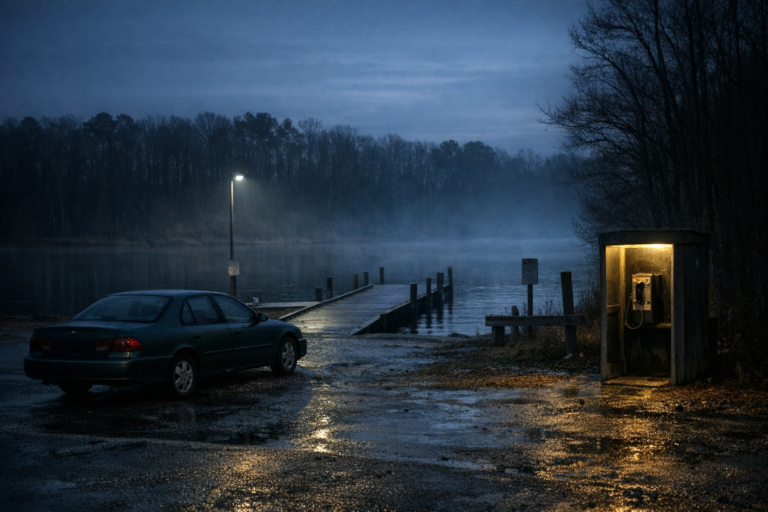
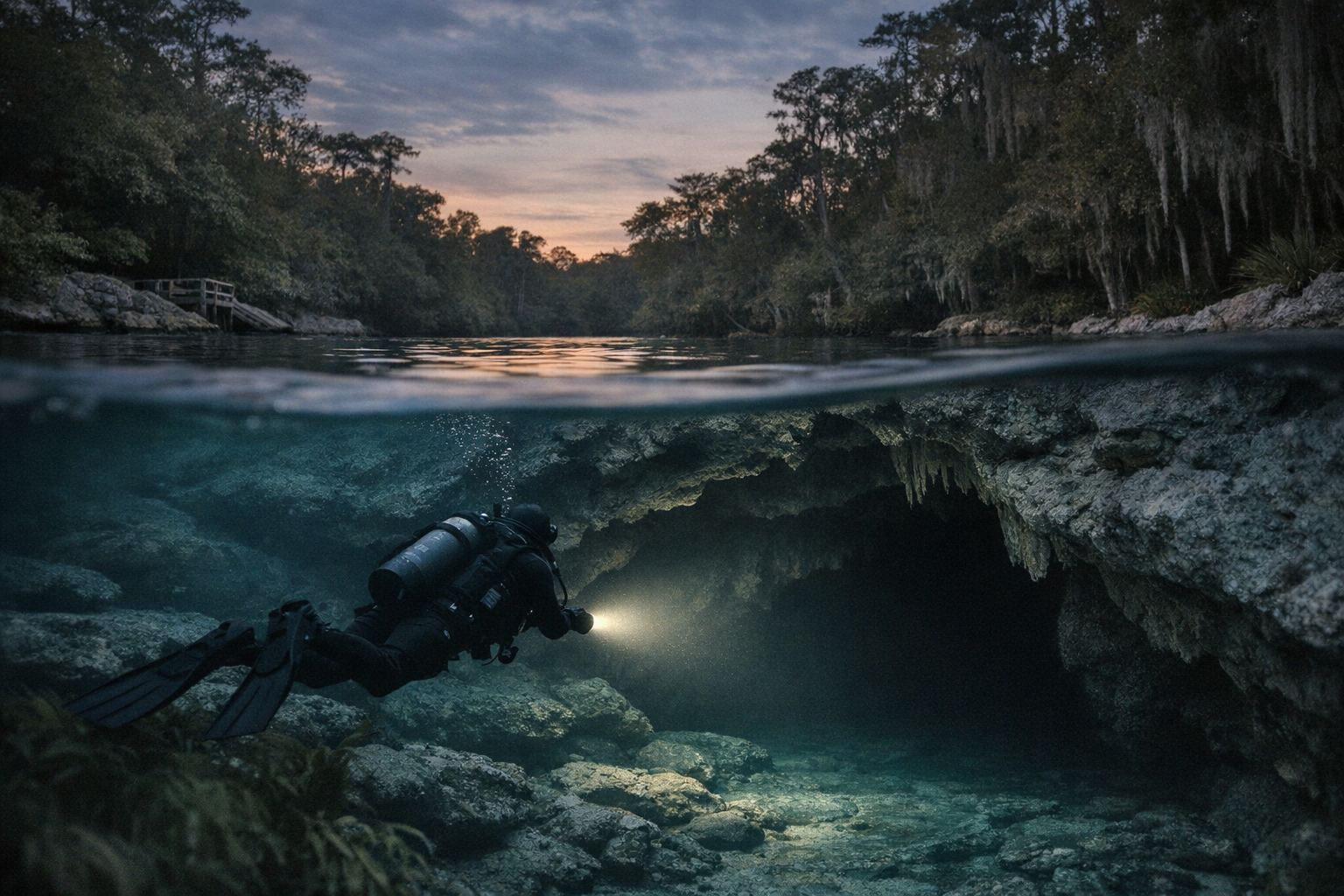
The water at Vortex Spring looked calm enough to trust.
The Florida diving site had open recreational water and a restricted cave beyond it.
But deep below that calm water, the cave narrowed into darkness, tight stone restrictions, and silence.
That was where Ben McDaniel was reported last seen.
On August 18, 2010, 30-year-old Ben McDaniel was last reported seen diving at Vortex Spring in Florida. Accounts place him near the restricted underwater cave.
Then he was never seen again.
No confirmed body was ever recovered.
And more than a decade later, people still argue over the same terrifying question:
How does someone vanish inside a place that should have trapped the answer?
Ben McDaniel’s disappearance remains one of the strangest unsolved diving mysteries in America because the environment itself seems impossible.
The cave had known entry points.
Known hazards.
Known witnesses.
It was not the open ocean where currents could carry someone for miles. It was a confined underwater system where divers expected evidence to stay behind.
Yet after years of searches, debates, and theories, investigators still cannot fully explain what happened inside Vortex Spring that night.
Cases like the Leah Roberts disappearance continue haunting people because they leave behind scenes that feel almost complete — except for the one missing piece that matters most.
The ending.
Ben McDaniel Was Trying to Rebuild His Life
Before the disappearance, Ben had faced personal and financial difficulties.
He grew up near Memphis, Tennessee, and had loved diving since he was young. Friends described him as adventurous and intelligent, someone who felt comfortable underwater in a way many people never could.
But by 2010, life had hit him hard.
His marriage had ended.
His construction business struggled.
He faced financial pressure and tax debt.
And perhaps most painful of all, his younger brother had died unexpectedly years earlier — something family members believed deeply affected him.
So when his parents offered him a chance to stay at the family’s beach house in Florida for a while, Ben accepted.
The move was supposed to help him reset.
Diving remained central to his plans.
The Cave That Drew Him In
Ben became a regular at Vortex Spring in the Florida Panhandle.
On the surface, the site looked harmless enough. Divers trained there every day. The water stayed clear and relatively calm. Recreational divers floated near the entrance cavern while instructors guided beginners through basic skills.
But experienced divers knew the real danger started deeper below.
Past the main cavern sat an underwater cave system known for being beautiful, narrow, and brutally unforgiving.
Multiple divers had already died there over the years.
The dangers became so serious that the site eventually installed a locked gate to restrict access beyond certain points. Warning signs reportedly told divers there was nothing in the cave worth dying for.
That mattered because Ben was not cave certified.
And according to people familiar with the site, he had become increasingly fascinated with what lay beyond the gate.
He studied maps.
Spent long hours near the cave area.
Talked about deeper diving.
Talked about future plans involving diving.
Some believed he had secretly entered restricted sections before.
Family members said he wanted to explore deeper.
That is what makes the case so unsettling.
Ben did not disappear in a massive wilderness or somewhere impossible to search.
His last reported dive directed the search underwater.
Instead, the deeper investigators looked, the stranger the story became.
Timeline of Events
-
- April 2010: Ben moves into his family’s Florida beach house during a difficult period in his life.
- Spring–Summer 2010: He becomes a frequent diver at Vortex Spring and develops a growing interest in cave diving.
- Mid-August 2010: Ben visits Tennessee, sees family and his girlfriend, and reportedly discusses future plans.
- August 18, 2010 – Daytime: Ben spends hours at Vortex Spring diving, checking equipment, and studying the cave system.
- August 18, 2010 – Evening: His last reported dive begins.
- Shortly afterward: Two Vortex Spring employees reportedly see Ben descend toward the cave area. One allegedly unlocks the gate for him.
- August 20, 2010: Ben’s truck remains parked at the site. Authorities are finally contacted, and the search begins.
That timeline feels unusually tight for a disappearance case.
There are witnesses.
There is a location.
There is a final known direction.
And yet somehow the closer the story gets to the final moments, the less certain everything becomes.
The Last Dive
Contemporary reporting described equipment checks and entries in his dive log before the evening dive.
Then, near sunset, he geared up again.
Employees reported seeing him near the restricted cave. Accounts of access to the gate differed; investigators had not established his exact route through the cave.
No confirmed sighting ever came after that.
At first, the explanation seemed obvious.
A diver without cave certification was reported near a dangerous underwater cave.
Cave diving can become deadly within seconds.
Visibility disappears.
Silt explodes into clouds.
Passages narrow unexpectedly.
One wrong turn can leave a diver trapped in total darkness with no sense of direction.
If there were ever a disappearance where an accident seemed like the clear answer, this was it.
Then the searches began.
And suddenly nothing felt simple anymore.
The Searches Changed Everything
When authorities finally responded after Ben’s truck remained in the parking lot, they discovered something eerie.
His wallet was inside.
His cash remained untouched.
His phone was still there.
Dive notes sat in the vehicle.
Back at the beach house, his dog had been left alone.
Those findings supported an underwater search; they did not prove his final location.
Search divers began exploring the cave system expecting to recover a body.
Instead, the searches produced confusion.
Highly experienced cave divers pushed deep into the passages searching for any convincing sign of Ben McDaniel.
Many expected the cave itself to tell the story.
But according to multiple divers involved over the years, the evidence never fully lined up.
Searchers found his unused decompression tanks at the cave mouth.
Others questioned where the tanks were positioned.
Several experienced cave divers later argued that if Ben had forced himself deep into the tight restrictions, there should have been more obvious signs.
Disturbed silt.
Rock scrapes.
Equipment damage.
Something.
Instead, the cave seemed strangely empty.
What Doesn’t Add Up
-
- No body recovery: Searchers found tanks, but no body.
- Limits of the search: Divers disagreed about whether he could remain in an inaccessible passage.
- The reporting delay: Ben’s truck reportedly sat in the parking lot too long before authorities were contacted.
- Conflicting expert opinions: Some divers remain convinced he died deep inside the cave, while others believe the searches were too thorough for that explanation to fully hold up.
- The “locked room” problem: If Ben did not die in the cave, then the final scene itself may not tell the real story.
That last point is what keeps the case alive.
Most disappearances expand outward.
A person can go anywhere.
The map stays open.
But Ben McDaniel’s case collapses inward.
The reported sighting focused attention on the cave.
And somehow that location still refuses to provide certainty.
🔎 Related Investigation:
If this case pulled you deeper into the mystery, continue into:
The Two Theories That Refuse to Die
The first theory is the simplest:
Ben entered the cave, became trapped somewhere unreachable, and died underwater.
That explanation fits the danger of cave diving.
It explains why he was never seen again.
It explains why he left behind his belongings, his dog, and plans for the future.
And it explains why the final known sighting points directly toward the cave system.
But the second possibility is what continues haunting people years later.
What if the cave is only where the story was meant to end?
Over time, speculation about foul play, hidden accidents, or staged timelines has continued circulating around the case. Some theories are highly speculative, but they survive because one fact continues bothering investigators and divers alike:
A man was reported diving at a known site.
And despite massive attention and repeated searches, almost nothing definitive was found.
In most missing person cases, uncertainty comes from too much space.
Here, uncertainty comes from too little.
Key Evidence and Clues
-
- The final sighting: Witnesses reportedly saw Ben heading toward the restricted cave system near sunset on August 18, 2010.
- His abandoned belongings: His wallet, phone, cash, and dive records remained behind in his truck.
- The cave certification issue: Ben reportedly lacked official cave diving certification despite exploring extremely dangerous areas.
- The decompression tanks: His unused tanks were found at the cave mouth.
- The search mystery: Highly skilled cave divers searched extensively but failed to locate convincing evidence explaining exactly where Ben went.
If the accident theory is true, then Ben McDaniel may have died in one of the worst places imaginable:
Close enough that everyone knows roughly where he should be.
Hidden enough that the cave never had to give him back.
Other theories remain unproved. The absence of a body does not establish a crime or a staged disappearance.
That is why the disappearance still resurfaces in documentaries, diving discussions, and true mystery circles more than a decade later.
People understand how deadly underwater caves can be.
But they also understand how unusual it is for such a confined environment to remain this empty after so much searching.
And maybe that is what makes the case so difficult to forget.
Ben McDaniel’s last reported dive led searchers into a difficult cave system.
The record remains incomplete:
A reported dive.
A difficult search.
No recovery.
And then the story stops.
Everything after that becomes theory, argument, and silence underwater.
🔎 Related Investigation:
- Disappearances Caught on Camera: 6 Final Footage Cases Where Being Seen Only Made the Mystery Worse
- Disappearance Cases Where One Small Clue Rewrote the Entire Timeline
🔎 If this disappearance pulled you in, continue with these next:
Explore more real disappearance cases here:
Research Sources
The following resources were consulted to verify and update this article.
- The Charley Project — Benjamin Wayne McDaniel
Records the last dive, missing-person classification and tanks found at the cave mouth. - Action News 5 — Family ponders fate of Collierville man who disappeared near cave
Interviews family and the investigating sheriff’s captain about the cave and competing possibilities. - Nieman Storyboard — Ben Montgomery explores a mystery: “This is a story about grief”
The original reporter explains the search, diver disagreements and unproved theories. - Nieman Storyboard — May Editors’ Roundtable: St. Petersburg Times dives into missing man mystery
Examines contemporaneous reporting on the equipment checks, log, gate and cave hazards.