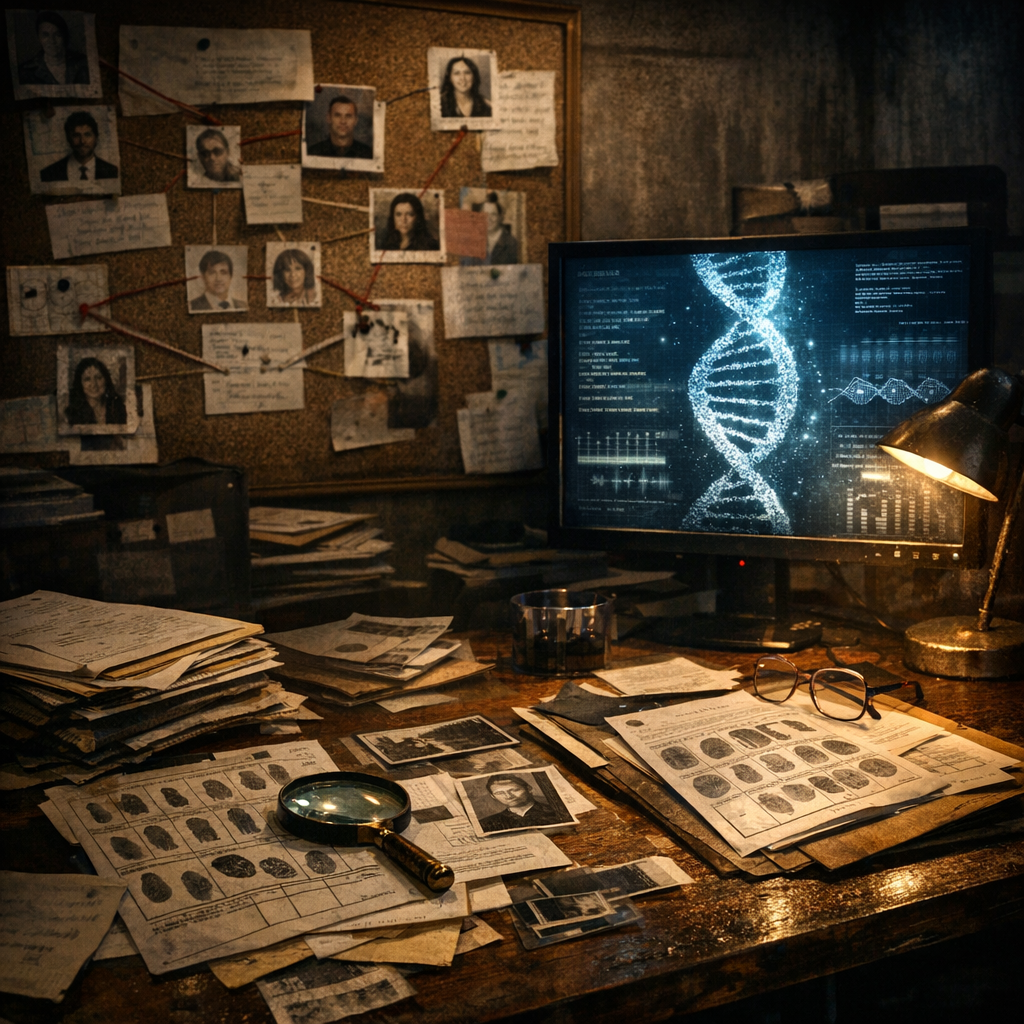
Some cold cases do not break because a witness finally talks or because a detective suddenly gets lucky. They break because a tiny strand of DNA survives long enough for a future no one could have imagined, and because genetic genealogy can turn a dead end into a name. These are the cases where science reached across decades and dragged the truth back into the light.
The Cases That Waited in Silence
For most of the twentieth century, a cold case usually died the same way. A detective chased the obvious leads. The newspapers lost interest. The evidence went into a box. Families learned to live with the kind of pain that never really leaves, because every year that passed made the answer feel more impossible.
Then something changed. DNA testing got better. Databases got larger. And eventually investigators learned how to use genetic genealogy to do something that used to sound impossible: start with an unknown DNA sample, move outward through distant relatives, build family trees, and slowly close in on one person who should have stayed hidden forever.
That process did not just solve a few crimes. It changed what a cold case meant. Suddenly, time was no longer always the killer’s best friend. In some cases, time became the trap.
The stories below matter because each one shows a different side of that shift. Some led to arrests. Some finally gave victims their names back. One exposed a devastating wrongful conviction. But all of them prove the same unnerving point: even when a case looks buried, the evidence may still be waiting for its moment.
Rita Curran — A Murder That Outlived Its Killer
When 24-year-old schoolteacher Rita Curran was found murdered in her Burlington, Vermont apartment in 1971, the case looked like the kind of mystery that might never be solved. The scene was violent. The suspect pool was broad. And as the years passed, the trail only got colder. Witness memories faded. Early theories collapsed. The case became one more file that seemed destined to gather dust.
But Rita Curran’s case did not disappear. It waited. Decades later, investigators returned to the evidence with modern forensic tools that did not exist when she was killed. That old biological evidence, once too limited to finish the story, suddenly had a voice again.
What followed was the kind of breakthrough that still sounds unbelievable: researchers used DNA and family-tree analysis to identify a suspect more than half a century after Rita died. The man had already died years earlier, which meant there would never be a dramatic trial or late-life confession. But the answer still mattered. For Rita’s family, for the city, and for the record itself, the truth finally had a name.
If you want the full case, start here: Rita Curran — The Murder Solved Half a Century Later.
That is one of the strangest things about these DNA cases. Sometimes justice arrives too late to punish anyone. But it can still end the long, brutal uncertainty that has haunted a family for generations.
Michelle Martinko — The Iowa Cold Case That Suddenly Moved Again
Michelle Martinko was murdered in 1979 after a night of Christmas shopping in Cedar Rapids, Iowa. She was found in her car at a mall parking lot, and the image of that scene stayed with investigators for decades. There was no shortage of attention. The case was high profile, deeply disturbing, and intensely frustrating. Yet year after year, it remained unsolved.
That is what makes the eventual break feel so jarring. One moment, the case had been cold for nearly forty years. The next, a new generation of forensic work pushed it forward in a way older methods never could. Genetic genealogy and renewed DNA analysis gave investigators a route through the darkness that had trapped the case for decades.
Instead of waiting for the perfect eyewitness or a lucky confession, investigators worked backward from the science. They built connections through family lines, narrowed the field, and identified a suspect who had never been publicly known as the answer for all those years. What looked frozen was suddenly moving fast.
The full breakdown is here: Michelle Martinko Murder — The Cold Iowa Case Solved by Family Tree DNA.
Michelle’s case became one of the clearest examples of why people talk about genetic genealogy almost like a revolution. It did not replace old detective work. It gave old detective work a map.
Bear Brook — When DNA Did More Than Find a Killer
The Bear Brook murders are one of those cases that sound cursed from the beginning. Barrels were found in a New Hampshire state park. Inside were human remains. More remains were discovered later. The victims included children. For years, the mystery was not just who killed them. It was who they were.
That detail matters. In some cold cases, DNA helps identify a suspect. In Bear Brook, DNA also helped restore identity to victims who had been stripped of it for years. That is a different kind of power. It means science is not just solving the crime. It is rebuilding the humanity the crime tried to erase.
As forensic techniques improved, investigators were able to connect the remains, reconstruct family relationships, and eventually point to a killer whose history of violence stretched across multiple lives and identities. The case did not open all at once. It unfolded in layers, each answer exposing something even darker underneath.
Read the full story here: Bear Brook Murders — The Barrels in the Woods That Hid a Family Secret for Decades.
Bear Brook is one of the most haunting examples in this roundup because it shows that genetic genealogy is not only about catching someone. Sometimes it is about returning stolen names to the dead.
William Talbott — A Killer Hidden Inside a Family Tree
In 1987, Canadian couple Jay Cook and Tanya Van Cuylenborg crossed into Washington State and never came home. They had their whole lives in front of them. Then, suddenly, they were gone, and what investigators found was horrifying. The case sat unsolved for decades, with DNA evidence preserved but no suspect in sight.
For years, that evidence was like a locked door with no key. Then genetic genealogy gave investigators a way in. By tracing the unknown DNA sample through distant relatives, authorities worked toward a family tree and eventually toward one man: William Talbott II.
That kind of reveal is what makes genealogy cases so unsettling. The suspect is not dragged into view by a dramatic mistake in the moment. He is found because his DNA, mixed invisibly into a much larger web of relatives, quietly betrays him. The science does not need him to confess. It just needs the pattern.
You can read the case-focused version here: The Cold Case That Waited Decades for One Strand of DNA: William Talbott DNA Murder Case.
And the victim-centered story is here: The Couple Who Crossed the Border and Never Came Home: Jay Cook and Tanya Van Cuylenborg.
Few stories capture the power of DNA genealogy more clearly than this one. A case that seemed stranded in 1987 was pulled into the present by a method that barely existed when the murders happened.
Craig Coley — The DNA Case That Proved the System Can Be Wrong
Most stories about forensic breakthroughs focus on identifying the guilty. Craig Coley’s story matters because it shows the other side of the same technology. In 1978, Coley was convicted of murdering his ex-girlfriend and her son in California. He spent nearly four decades in prison for a crime prosecutors said he committed.
Then newer DNA testing changed everything. The evidence that once seemed to support the case against him no longer held up. Modern analysis pointed away from Coley, not toward him. After 39 years behind bars, he was released and later declared factually innocent.
That does not fit the usual cold-case narrative, but it belongs in this roundup for a reason. DNA is not just a weapon for prosecutors. At its best, it is a truth tool. And truth does not always go where the original investigation expected it to go.
The full account is here: Craig Coley Case — 39 Years for a Crime He Did Not Commit.
Cases like Coley’s are a reminder that breakthroughs in forensic science can expose two different kinds of buried horror at the same time: the original crime and the damage done by getting the answer wrong.
Why Genetic Genealogy Changes the Fear Equation
For a long time, killers in cold cases relied on one brutal truth: if they escaped the first wave of investigation, they had a decent chance of disappearing into ordinary life. They got older. The case file got quieter. The world moved on.
Genetic genealogy changes that equation in a way that is almost eerie. It means the killer does not have to leave behind a perfect fingerprint or confess under pressure. A tiny biological trace can remain silent for decades and still become the thread that unravels everything later. It means your family tree can become the map investigators use to reach you. It means the past is no longer as dead as it used to be.
That is why so many of these breakthroughs feel dramatic even when they happen in a lab instead of a courtroom. They reverse the usual logic of cold cases. Time does not just erase. Sometimes, time strengthens the science enough to finally expose what happened.
And there is another reason these cases hit so hard: they restore something that cold cases steal. Names. Sequences. Certainty. Families who spent years trapped in rumor suddenly get facts. Victims who were reduced to headlines become real people again. Even when the justice is incomplete, the silence is broken.
The Truth Was Always There
What makes these stories unforgettable is not only that they were solved. It is that the answers were often present from the beginning, hidden in blood, skin cells, or a single microscopic trace no one knew how to fully read yet. The truth was there. The future just had to catch up to it.
That is the real power of DNA and genetic genealogy in cold cases. It turns old evidence into new danger for the guilty, new hope for families, and new pressure on every unsolved file that still holds biological clues. These cases are chilling because they prove something both hopeful and deeply unnerving: if the evidence survives, the past may not be finished with anyone at all.
🔎 Explore more deep-dive investigations like this:
- Doomsday Cults That Ended in Death — The Beliefs, Leaders, and Final Catastrophes
- Strange Sky Mysteries That Still Have No Explanation
- True Crime Cases Back in the Spotlight: Retrials, Appeals, and New Evidence That Reopened the Story
- Disappearances Solved Years Later: The Cases That Went Cold Until One Break Reopened Everything