
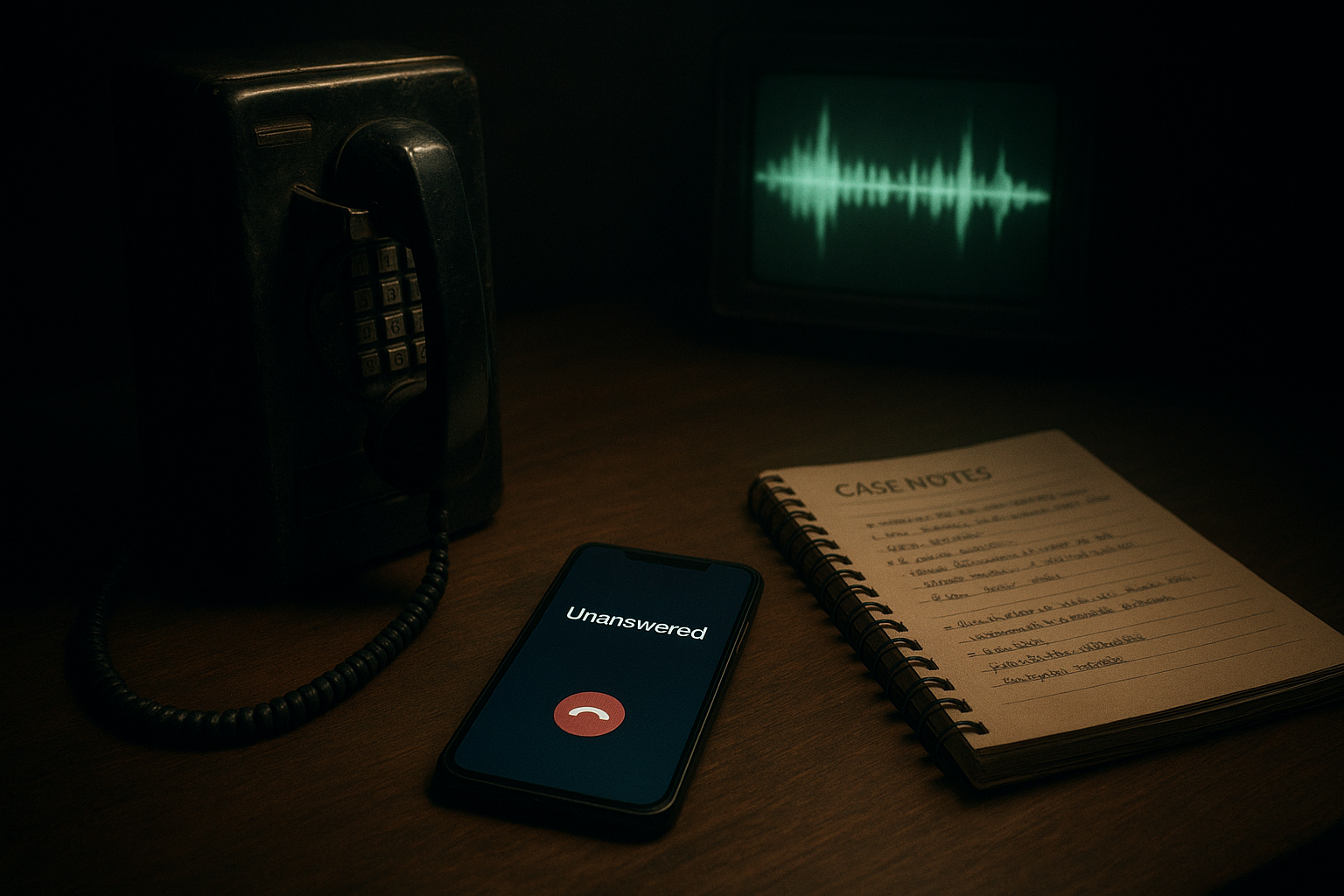
Some disappearance cases stay with people because there was no final contact at all. Others stay with people because there was contact — and it should have helped more than it did. A payphone call. A frantic 911 recording. A final voice on the line. A known exchange that ended too abruptly. A communication window that should have clarified the next movement and instead became the place where the mystery hardened. That is a different kind of investigative ache. The missing person does not vanish into total darkness. They vanish just after sounding reachable.
That is why a last-contact archive matters. Readers searching these cases are often not only looking for a name. They are looking for the call, the text, the voicemail, the final words, or the communication gap that changed how the whole disappearance is understood. In many investigations, the final contact is not just another fact in the file. It is the hinge between ordinary life and permanent uncertainty.
This page compares different kinds of last contact. Some cases involve a documented telephone conversation or anonymous calls; others concern a final sighting, a recovered phone or the point when someone was reported missing. Those categories should be kept distinct. A communication gap alone does not show what happened.
People do not simply search for “unsolved disappearances.” They search for the 911 call, the payphone moment, the final message, the unanswered voicemail, the last signal before the trail went cold.
They also matter because phone and communication evidence create a false promise of clarity. A last call feels objective. A voice recording feels close to proof. A known contact window feels like it should lock the timeline down. But in the cases below, communication does not finish the story. It becomes part of the mystery itself.
In practical investigative terms, final-contact cases often generate three kinds of questions at once. First, what exactly was said or expected in the last reachable moment? Second, what should have happened next if the day had remained ordinary? Third, what changed so quickly that the line between contact and disappearance still cannot be explained cleanly? Those questions are why call-centered cases age differently from broad missing-person mysteries. The communication itself keeps inviting reanalysis.
It is a way to compare the same fracture point across different settings: a public street, a family home, a retreat, a parking lot, a campground, a remote ocean route, or a historical case flooded with rumored calls. Seen together, these stories reveal how often the final contact becomes the coldest part of the file.
It also shows why “last call” cases are not all the same. Some preserve fear. Some preserve routine. Some preserve manipulation, warning, or false reassurance. In each version, the communication record creates a narrow strip of knowable human reality immediately before the case opens into uncertainty. That is a powerful comparison frame for readers, and exactly the kind of pattern that turns scattered case pages into a real documentary cluster.
Eight Cases Involving Last Contact, Phone Evidence or Reporting Gaps
Taylor Casey
Taylor Casey disappeared while attending a yoga retreat in the Bahamas in June 2024. Police said the retreat reported her absent from classes and that searchers recovered her phone from nearby water. The phone is a physical clue; it does not by itself establish a final conversation or explain her disappearance.
A recovered device can help an investigation, but its discovery does not mean the public has a complete account of its use. For Taylor’s case, the limits of the published record remain part of the story.
Read the full case here: Vanished at the Retreat — The Mystery of Taylor Casey.
Fiona Pender
Fiona Pender was last reported seen at her Tullamore flat on August23,1996. Gardaí confirmed in May 2025 that the inquiry had been reclassified as a murder investigation. Her remains had not been recovered. This is a last-seen case; the official account cited here does not establish a distinctive final telephone call.
Her disappearance leaves a gap between the final reported sighting and what followed. The question is how that gap can be explained by evidence, rather than by assumptions about calls she should have made.
Read the full case here: The Woman Who Never Came Home — The Disappearance of Fiona Pender.
Emanuela Orlandi
Emanuela Orlandi’s family received calls from purported abductors; the callers supplied no proof she was alive.
A claim made over the telephone is a lead to assess. It does not establish the caller’s identity or prove the missing person was in that caller’s custody. Later searches, including the 2019 opening of Vatican graves, also failed to supply an answer.
Read the full case here: Emanuela Orlandi Disappearance — The Vatican Girl Who Never Came Home.
Dorothy Jane Scott
Dorothy Jane Scott’s case includes repeated anonymous calls before and after her disappearance. Her remains were identified in 1984, so this is now an unsolved homicide rather than an ongoing search for a missing woman. The sheriff’s account describes a caller who claimed responsibility, but the man was never identified.
The calls remain relevant because they might connect the disappearance to the later murder investigation. They do not identify a suspect on their own, and their apparent intimacy is not a substitute for corroboration.
Read the full case here: Dorothy Jane Scott Disappearance — The Woman Who Vanished After Being Stalked.
The Springfield Three
The Springfield Three vanished from a Springfield home in June 1992. Reports describe obscene calls received after the women were missing and an answering-machine message that was erased. The record does not establish that the callers caused the disappearance, nor does it preserve a final conversation with the women.
The telephone details illustrate a limit of the evidence: reports of later contact cannot stand in for a verified account of the women’s last movements. The FBI continues to list all three as missing.
Read the full case here: The Springfield Three Disappearance: The Night Three Women Vanished and the Timeline Still Broke Apart.
Gus Lamont
Gus Lamont was a young child last reported seen at Oak Park Station in September 2025. South Australia Police declared the disappearance a major crime in February 2026. It is a last-sighting investigation; there is no verified final phone conversation involving Gus in the official account cited here.
The last reported sighting and the circumstances in which Gus was reported missing matter because they define the starting point of the inquiry. The gap concerns what happened after that sighting, not a documented telephone exchange.
Read the full case here: The Evening the Outback Went Silent – The Mystery of Gus Lamont.
DeOrr Kunz Jr.
DeOrr Kunz Jr. disappeared near Leadore, Idaho, in July 2015. The official missing-child record gives a last-seen date, not evidence of a final telephone conversation. His case belongs in a discussion of last sightings and reporting timelines rather than as an example of a call that went silent.
For a missing child, the important questions concern who last saw him, when he was noticed missing and what the search established. The missing-child record does not describe a check-in the child was expected to make.
Read the full case here: What Happened to DeOrr Kunz Jr.? The Campground Timeline and Contradictions That Still Divide This Idaho Case.
Flight MH370
Flight MH370 involves several distinct forms of communication evidence. The final routine voice transmission preceded later radar and satellite records. Those signals were not passenger telephone calls. The aircraft’s main wreckage location remained unconfirmed after the 2025–2026 search phases described by Malaysia’s transport ministry.
The aviation record is useful as a comparison because a final voice message and later automated signals can mark different points on the timeline. Treating them as one moment of silence obscures evidence rather than clarifying it.
Read the full case here: Flight MH370 Disappearance — The Flight Path, the Silence, and the Mystery the Ocean Still Hasn’t Given Back.
🔎 Related Investigation:
If this case pulled you deeper into the mystery, continue into:
Why These Disappearances Still Don’t Make Sense
What these cases share is not one geography, one suspect type, or one explanation. It is a final-contact structure strong enough to feel investigative and weak enough to remain unresolved. In some stories, the communication itself is chilling. In others, the disturbing part is the expectation that a person should have called, checked in, answered, or been reached — and then never was. Either way, contact becomes the last intact thread before the whole case frays.
Brandon Lawson involved an emergency call, but his remains were found in 2022 and his family announced identification in December 2024. Brandon Swanson remains a missing-person case after a call to his parents, while Angela Hammond concerns a reported payphone conversation before an abduction. These outcomes and types of evidence differ.
Another reason these cases endure is that communication creates false proximity. When someone is still on the line, or was just on the line, the disappearance feels as if it should remain solvable for a little longer than it does. That makes the silence afterward hit harder. The call does not only preserve evidence. It preserves expectation — the feeling that the next answer should have arrived and never did.
Last-contact evidence can connect to timelines, witness accounts and physical discoveries. Comparing those categories is useful when the same standard is applied to each: what can be verified, what depends on a witness, and what is unknown.
That matters because communication evidence often behaves like an emotional accelerant. A final call can compress the whole mystery into one replayable object. It gives families, investigators, and readers something to revisit over and over — not because it solves the case, but because it seems as if it should. The more replayable the final contact is, the harder it becomes for the case to fade from public memory.
A comparison of communication evidence is useful only when it identifies which cases actually contain that evidence. Last sightings and reporting gaps matter too, but they should not be presented as missing conversations.
Conclusion
The most haunting thing about last-contact disappearances is how little distance often exists between reachability and total uncertainty. A person is speaking, expected to speak, or should have answered. Then the line goes dead, the check-in never happens, the message stops, or the next contact point never arrives. In that tiny break between communication and silence, an entire case can disappear.
That is why these stories remain so sticky in public memory. They leave behind something almost more frustrating than a total blank space. They leave behind the impression that the truth was close enough to hear. Whether the last-contact clue was a real call, a pattern of threatening communication, a failed follow-up, or a final expected signal that never came, it gives the case a reachable edge that readers cannot stop leaning toward.
In practical terms, that reachable edge is what keeps both search behavior and human curiosity alive. People return not just because someone vanished, but because they believe the final contact should still contain the missing hinge of the story. The clue feels audible, almost tactile, and therefore permanently unfinished.
That is what gives this archive its authority. These are not just disappearances with phones somewhere in the background. These are cases where communication became the final structure readers still return to: the warning, the call, the payphone, the contact gap, the missing follow-up, the signal that should have meant more than it did. In every one of them, the last reachable moment still refuses to tell the whole truth.
And that shared pattern is exactly why these stories belong together as a hub rather than as isolated tragedies scattered across the archive, especially for readers tracing how the final reachable moment failed.
Research Sources
The following resources were consulted to verify and update this article.
- Royal Bahamas Police Force — Taylor Casey: July2,2024 missing-person update
The retreat’s report and recovery of her phone. - An Garda Síochána — Fiona Pender: Murder investigation, May 2025
The last-seen account and reclassification of the inquiry. - The Washington Post — Calls About Missing Girl
Unverified purported abductors’ calls. - Vatican News — Emanuela Orlandi: No human remains found in Vatican graves
The 2019 search prompted by another unconfirmed lead. - Orange County Sheriff — May 1980: Dorothy Jane Scott
Anonymous calls and the 1984 identification of her remains. - FBI — The Springfield Three
The three women’s disappearance from a Springfield home. - The Charley Project — Stacy Kathleen McCall
Reports of obscene calls and an erased message after the disappearance. - South Australia Police — Disappearance of Gus Lamont declared a major crime
The child’s last sighting and later major-crime investigation. - National Center for Missing & Exploited Children — Deorr J Kunz
The official missing-child record. - Australian Transport Safety Bureau — MH370 search overview
The distinction between final voice contact and later recorded signals. - Malaysia Ministry of Transport — MH370 Search Operation 2025–2026: Update to Families
The latest search phases and continuing uncertainty. - Navigating Advocacy — Brandon Lawson: Confirmed
The December 2024 identification announcement. - FBI — Brandon Victor Swanson
The Minnesota disappearance and recovered car. - The Charley Project — Angela Marie Hammond
The reported payphone contact before her abduction. - The Charley Project — Brandon Victor Swanson
The reported telephone conversation with his parents.
🔎 If this story stayed with you, the author suggests these deeper investigations next:
- Disappearances where the final hours became the whole mystery
- Cases where the last visible footage only deepened the unanswered middle
- Disappearances where later sightings only made the story stranger
Explore more Disappearances stories here: