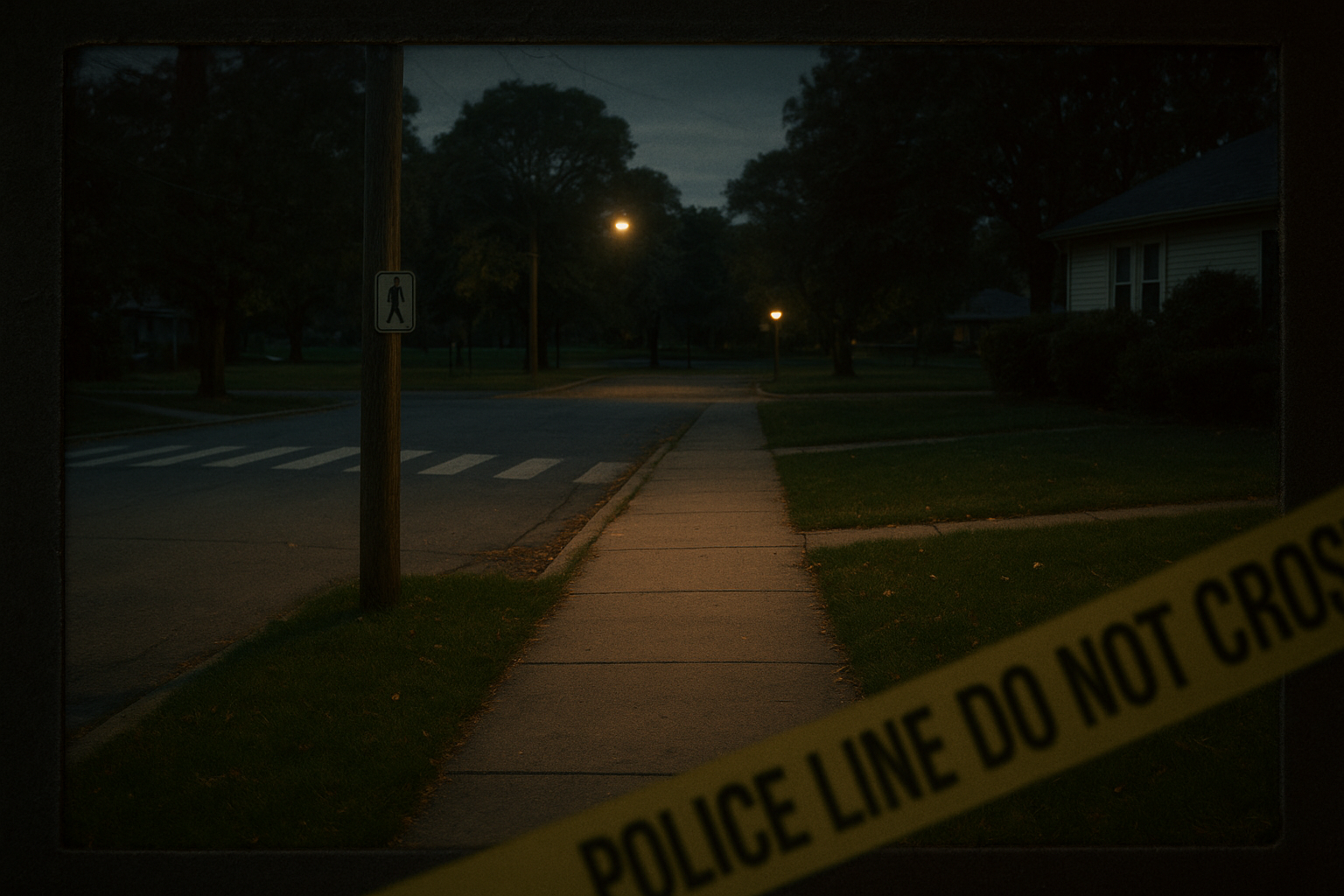
Disappearances disturb people differently when the distance was almost nothing. Not a cross-country flight. Not a wilderness expedition. Not a vanishing at sea. Just a short walk. A trip to school. A walk across a neighborhood. A stop at the park. A ten-minute errand. A quick route between one safe place and another. The scale is tiny, and that is exactly what makes these cases feel so bottomless.
Most people can understand danger when the setting already feels dangerous. These cases refuse that comfort. The route is familiar. The destination is close. The person should have been back quickly enough that nobody expected the story to turn into a permanent file. In many of these disappearances, the whole nightmare begins in a time window so ordinary that it barely registers at first. Then the person does not arrive. Or they are seen once more and then never again. Or the route itself becomes the mystery.
That is why unresolved short-route disappearances stay alive in a special way. They attack the smallest routines in daily life. Walking to meet a coworker. Riding to school. Crossing a parking lot. Leaving a ball field. Heading from one room of normal life into the next. The shorter the route, the more offensive the absence feels. People do not just ask what happened. They ask how so little distance could hold so much darkness.
Not a roundup of creepy cases. Not a stacked list of missing-person names. A documentary archive. A route-based investigation guide.
How This Archive Is Organized
This archive is organized by investigative lens, not by fame. That matters because short-route disappearances do not all fail in the same way. Some collapse around a school-day routine. Some revolve around a final public sighting. Some begin with a child only minutes from home. Some widen through surveillance gaps, witness failures, found vehicles, or unexplained pauses inside an otherwise tiny route. When you put these cases in the right rooms, the pattern becomes clearer.
This page also sits above existing disappearance branches rather than replacing them. The broader authority room is The Unsolved Disappearances Archive — Timelines, Surveillance, Sightings, Vehicles, and the Cases That Still Refuse to End. The deeper route into break-point cases is The Disappearances That Break at the Last Known Moment: Final Calls, Camera Footage, Routes, Vehicles, and the Cases That Never Close. The strongest supporting investigative rooms include What Happened After the Last Sighting? The Disappearance Cases Where One Witness, One Camera, or One Clue Changed Everything, Last Seen on Surveillance: 6 Disappearances Where the Final Footage Only Deepened the Mystery, Unsolved Disappearances With Witness Sightings That Only Made the Mystery Stranger, What Happened After the Car Was Found? 6 Real Disappearances Where the Vehicle Was Recovered but the Person Was Not, and The Final Timelines That Still Don’t Close: 9 Disappearances Reconstructed Minute by Minute. This page is the corridor that explains why readers move so naturally between those rooms: once a disappearance begins inside a tiny, ordinary route, every clue feels one detail away from explanation.
The emotional logic is brutally simple. A person did not vanish in some unknowable faraway place. They vanished between here and there. That creates obsession, and obsession creates authority. Readers do not come to these cases only for the names. They come for route tension, last movement analysis, ordinary-place dread, missing minutes, and the question that keeps repeating across the whole cluster: how can someone vanish when they were only supposed to be gone for a moment?
Short Walks and Tiny Routes That Should Have Been Nothing
The purest version of this pattern is the disappearance built around almost no distance at all. These are the cases where the route was so short that the world should have held onto the person by default. The fact that it did not is what gives these files their strange endurance.
Jason Jolkowski’s disappearance belongs here as one of the clearest examples in the cluster. He was not heading into danger as anyone understood it. He was walking a short route through a familiar neighborhood to meet a coworker. That is what gives the case its particular force. There is no grand journey to hide inside. Just a tiny movement that should have ended in an ordinary arrival and never did.
Steven Koecher’s case belongs in this room for a related but colder reason. His final visible movement into a quiet neighborhood is short enough, clean enough, and geographically contained enough that the break in the story feels almost unnatural. The vanishing point looks manageable. The answer does not.
Phoenix Coldon’s disappearance also fits this lens because the departure window is so compressed. She backed out of her own driveway. The route was not supposed to become a legend. Yet the smallness of that moment is exactly what turned it into one.
These cases route naturally into The Final Timelines That Still Don’t Close: 9 Disappearances Reconstructed Minute by Minute and The Disappearances That Break at the Last Known Moment: Final Calls, Camera Footage, Routes, Vehicles, and the Cases That Never Close because the short distance creates the illusion that a perfect sequence can still be rebuilt. But the deeper emotional hook is simpler than that. These stories tell readers that vanishing does not require a dramatic setting. Sometimes it only requires one ordinary path that never finishes.
That is the first wound in this archive. The route was tiny. The mystery was not.
School-Day Routines and the Routes Children Should Have Survived
Child disappearances inside ordinary daily structures carry a different kind of pressure. School creates schedule. Parents create expectation. Public environments create the sense that too many eyes were present for a child to simply fall out of the world. When that expectation fails, the case never stops feeling unfinished.
Kyron Horman’s disappearance belongs here because school was supposed to be the controlled environment that held the day together. Instead, the route between school presence and safe return fractured into one of the most debated missing-child cases in the cluster.
Asha Degree’s case belongs here even though her route unfolded in darkness. It remains one of the strongest examples of a child disappearing during what should have been a small, knowable movement. The road, the weather, and the eyewitness layer keep the route alive in public memory because the story feels close to explanation without ever settling into it.
Johnny Gosch’s disappearance fits the same room because paper routes are built from routine, repetition, and expectation. A route repeated enough times should become easier to protect, easier to witness, easier to reconstruct. Instead it became part of the reason the case still feels culturally unfinished.
Summer Wells belongs here because the setting was domestic and near-home rather than school-centered, but the same emotional law applies. The distance around the child was supposed to be small enough for certainty. It was not.
These cases often push readers deeper into Unsolved Disappearances With Witness Sightings That Only Made the Mystery Stranger and What Happened After the Last Sighting? The Disappearance Cases Where One Witness, One Camera, or One Clue Changed Everything because once the child fails to return through a normal route, every possible sighting or missed observation becomes painfully important. The route becomes an accusation against the environment itself. Home should have been closer. School should have been safer. Adults should have noticed sooner. Someone should have seen the wrong moment forming.
That is why school-day and near-home child cases never really quiet down. They are not only unresolved. They feel like they violated a structure people trusted.
Parks, Playgrounds, and Public Places That Looked Too Normal to Hold a Vanishing
Some short-route disappearances happen in places that are supposed to feel socially protected by sheer normality. A park in daylight. A public recreational space. A ball field. A shopping area. A workplace-adjacent lot. The case remains active because the public setting promises witness potential, and then fails to deliver enough of it.
Dulce Alavez’s disappearance belongs here because the setting was so brutally ordinary. Public park. Daylight. Family routine. The kind of place where people assume the story could only stay open for a short time. Yet the more public the setting, the harsher the unanswered space can feel.
Angela Hammond’s case fits here because the public edge of the disappearance intensifies the route tension. She was not vanishing into some unknown wilderness. She was inside a recognizable social environment, and the final moments still widened into one of the cluster’s most persistent unfinished routes.
Jennifer Kesse’s disappearance belongs here too, not because it was a park case, but because it demonstrates the same public-space pressure. Apartment complex. Workday departure. A route that should have created visual trace and practical containment. Instead the final movement only produced sharper questions.
Patrice Endres’s disappearance belongs in this section when the cluster is viewed through public-space vulnerability. A routine day inside a normal working world can produce the same kind of rupture as a park or parking lot if the disappearance tears through the expectation of visibility.
These stories connect naturally to Last Seen on Surveillance: 6 Disappearances Where the Final Footage Only Deepened the Mystery and What Happened After the Last Sighting? The Disappearance Cases Where One Witness, One Camera, or One Clue Changed Everything because public places create the expectation of record. Cameras. Witnesses. remembered vehicles. remembered movements. remembered faces. When those tools fail, the absence feels more aggressive, not less.
Public normality is supposed to keep people from disappearing cleanly. These cases are the evidence that it doesn’t always.
Teen and Young-Adult Movements That Became Route Puzzles
Teen and young-adult disappearances often develop into route puzzles rather than simple last-seen cases. The missing person is mobile enough to make small autonomous decisions. They can change direction, pause, wait, hide stress, or pursue something they have not disclosed. That mobility creates more possibilities — and often more ambiguity.
Noah Donohoe’s disappearance belongs here because the movement itself became part of the obsession. Short route logic matters in the case: the journey was not supposed to become a descent into permanent uncertainty. Yet every known stage of the route only made the final absence feel stranger.
Andrew Gosden’s case fits this room because the departure decision was simple enough to describe and still impossible to resolve emotionally. A brief movement inside ordinary life opened into a route that people continue to map because the initial step feels so contained compared with the size of the mystery that followed.
Mekayla Bali’s disappearance belongs here because the morning movement pattern created one of the strongest route-analysis cases in the whole cluster. Stops, observed moments, and ordinary-place transitions build the feeling that the story should be recoverable minute by minute, even though it keeps resisting that kind of closure.
Alicia Navarro’s case also matters to this lens because the emotional logic of a teen leaving ordinary life behind can turn a short departure into a long-running question about intent, vulnerability, and what part of the route mattered most.
These stories push readers toward The Final Timelines That Still Don’t Close: 9 Disappearances Reconstructed Minute by Minute because sequence matters more here than broad atmosphere. Small choices become large investigative objects. A stop, a delay, a direction change, a missing camera angle, one unexplained contact — each one can turn a short route into a permanent maze.
That is the trap of teen-route cases. The movement is just independent enough to complicate the file, but still ordinary enough that the final disappearance feels impossible to accept.
Witnesses, Final Sightings, and the Last Safe Moment Before the Story Collapsed
A short-route disappearance often survives in public memory because somebody saw the person close to the end. Not far from home. Not far from school. Not far from the last expected checkpoint. Witnesses should help stabilize the route. Sometimes they do the opposite. They keep the final safe moment vivid without bringing the answer any closer.
Asha Degree returns here because witness sightings are part of what fixed the route so firmly in public imagination. The observations extend the known movement while also raising harder questions about why she was there at all.
Dorothy Jane Scott’s disappearance belongs here because the final known movement sits inside a very specific, emotionally loaded sequence. She was not drifting across a continent. She was moving through a contained real-world route when the story broke. The targeting and stalking dimension only sharpens the terror around the final sighting layer.
Jennifer Kesse fits here again because the public trace exists without producing the resolution it seems to promise. That is one of the defining patterns of this entire hub: a route narrow enough to be known, but not narrow enough to save the truth.
Brandon Swanson’s disappearance belongs in this section because the final humanly traceable phase of movement is what turns the case into an obsession. Even when the route becomes larger or darker than the title theme suggests, the emotional engine is still the same: how did the story cross from contact to permanent uncertainty so fast?
This is the room that feeds most directly into What Happened After the Last Sighting? The Disappearance Cases Where One Witness, One Camera, or One Clue Changed Everything and Unsolved Disappearances With Witness Sightings That Only Made the Mystery Stranger. Short-route disappearances thrive on those pages because the witness layer does not merely document the ending. It dramatizes the failure of the route to remain ordinary.
People stay with these cases because they can still picture the last safe version of the story. That picture never stops hurting.
When Vehicles, Cameras, or Tiny Delays Made a Short Route Feel Bigger Than It Was
Not every disappearance in this archive is literally a walk around the corner. Some begin with a route that should have been brief or routine, then expand through one piece of physical evidence that makes the small route feel suddenly much larger. A found car. A missing camera segment. A delayed arrival. A detour that should not matter but never stops mattering.
Bryce Laspisa’s case belongs here because the distance kept expanding long after the route should have resolved, yet the emotional structure still resembles a short-route mystery: everything feels like it broke inside a finite, knowable chain of movements.
Phoenix Coldon returns here because the vehicle is part of what gives the departure its eerie compression. The route opens with ordinary motion and then refuses to become legible.
Jennifer Kesse belongs here again because surveillance and public movement created exactly the kind of near-solution architecture that keeps this whole cluster bingeable. Readers feel that if they study the route hard enough, the missing part may still yield.
Noah Donohoe also fits this room because the route-analysis pressure is inseparable from the way physical evidence and partial reconstruction interact. The whole case keeps asking whether the route was really as small and simple as it first looked.
That tension is why What Happened After the Car Was Found? 6 Real Disappearances Where the Vehicle Was Recovered but the Person Was Not and Last Seen on Surveillance: 6 Disappearances Where the Final Footage Only Deepened the Mystery matter so much as supporting branches. Short-route disappearances often do not stay emotionally small. One physical clue can stretch the mystery outward while keeping the original departure painfully close to ordinary life.
The route should have stayed short. The evidence made it wider. The answer never caught up.
Why These Cases Keep Pulling People Back
Short-route disappearances survive in memory because they compress dread into everyday space. The person was not supposed to be gone long enough for anyone to build a theory. That is the first thing that makes the cases powerful. They begin below the threshold of panic. Only later do people realize the route itself was the last intact part of the story.
They also create unusually strong investigative geometry. The search area feels smaller. The time window feels tighter. The environment feels more knowable. That combination gives readers and investigators the same dangerous hope: if the route was short enough, surely the answer must be close too. When the answer never arrives, the case becomes harder to release than a broader, messier disappearance.
Another reason these cases endure is that they attack routine at the point where routine is supposed to protect us. Walks to school. Quick work transitions. Small neighborhood movements. Daylight play. A short trip from one safe place to another. Once those routes become unstable in the public imagination, they stay unstable. Readers do not experience the case as distant tragedy alone. They experience it as a fracture in the map of ordinary life.
That is also why this pattern is so strong for cluster authority. Short-route cases connect naturally to nearly every major disappearance branch already on the site. They feed timeline analysis because minute-level sequencing matters. They feed surveillance pages because visibility is central to the expectation of safety. They feed witness-sighting pages because somebody often should have seen enough. They feed found-vehicle and final-moment hubs because tiny routes create outsized pressure on the evidence that survives.
There is a deeper emotional engine too. These cases leave almost no room for acceptance. A vanishing on a long journey can at least pretend to belong to distance. A vanishing on a short walk belongs to interruption. Something cut through the route so abruptly that the entire structure of the day broke in half. That kind of break is hard for families, readers, and communities to metabolize.
They also generate repeated analytical behavior. People map sidewalks. They compare route lengths. They look at intersections, parking lots, school exits, park boundaries, bus stops, and alley lines. They replay the final ordinary choice. They ask whether the danger came from the route itself, from someone waiting inside it, or from a later stage that only looks connected because the opening was so small. Short-route disappearances turn the reader into a route analyst almost immediately.
People are not only looking for names. They search for missing on short walk, vanished walking to school, disappeared after leaving home, brief trip disappearance, missing after quick errand, final route disappearance, last known route, child vanished near home, and similar route-length phrases.
Another repeated pattern is overlap. A short-route disappearance rarely stays only a short-route disappearance. It becomes a witness case, a surveillance case, a final-sighting case, a found-vehicle case, or a near-home child case depending on which fragment survives longest.
These stories also create unusually strong reread behavior. People return to the map. They count minutes again. They imagine the sidewalks, the parking rows, the school exits, the houses overlooking the road, the places where one more person might have noticed something. The smaller the route, the larger every missed chance begins to feel.
And finally, these cases keep pulling people back because they preserve the last ordinary version of the world too clearly. Before the route failed, nothing looked large enough to become permanent mystery.
Seen together, these stories build a real authority pattern. The shortest routes often produce the longest obsessions.
Conclusion
The disappearances in this archive are united by one brutal fact: the final movement should have been small enough to survive. A short walk. A school-day route. A playground interval. A brief public-space transition. A near-home errand. Instead those tiny routes became permanent fracture lines.
It does not just collect cases. It explains the pattern that binds them. The distance was short. The expectation of safety was high. The uncertainty that followed was almost impossible to absorb.
Related investigations include the broader disappearance authority room, the final-moment collections, the witness and surveillance branches, and the cases where one ordinary route still feels like it should have given up the truth by now. It never did. That is why people keep coming back.
🔎 If this investigation pulled you deeper into the mystery, continue with these next archive files:
- The Unsolved Disappearances Archive — Timelines, Surveillance, Sightings, Vehicles, and the Cases That Still Refuse to End
- The Disappearances That Break at the Last Known Moment: Final Calls, Camera Footage, Routes, Vehicles, and the Cases That Never Close
- What Happened After the Last Sighting? The Disappearance Cases Where One Witness, One Camera, or One Clue Changed Everything
Explore more Disappearances investigations here: