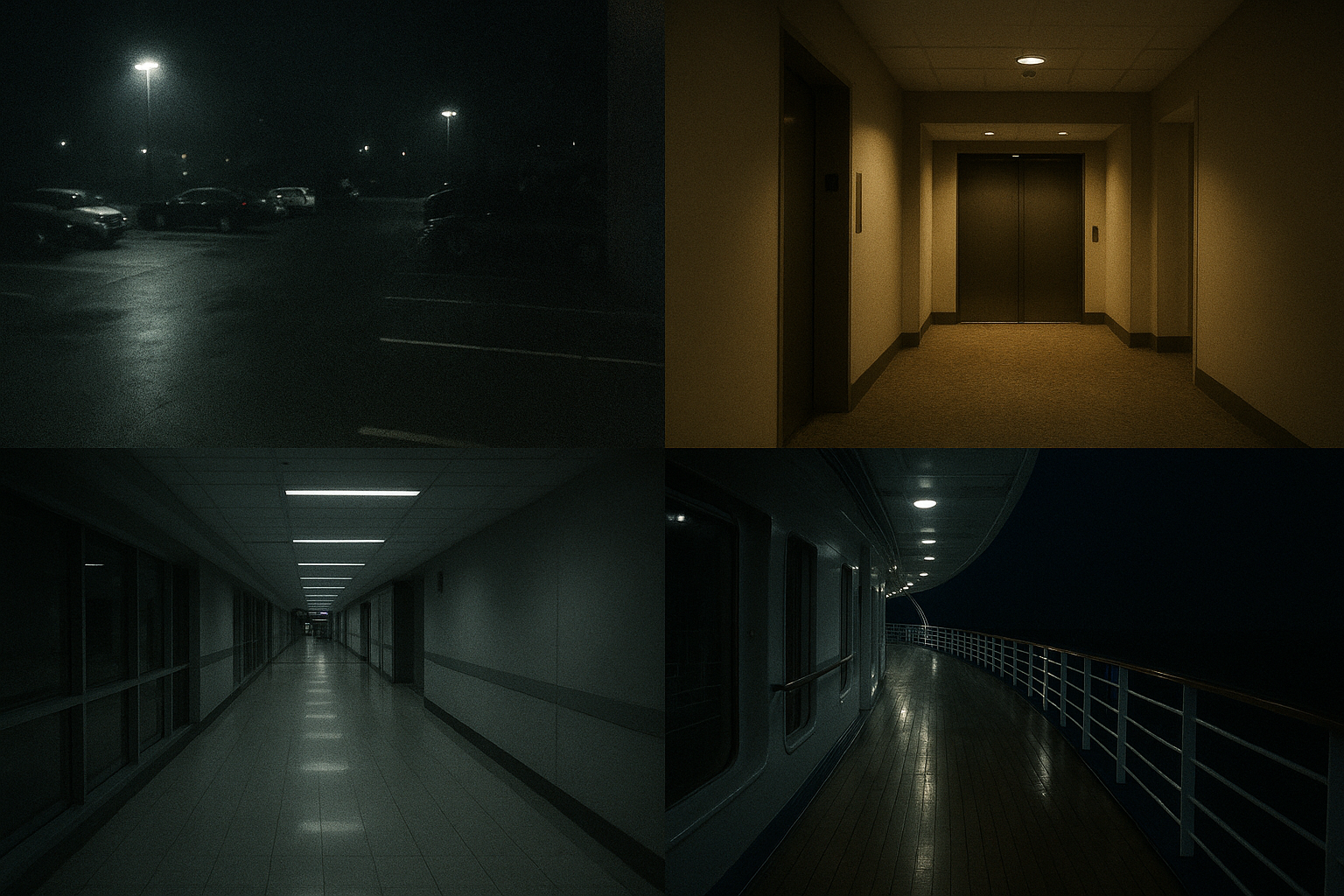
A camera can record a clue without recording the disappearance itself. In Jennifer Kesse’s case, it shows an unidentified person walking away after parking her car. Other cases involve footage of the missing person, reported sightings or gaps in the available record. Those distinctions change what an image can actually prove.
This collection compares eight cases involving cameras, last sightings and incomplete records. It distinguishes filmed movements from witness reports and includes Elisa Lam’s death, which received an official finding rather than remaining an open missing-person case.
These cases matter because modern readers trust cameras more than memory. A witness can misremember. A rumor can mutate. But footage feels objective, even when it is incomplete. That is why visual evidence changes the emotional texture of a disappearance. It promises certainty. It suggests that if you replay the clip enough times, zoom far enough, or map the sequence cleanly enough, the answer will finally rise to the surface. In the cases below, that promise fails.
The record can invite reconstruction without supplying the missing sequence. A person of interest, a missing person and a later reported sighting are different kinds of evidence; none should be silently substituted for another.
Related case: Jennifer Kesse
Related case: Elisa Lam
Related case: Brian Shaffer
Not all eight cases have a definitive public final clip. The cruise-ship cases involve different records, while Phoenix Coldon’s reported departure is a witness account. A confined setting does not guarantee that every relevant movement was recorded.
Jennifer Kesse
Jennifer Kesse was reported missing after failing to arrive at work in January 2006. The FBI’s public footage shows a person of interest walking away from her parked car, not Kesse leaving for work. Her actual movements after her last contact remain uncertain.
The key mystery point is that the visual trail exists just long enough to suggest control, but not long enough to reveal who controlled it.
For the full case breakdown, read Jennifer Kesse’s Disappearance and the Recorded Person of Interest.
Elisa Lam
Elisa Lam’s elevator footage drew intense attention after she disappeared in Los Angeles in 2013. She was later found in a Cecil Hotel rooftop water tank. The coroner ruled her death an accidental drowning, with bipolar disorder a contributing factor.
The clip is unforgettable because it invites interpretation without ever confirming whether it records fear, confusion, concealment, or something else entirely.
For the full case breakdown, read Elisa Lam Disappearance: The Elevator Footage, the Final Timeline, and the Questions That Still Won’t Go Away.
Lars Mittank
Lars Mittank remains memorable not just because of the disappearance itself, but because the case appears to stop inside a visible or near-visible frame. The airport footage made the case feel close to solvable: a public setting, visible movement, and a final sprint into open space that should have produced answers.
Instead, the footage only sharpened the rupture between a visible final movement and a total disappearance.
For the full case breakdown, read What Happened to Lars Mittank? The Tourist Who Ran from the Airport and Vanished.
Rebecca Coriam
Rebecca Coriam disappeared from Disney Wonder in March 2011. Bahamian police reported examining shipboard CCTV as part of the search. The existence of footage does not supply a complete account of what happened after her last recorded movements.
The central problem is that a ship is both confined and opaque: the final visual trace exists, but the decisive surrounding context does not.
For the full case breakdown, read Rebecca Coriam Disappearance — The Cruise Ship Mystery Captured on Camera.
Amy Lynn Bradley
Amy Lynn Bradley disappeared from Rhapsody of the Seas in March 1998. The FBI continues to seek information. Her inclusion here concerns last sightings and an incomplete record, rather than an established final surveillance clip showing how she disappeared.
The mystery point is that the environment feels too contained for such a clean vanishing, which keeps visual and witness-based theories alive decades later.
For the full case breakdown, read What Happened to Amy Lynn Bradley? The Cruise Ship Timeline and the Sightings That Still Raise Questions.
Madeleine McCann
Madeleine McCann’s case is another comparison based on missing information rather than one definitive public final clip. The Metropolitan Police’s Operation Grange describes an international investigation; the absence of a decisive image does not itself establish what happened.
It fits because the modern surveillance expectation hangs over every reconstruction: how can a case this famous still have no visual closure?
For the full case breakdown, read Madeleine McCann’s Disappearance and the Continuing Investigation.
Phoenix Coldon
Phoenix Coldon’s reported departure from home and the later recovery of her vehicle leave a missing sequence. That departure is a witness account, not a verified surveillance clip.
The interval after the reported departure remains unverified.
For the full case breakdown, read Phoenix Coldon’s Disappearance, Reported Departure and Recovered Vehicle.
Brian Shaffer
Brian Shaffer remains memorable not just because of the disappearance itself, but because the case appears to stop inside a visible or near-visible frame. His case remains one of the purest surveillance-era vanishings because a camera-heavy environment still failed at the exact point everyone expected certainty.
The mystery survives because the footage does not look incomplete until you realize the one movement that matters is missing.
For the full case breakdown, read Brian Shaffer Disappearance — The Bar Exit Nobody Saw and the Timeline That Still Refuses to Close.
Why These Disappearances Still Don’t Make Sense
What these cases have in common is not just that cameras appear somewhere in the story. It is that the camera presence changes the shape of the mystery. In a traditional disappearance, the final gap may feel abstract. In a footage-driven disappearance, the gap becomes cruelly precise. You know where the frame starts. You know where the sequence should continue. And you know, with increasing frustration, that it does not.
The contrasts matter. Lars Mittank was recorded leaving an airport; Phoenix Coldon’s departure is a reported sighting. Kesse’s footage concerns another person. Lam’s video must be read alongside the coroner’s accidental-death finding. These are different evidentiary problems, rather than the same unresolved final frame.
Related case: Elisa Lam
Related case: Rebecca Coriam
Related case: Amy Lynn Bradley
Related case: Lars Mittank
Related case: Phoenix Coldon
Related case: Brian Shaffer
Compare the available records in these related collections: Disappearances Caught on Camera, Last Seen on Surveillance, Unsolved Disappearances Where the Final Hours Still Don’t Add Up.
Visual evidence does not become complete simply because it is replayable. A clip can show movement without motive, while an unrecorded interval supplies no image to interpret. Some questions remain unresolved; that does not overturn an official finding such as Lam’s.
There is also a psychological trap built into these stories. Visual evidence turns the audience into unpaid investigators. People slow the clip down, compare frames, map travel windows, and build whole theories around posture, pacing, or a single unexplained movement. Sometimes that helps surface neglected details. Just as often, it proves how little a camera can actually tell us without the missing context around it. That combination of access and helplessness is why footage-driven disappearances become cultural obsessions rather than simply unresolved cases.
The cases can be compared by asking what each record actually shows: a filmed movement, an unidentified person, a witness account or an unknown interval. That question is more useful than assuming one additional frame must contain the answer.
Conclusion
The most unsettling thing about final-footage disappearances is not that the visual record is absent. It is that the visual record is present enough to feel personal, replayable, and almost usable. That nearness is what makes these cases stick. The answer never feels distant. It feels interrupted.
These eight cases show the limits of different kinds of records. A surviving image can matter deeply without documenting the disappearance or explaining everything that followed.
Research Sources
The following resources were consulted to verify and update this article.
- FBI — Jennifer Joyce Kesse
Identifies the recorded car-mover as an unidentified person of interest. - CityNews Vancouver — Elisa Lam death ruled accidental drowning
Reports her recovery and the coroner’s accidental-death finding. - Schleswig-Holstein State Police — Missing person Lars Mittank
Official appeal records his departure from Varna Airport. - Royal Bahamas Police Force — Missing Person Rebecca Coriam: News Release 425-2011
Documents shipboard searches and examination of CCTV. - FBI — Amy Lynn Bradley
Maintains the appeal for Bradley’s cruise-ship disappearance. - Metropolitan Police — Operation Grange
Describes the continuing McCann investigation, rather than a verified final video. - Uncovered — Phoenix Coldon
Summarizes the reported departure and recovered vehicle. - The Charley Project — Brian Randall Shaffer
Summarizes the camera record and unconfirmed route out of the bar.
🔎 If this story stayed with you, the author suggests these deeper investigations next:
- Disappearances Caught on Camera — The Footage That Still Haunts Investigators
- Last Seen on Surveillance: 6 Disappearances Where the Final Footage Only Deepened the Mystery
- Unsolved Disappearances Where the Final Hours Still Don’t Add Up
Explore more Disappearances stories here: