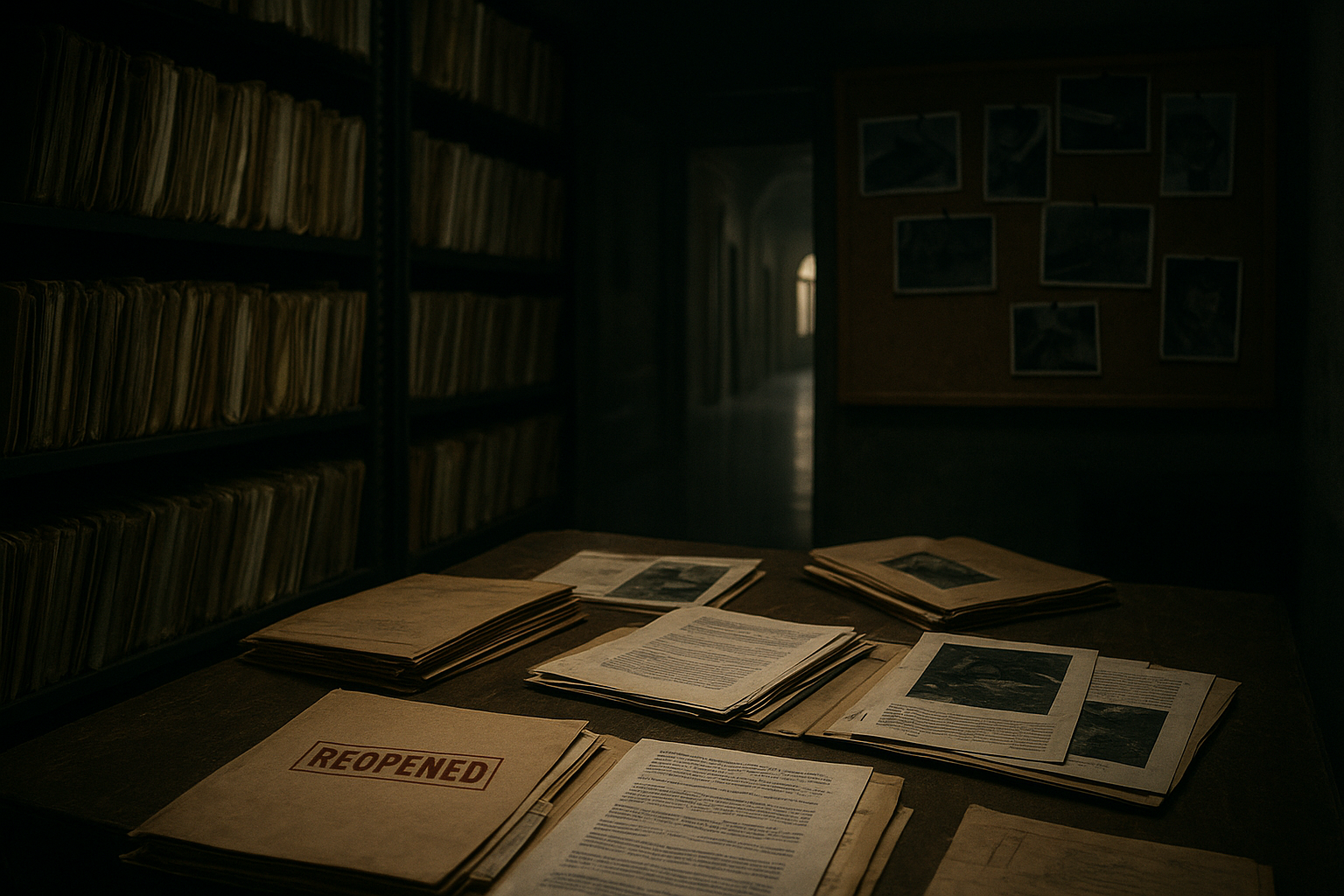
Cold cases do not die cleanly. They do something stranger.
They go quiet. They harden. They become shelves, boxes, mislabeled evidence envelopes, rumors people stopped correcting, and families who learn how to speak about grief in the present tense for decades at a time.
Then sometimes, without warning, the file moves again.
A hair is tested with technology that did not exist when the body was found. A witness who lied in 1981 can no longer keep the story straight in 2025. A detective opens an old report and notices the one contradiction everyone else had learned to step over. A DNA profile reaches across generations. A false confession starts looking weaker than the silence around it. A name that once felt permanently buried suddenly comes back into the room.
That is why cold cases solved years later disturb people so deeply. They force us to confront two timelines at once. One is the original crime — the night, the attack, the disappearance, the body, the lie, the wrong suspect, the missed chance. The other is the long unnatural afterlife of the case itself: the years spent waiting while technology improved, witnesses aged, parents died, evidence degraded, and the public moved on before the truth did.
Dead cases started speaking again through family trees, preserved evidence, collapsing alibis, overturned convictions, delayed forensic progress, and the kind of stubborn reporting that can drag an old file back into motion after everyone assumes it belongs to the past.
How This Cold-Case Archive Is Organized
That matters because cold cases do not reopen for one reason. Some break because science finally catches up to the evidence. Some break because an old lie starts rotting under scrutiny. Some break because a wrongful conviction leaves the real story sitting in the dark. Others reopen because journalists, podcasts, or victim families refuse to let a file stay bureaucratically dead.
If DNA and genetic genealogy are the pattern you keep returning to, the deepest branch is The DNA Cold Case Archive — Murders Solved by Genetic Genealogy, Family Trees, and Evidence That Waited Decades to Speak alongside Cold Cases Solved by DNA and Genetic Genealogy — The Breakthroughs That Finally Named the Killer. If you are drawn to appeals, retrials, and cases that came roaring back through courtroom pressure, continue into True Crime Cases Reopened by Appeals, Retrials, and New Evidence — The Stories That Refused to Stay Closed. If you want the broader context around how delayed breakthroughs fit into the category as a whole, The True Crime Archive — Unsolved Murders, DNA Breakthroughs, False Narratives, Retrials, and the Cases That Still Divide the Public remains the larger authority room this archive now branches from.
It gathers the cases where time itself became evidence — or where time protected the lie until one late break finally destroyed it.
DNA Breakthroughs That Turned Old Evidence Into a Live Threat
No modern force has changed cold-case storytelling more than DNA. Not because it solves everything. It does not. But because it can make a case feel alive again after decades of complete stillness. A strand of hair, a stain no one understood how to test, a sample too weak for the lab in 1987 and suddenly usable in 2026 — that is enough to turn a dead file back into an active danger for whoever thought time had protected them.
That is why Michelle Martinko Murder — The Cold Iowa Case Solved by Family Tree DNA belongs near the front of this archive. The Michelle Martinko case was not simply solved late. It was transformed by the fact that family-tree DNA could reach backward across generations and expose a killer who had lived in ordinary anonymity for decades.
The same delayed force runs through Rita Curran — The Murder Solved Half a Century Later. Rita Curran’s murder sat unresolved for half a century, which meant the eventual answer did more than identify a suspect. It changed the emotional shape of the case itself. What once looked like permanent historical loss became a reminder that evidence does not always expire when public attention does.
Then there is William Talbott II DNA Murders — The Killer Hidden Inside His Own Family Tree, a case that feels almost custom-built for this archive because the entire narrative hinges on the way genetic genealogy turned family history into an investigative weapon. Readers who want the fuller solved-case framing can also move into The Cold Case That Waited Decades for One Strand of DNA: William Talbott DNA Murder Case, where the same delayed DNA logic is made even more explicit.
The pressure gets even heavier in files like Bear Brook Murders — The Barrels in the Woods That Hid a Family Secret for Decades and The Golden State Killer DNA Breakthrough — How One Family Tree Finally Cornered a Ghost. These are not merely examples of forensic success. They are case studies in how identity can stay hidden in plain sight until a method exists that did not previously belong to police work at all.
What makes this pattern so binge-readable is that DNA rarely feels like magic when you sit inside the timeline. It feels procedural. A sample is preserved. A lab reruns it. A genealogy path opens. A name comes closer by inches. That slow movement matters because it turns readers into investigators. You can see exactly how the case begins breathing again.
It also changes the moral texture of the story. Every year between the crime and the breakthrough becomes part of the case file. Those lost years are not empty background. They are the period in which families waited, suspects aged, officers retired, and ordinary life continued around an answer that technically already existed in biological form.
That is also why the DNA branch archive matters so much structurally. The DNA Cold Case Archive — Murders Solved by Genetic Genealogy, Family Trees, and Evidence That Waited Decades to Speak and Cold Cases Solved by DNA and Genetic Genealogy — The Breakthroughs That Finally Named the Killer do not compete with this page. They deepen it. They show what happens when the breakthrough is not a confession, not a lucky witness, not a dramatic sting — just patience, preserved material, and a lab result that arrives decades too late for comfort.
The emotional force of these cases comes from the same blunt fact every time: the evidence was there long before the answer was. The truth did not appear out of nowhere. It waited for the world to become capable of hearing it.
Old Lies, Fake Narratives, and the Stories That Started Falling Apart
Some cold cases move again because a hidden killer is identified. Others move because the story everyone lived with for years stops holding together. Those cases are different. They feel less like discovery and more like decay. A lie does not explode. It sags. It misaligns. It starts contradicting itself under the weight of time.
That is one reason Houston Lovers’ Lane Murders — How Cheryl Henry and Andy Atkinson’s 1990 Case Finally Led to an Arrest lands so hard. The Houston Lovers’ Lane murders were not just old. They were suspended inside the kind of long delay that can make a community half-accept that justice may never come. When an arrest finally arrives, it does not merely answer a case. It forces every year of assumed silence to be reread.
You can feel the same late-collapse energy in Roxanne Sharp Cold Case — How a Podcast Helped Lead to Arrests 44 Years Later. The Roxanne Sharp case matters here because the break did not come from one cinematic moment. It emerged from persistence, modern attention, and the refusal to let an old file stay culturally buried.
And sometimes the delayed collapse is not about who committed the crime but about who did not. Craig Coley Case — 39 Years for a Crime He Did Not Commit belongs in this archive because wrongful-conviction stories reveal another cold-case pathology: the system may appear to have closed the case while the truth remains locked outside.
That is why pages like The Central Park Five — The Night the Case Was Built, the Years That Were Taken, and the Truth That Came Too Late matter as supporting evidence for this pattern. The public often treats solved and closed as interchangeable words. They are not. A case can be closed on paper and still be rotten at the core. When that happens, time does not heal the file. It preserves the mistake.
The same pressure hangs over newer courtroom-centered stories like Karen Read Retrial — Why the John O’Keefe Case Is Back at the Center of True Crime and Menendez Brothers Resentencing — Why the Beverly Hills Murders Still Grip the World. These are not classic cold cases in the oldest sense, but they belong in the same documentary corridor because they show how fragile closure can be once appeals, resentencing fights, contested narratives, and new scrutiny begin reopening rooms people thought were sealed.
These files pull readers in because they confront a deeply uncomfortable truth: many cases survive not because the evidence was impossible, but because the original story was accepted too quickly, defended too hard, or never questioned by the right people until far too late.
Preserved Evidence and the Uneasy Power of What Waited in Storage
A cold case archive is also an archive of storage. Refrigerators. cardboard. property rooms. freezer shelves. mislabeled envelopes. swabs whose significance changed over time. Evidence does not become dramatic while it waits. It becomes vulnerable. It can be contaminated, forgotten, degraded, or quietly transformed into an object that matters only if someone later decides it still matters.
That is what makes BTK Killer Explained: The Floppy Disk Mistake That Finally Unmasked Dennis Rader so structurally important. The BTK case is remembered for the floppy disk mistake, but the larger lesson is colder than that. Some offenders survive for years because they misunderstand how future evidence will interact with their own arrogance.
The Golden State investigation, captured in The Golden State Killer DNA Breakthrough — How One Family Tree Finally Cornered a Ghost, leaves the same impression in a different register. The breakthrough feels modern, but the terror is old. The evidence had been waiting through years when nobody knew how to extract this answer from it.
Even when the eventual resolution happens through a more direct suspect path, as in Michelle Martinko Murder — The Cold Iowa Case Solved by Family Tree DNA or Rita Curran — The Murder Solved Half a Century Later, the emotional center often remains the same: what if the physical trace had been mishandled, discarded, or simply ignored?
That is why DNA-centered pages should never be read as triumphalist. The DNA Cold Case Archive — Murders Solved by Genetic Genealogy, Family Trees, and Evidence That Waited Decades to Speak works best when read beside this archive because it shows how narrow the path to late justice often is. One surviving fragment. One preserved profile. One lab willing to revisit something everyone else filed away.
There is a documentary cruelty in that. The archive is full of cases where the answer was not truly absent. It was deferred by cost, by available science, by triage, by institutional fatigue, or by the simple fact that old evidence looks unpromising until one generation of technology hands it to the next in a different language.
Readers keep following this branch because it restores scale to the waiting. Fifty years is not just a number in a headline. It is birthdays, funerals, retired detectives, changed neighborhoods, dead suspects, and parents who learned to keep hope on a lower shelf because carrying it every day became impossible. When a preserved sample finally speaks, it does not only solve a crime. It rewrites decades of emotional weather.
The archive room behind these cases is not glamorous. It is administrative. That is precisely why it matters. Cold cases are often solved in the distance between what a culture remembers and what a storage system accidentally managed to keep alive.
When the Wrong Person Carried the Weight of the Case
The most brutal cold-case files are not only the ones that stayed unsolved. They are the ones that stayed wrongly solved.
That is where Craig Coley Case — 39 Years for a Crime He Did Not Commit becomes more than an injustice story. It becomes a warning about what happens when certainty hardens before the evidence deserves it. A wrongful conviction can freeze a real investigation in place for years, sometimes decades, because everyone inside the system starts working backward from the assumption that the answer already exists.
The same long shadow hangs over The Central Park Five — The Night the Case Was Built, the Years That Were Taken, and the Truth That Came Too Late. Whatever category label a site gives that case, the deeper archive truth is this: late justice does not erase the years when the wrong story ruled public memory.
Cases like Sherri Papini — The Kidnapping Story That Collapsed Under Its Own Lies belong here too, even though the factual structure is different, because they reveal how seductive narrative can be in the absence of clean verification. Once a story becomes emotionally useful, institutions and audiences both become vulnerable to protecting it.
That is the part many cold-case explainers rush past. A wrong theory does not merely delay the truth. It restructures the entire archive around itself. Evidence gets interpreted through it. Interviews are colored by it. Later witnesses absorb it. The public repeats it until the false version develops its own defensive shell.
When the case finally breaks open, readers are not just learning who did it or who did not. They are watching the old architecture collapse in public. That collapse is one reason these files are so hard to leave. You are not merely reaching an ending. You are watching a former ending die.
That is also why Scott Peterson Case — The Christmas Eve Disappearance That Turned Into a Murder Trial and Nathan Carman and Linda Carman — The Fishing Trip That Ended in a Family Mystery are useful companion files. They remind readers that once a case becomes culturally dominant, people stop separating proof, performance, suspicion, and storytelling as carefully as they should.
Cold-case authority is not built by pretending every delayed case is the same. It is built by showing how often the investigative damage begins early. Misread evidence. Overcommitted theory. Public certainty that outruns the file. Those are not side details. They are often the reason the real answer arrives so late.
The Reopened Case as a Public Obsession Machine
There is another pattern running through this cluster: some cases come back because the public cannot leave them alone. That can be ugly, exploitative, and useful all at once. The best reopened cases are not kept alive by hype alone. They are kept alive because some structural problem in the file still feels unresolved enough to demand return visits.
That is why Roxanne Sharp Cold Case — How a Podcast Helped Lead to Arrests 44 Years Later matters alongside podcast-era and reporting-driven case revivals, and why the broader branch True Crime Cases Reopened by Appeals, Retrials, and New Evidence — The Stories That Refused to Stay Closed is so important. It captures the stories that re-entered the bloodstream through appeals, new evidence, documentaries, family pressure, or one late disclosure that changed how the whole case was being held.
Even unresolved but still-active public files like What Happened to Missy Bevers? The Church Surveillance Footage and Timing Questions That Still Haunt This Unsolved Murder belong in the same investigative neighborhood. They show why some stories stay available for future movement. The timeline is contested. The footage is rewatched. The case architecture keeps producing fresh public return.
The same goes for high-friction courtroom stories such as Karen Read Retrial — Why the John O’Keefe Case Is Back at the Center of True Crime and Menendez Brothers Resentencing — Why the Beverly Hills Murders Still Grip the World. Whether readers come for legal process, disputed evidence, or competing narratives, they are participating in the same pattern that defines old-case obsession: the feeling that the case is not done being interpreted.
This is one place where SEO and human behavior actually align. People do not search these cases only because they want a fact. They search because a file in motion creates a different emotional demand than a file at rest. Reopened cases invite return visits. They recruit comparison. They send readers laterally into older files where the same delayed movement finally changed everything.
Why These Cases Never Really Felt Finished in the First Place
The cold cases that break open years later usually share a few repeating features.
First, they leave behind one investigative hinge that never stopped bothering people: the unidentified profile, the strange alibi, the witness who never fully fit, the conviction that felt overbuilt, the object in storage no one could yet use, the timeline gap that kept resisting the official version.
Second, they preserve tension between what the public believed and what the evidence could actually support. A case with no tension goes dormant for good. A case with durable tension waits for a method, a witness, or a contradiction strong enough to reopen the room.
Third, they create a split between closure and truth. Sometimes there was no closure at all. Sometimes there was too much of the wrong kind. Either way, the file remained vulnerable to the future.
Fourth, the best of these cases never stop feeling physically anchored. There is always something to return to: the sample, the letter, the route, the archived statement, the court filing, the body, the object in evidence, the sequence that still feels one revision away from unlocking. That physical anchor is what converts passive curiosity into obsession.
That is why pages like Cold Cases Solved After Decades — Crimes That Finally Got Answers and Cold Cases Solved by DNA and Genetic Genealogy — The Breakthroughs That Finally Named the Killer pull readers so reliably. They do more than promise answers. They promise a change in state. They let people watch certainty arrive late — or watch an old certainty collapse.
This archive also clarifies why The True Crime Archive — Unsolved Murders, DNA Breakthroughs, False Narratives, Retrials, and the Cases That Still Divide the Public and The DNA Cold Case Archive — Murders Solved by Genetic Genealogy, Family Trees, and Evidence That Waited Decades to Speak are useful neighbors rather than rivals. Together they show that true-crime authority is not just about famous names. It is about recurring investigative patterns: evidence that waits, stories that crack, convictions that rot, and files that stop behaving like the past.
There is a special unease in that pattern. It tells us justice is possible. It also tells us justice is often slow in ways that feel morally obscene.
Conclusion
A cold case solved years later is never just a solved case. It is a time-bent case. It contains the original violence and the long silence after it. It contains the years when the wrong person lived under suspicion, or the real one lived freely, or the family learned how to age without answers. And it contains the late interruption — the moment the shelf starts speaking, the lie weakens, the profile hits, the witness cracks, the conviction falls, the file opens, and the past refuses to stay where it was put.
That is why this archive has to sit above the individual stories. The cluster is not only about murders, trials, and forensic breakthroughs. It is about delayed motion. The cases here teach the same brutal lesson in different forms: old evidence can become new evidence, old stories can become false stories, and old certainty can become evidence of how badly the truth was handled the first time.
If you entered through one DNA case, there are deeper genealogy branches waiting. If you came for wrongful convictions, the reopened-case corridors are already open. If what keeps pulling you back is that specific cold-case sensation — the moment a dead file begins moving like it has a pulse again — then this is the right room to start from.
Because that sensation is the real glue across this cluster. Different victims. Different decades. Different evidence. The same impossible shift from silence to motion. The same feeling that time protected the wrong person until, finally, it did not.
🔎 If this investigation pulled you deeper into the mystery, continue with these next archive files:
- The DNA Cold Case Archive — Murders Solved by Genetic Genealogy, Family Trees, and Evidence That Waited Decades to Speak
- True Crime Cases Reopened by Appeals, Retrials, and New Evidence — The Stories That Refused to Stay Closed
- Cold Cases Solved by DNA and Genetic Genealogy — The Breakthroughs That Finally Named the Killer
Explore more True Crime investigations here: