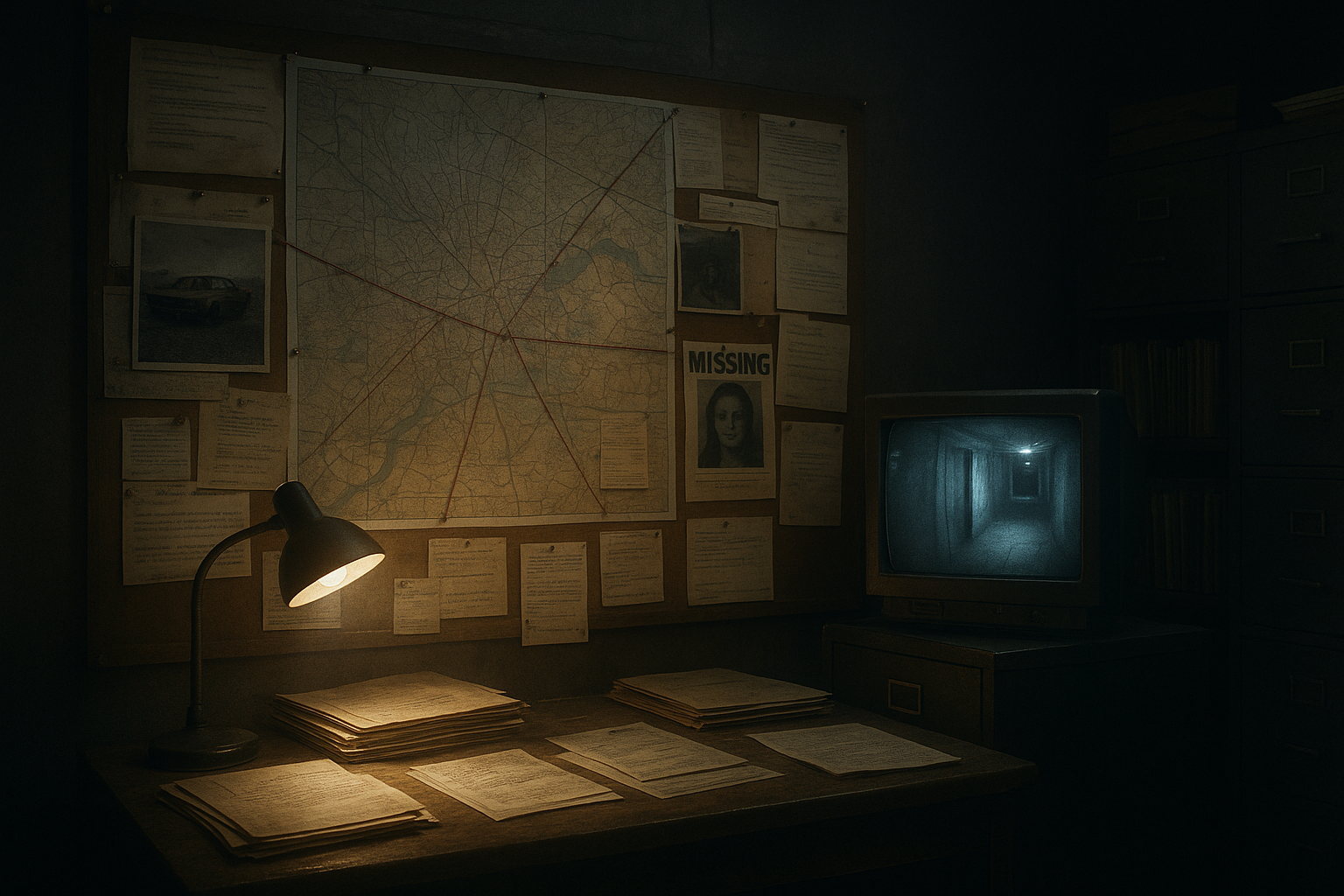
Disappearances disturb people differently because death, however brutal, still ends in a fact. A disappearance does not. It leaves behind a bedroom that still looks temporary, a voicemail nobody deletes, a route that can be retraced a thousand times, and a final ordinary moment that becomes radioactive with hindsight. Families are forced to live beside possibility. Investigators are trapped between evidence and absence. And readers, decades later, keep coming back because unresolved disappearances create a kind of psychological static that never fully clears.
That is why certain missing-person cases refuse to leave the culture. They do not settle into history. They remain active in the imagination. A car turns up but the person does not. A child vanishes from a place that should have been safe. A surveillance clip catches the last visible movement and somehow deepens the uncertainty. A witness sighting offers hope, then muddies the record. Every unresolved disappearance becomes two stories at once: the life before the vanishing, and the permanent reconstruction after it.
This archive follows investigative patterns across missing-person cases and cases where remains were later recovered. Brandon Lawson has been identified; Dorothy Jane Scott’s remains were found; Kris Kremers and Lisanne Froon were confirmed dead. Their cases should not be read as continuing searches for people whose fate is wholly unknown.
How This Disappearance Archive Is Organized
This archive is organized by investigative lens rather than by simple popularity. That matters because disappearances do not linger for one reason. They stay alive because one part of the case refuses to behave: the final sequence does not close, the footage does not clarify, the witness account destabilizes rather than confirms, the recovered vehicle creates a new void, or the case later breaks open in a way that changes how every earlier clue is read.
If you are deep in timeline cases, start with the stories where the final verified movements still do most of the narrative work. If surveillance-driven mysteries are your doorway, move into the cases where cameras preserved the last visible fragment but not the answer. If you gravitate toward sightings, travel vanishings, or recovered-vehicle files, those sections below are built to route you deeper without flattening the cases into repetitions of one another.
This structure also matters because the site already has strong branch archives — including timeline hubs, surveillance hubs, witness-sighting hubs, vehicle-recovery collections, evidence-based pages, and solved-years-later disappearance files. Think of it as the main archive room, with each branch opening into a deeper cabinet of cases.
Last-Seen Timelines That Still Won’t Close
In some disappearances, the timeline becomes the central wound. The route is known. The departure is documented. The destination is ordinary. Yet somewhere between one verifiable point and the next, the entire story fails to hold together. These are the cases that pull readers into maps, timestamps, phone records, and minute-by-minute reconstructions because the answer always feels like it should be only a few missing steps away.
That is why the timeline archive branch remains one of the strongest structural assets in the cluster. It lets readers compare the same narrative fracture across different lives and settings: a short walk that becomes a void, a long drive that becomes a warning, a final routine that becomes unbearable in hindsight. The deeper branch for this pattern is The Final Timelines That Still Don’t Close: 9 Disappearances Reconstructed Minute by Minute, but several of the site’s strongest individual files live here as well.
Brandon Lawson: The 911 Call, Search and Identification remains an important timeline case. Remains found in 2022 were confirmed as Lawson’s by DNA, according to the search participants’ December 2024 announcement. The identification does not explain every moment of his final call. Bryce Laspisa Disappearance — The Strange Drive Before He Vanished belongs in the same corridor because Bryce Laspisa’s strange drive built a timeline so prolonged and visible that the final break feels impossible to accept. Andrew Gosden Disappearance — The Teen Who Took a One-Way Ticket to London keeps drawing readers back for the same reason: Andrew Gosden’s one-way trip to London created a clean departure and a devastating absence of closure after it.
Emanuela Orlandi Disappearance — The Vatican Girl Who Never Came Home adds a different kind of instability, because the ordinary act of leaving for music lessons opened into a case that grew larger, louder, and stranger without ever making the original final sequence feel secure. Dorothy Jane Scott: The Disappearance and Unsolved Homicide concerns an unsolved killing. Her remains were found in 1984; the mystery is who killed her and how, rather than whether she is still missing. And if you want the broader branch where final movements are reconstructed as the main investigative frame, continue into the timeline archive of disappearances reconstructed minute by minute.
The pull of these cases is simple: the timeline looks like a skeleton for the truth, but it never grows the missing flesh. That failure is what carries readers into the next archive room, where the camera appears to take over — and fails in a different way.
🔎 Related Investigation:
Surveillance Footage Cases That Deepened the Mystery
Surveillance footage changes the emotional geometry of a disappearance. It gives the public something to stare at. A hallway. An elevator. A parking lot. An apartment complex. A cruise-ship environment. Instead of imagining the final hours from pure absence, readers are forced to confront a visible fragment that feels objective, replayable, and almost usable. That “almost” is what makes these cases so sticky.
The branch archive for this pattern is Last Seen on Surveillance: 6 Disappearances Where the Final Footage Only Deepened the Mystery, and it exists because some disappearances are remembered as much for the final visual record as for the disappearance itself. Jennifer Kesse Disappearance — The Woman Who Vanished in Broad Daylight belongs near the front of that file because Jennifer Kesse’s case appears to stop inside a visible frame, with footage that preserved movement but concealed the one face investigators most needed. Rebecca Coriam Disappearance — The Cruise Ship Mystery Captured on Camera also fits this lens because Rebecca Coriam vanished from a controlled cruise-ship environment where the visual record should have narrowed the field, yet only widened suspicion.
Amy Bradley Disappearance — What Happened to the Woman Who Vanished From a Cruise Ship? sits in the same section for a slightly different reason: Amy Bradley’s disappearance endures because the ship setting itself feels too contained for such a clean vanishing, which keeps sighting theories and hidden-movement theories alive decades later. Even cases without one perfect CCTV clip still belong here when the visual expectation shapes the mystery. Readers do not return to these stories only because someone vanished. They return because the frame looks like it should have solved more than it did.
That tension — evidence that feels close to decisive while remaining painfully incomplete — is why the surveillance branch functions less like a simple roundup and more like a room full of frozen final moments. The more people replay them, the less settled they feel, which makes witness-driven cases the natural next step.
Witness Sightings That Opened New Questions Instead of Closing Them
Witness sightings can do something cameras cannot: they inject human interpretation back into the file. That can be useful, hopeful, and catastrophic all at once. A sighting might extend the timeline, relocate the case, or suggest the missing person was alive after the moment everyone assumed mattered most. But it can also split a case into competing realities, leaving investigators to choose between hard evidence and testimony that will not quite die.
The supporting branch here is Unsolved Disappearances With Witness Sightings That Only Made the Mystery Stranger, which gathers cases where sightings became part of the mystery rather than the solution. Amy Bradley Disappearance — What Happened to the Woman Who Vanished From a Cruise Ship? keeps surfacing in this room too because reported later sightings of Amy Bradley have attracted attention without establishing a confirmed post-disappearance location. Andrew Gosden Disappearance — The Teen Who Took a One-Way Ticket to London continues to pull readers for a similar reason: every attempt to stabilize Andrew Gosden’s final day has had to wrestle with the possibility of sightings that extend the case beyond its last verified documentary point.
Kris Kremers and Lisanne Froon: The Hike and Later Recovery also illustrates the limits of sightings. DNA identified recovered remains in 2014. Later forensic analysis favored an accident, though the exact final sequence remains incomplete. In these files, a sighting is never just a clue. It is an invitation to reopen everything.
That is why witness cases feel so unstable. They offer the hope of continuation and the risk of distortion at the same time. From there, the archive opens naturally into another recurring disappearance pattern: the vehicle that remains when the person does not.
Vehicles Found Without Their Owners
Few disappearance details create a sharper emotional afterimage than a recovered vehicle. A car anchors the case physically. It says the person was here, stopped here, or was made to stop here. It creates a scene without creating an ending. That is why vehicle-recovery cases often become obsession machines: the object remains, but the person has been erased from the frame around it.
The deeper branch for this lens is What Happened After the Car Was Found? 6 Real Disappearances Where the Vehicle Was Recovered but the Person Was Not. Recovered vehicles raise a specific question: what does it mean when mobility survives the missing person? Steven Koecher Disappearance — The Man Who Walked Into a Neighborhood and Vanished is one of the cleanest examples on the site, because Steven Koecher walked into a neighborhood, disappeared from the human record, and left behind one of the most maddeningly incomplete case architectures in the cluster. Bryce Laspisa Disappearance — The Strange Drive Before He Vanished also crosses into this room because Bryce Laspisa’s car became part of the evidence pattern that made his final sequence feel less finished, not more.
Dorothy Jane Scott: The Disappearance and Unsolved Homicide also belongs here: her burned car was recovered in 1980 and her remains in 1984. The homicide remains unsolved. And when readers want the branch collection where the recovered vehicle is the central structural clue, they can move directly into the archive of disappearances where the car was found but the person was not.
Vehicle cases are compelling because they create the illusion of proximity. The scene still exists. The route still exists. The object still exists. Yet the person has somehow slipped beyond the material evidence. That same sense of violated expectation becomes even more brutal in child disappearance files.
Children Who Vanished and Left Entire Communities Frozen in Time
Child disappearances remain some of the most difficult cases in any archive because the public instinctively believes a child should be easier to protect, easier to remember, and easier to recover. When that belief fails, the case often becomes generational. Entire towns keep replaying the same night, the same school morning, the same fairground, roadside, or family routine, as if enough repetition might eventually reveal the hidden mistake.
Asha Degree Disappearance — The 9-Year-Old Who Walked Into the Night endures because Asha Degree’s walk into the night feels impossible in a way that has never stopped unsettling people. The case combines a child, a rural roadside, and a final movement that has never settled into one accepted explanation. Kyron Horman Disappearance — The Boy Who Never Came Home from School carries a different but equally disturbing charge: Kyron Horman vanished from a school environment that should have produced stronger certainty than it did, which means every reconstruction still feels like it should be closer to an answer than it is.
These child cases also connect naturally to the solved-years-later branch, because the hope that one late discovery or one overlooked clue might finally break the file never entirely dies. That is part of what keeps communities emotionally trapped inside them. They are not simply old cases. They are unfinished rooms people keep returning to, waiting for one piece of evidence to reopen the door.
And once a disappearance involves movement across borders, travel systems, or unfamiliar terrain, that tension grows even harder to contain.
Disappearances While Traveling, Abroad, or in Transit
Travel-related disappearances disturb people for a different reason: they transform movement itself into vulnerability. A trip, a ship, a foreign city, a hike, a one-way ticket, a cruise, a study abroad story — all of them start with narrative momentum. The missing person is supposed to be going somewhere. When the disappearance interrupts that motion, the case becomes haunted by the contrast between intended destination and actual void.
Andrew Gosden Disappearance — The Teen Who Took a One-Way Ticket to London remains one of the strongest transit cases in the archive because Andrew Gosden’s decision to buy a one-way ticket turned an ordinary school day into an enduring mystery of intention and aftermath. Kris Kremers and Lisanne Froon: The Hike and Later Recovery belongs here because their deaths were confirmed after remains were recovered. A probable accident is the forensic interpretation; complete reconstruction of their final movements remains difficult. Amy Bradley Disappearance — What Happened to the Woman Who Vanished From a Cruise Ship? and Rebecca Coriam Disappearance — The Cruise Ship Mystery Captured on Camera both show why cruise-ship disappearances hold such power: a supposedly contained environment becomes its own labyrinth.
Emanuela Orlandi Disappearance — The Vatican Girl Who Never Came Home adds another dimension, because Emanuela Orlandi’s case became inseparable from place, power, and the instability of movement within and around Vatican space. Travel and transit disappearances linger because they produce two losses at once: the person disappears, and the expected narrative of return collapses with them.
Some of these cases stay open forever. Others, after years of frustration, finally shift because one break reopens everything. That is where the archive turns from pure uncertainty toward the rare files that later changed shape.
Cases That Broke Open Years Later
Not every disappearance stays trapped in the same form forever. Some cold files fracture late because of a confession, new evidence, recovered remains, or a forensic breakthrough that forces the original story to be reread from the beginning. Those cases matter in this archive because they remind readers that unresolved disappearance clusters are not static. They can harden for years and still be disrupted by one delayed fact.
The strongest supporting branch here is Disappearances Solved Years Later: The Cases That Went Cold Until One Break Reopened Everything, which tracks the disappearance cases that went cold until something reopened the story. That branch sits in productive tension with pages like Unsolved Disappearances Where the Final Hours Still Don’t Add Up and What Likely Happened? 7 Unsolved Disappearances Where the Evidence Points in One Direction, because together they show the full emotional spread of the cluster: some disappearances remain structurally broken, some start leaning heavily in one direction, and a few are later forced into a new shape by evidence that arrived far too late for anyone involved.
This solved-later room also increases authority because it teaches readers how to compare open and reopened cases without confusing them. A disappearance does not stop being valuable to the archive once it is partially explained. If anything, it becomes more valuable, because it shows which early patterns mattered, which theories collapsed, and how fragile first impressions can be in missing-person investigations.
That brings the archive to its central question: why do some disappearances keep a grip on the public mind long after other tragedies fade?
Why Certain Disappearances Never Leave the Public Mind
The strongest disappearance cases repeat a small number of investigative patterns over and over. There is usually a final ordinary action that later becomes unbearable — a school drop-off, a short walk, a train ride, a payphone call, a hotel corridor, a ship deck, a parking lot, a drive home, a hike that should have ended in photographs and return plans rather than archival obsession. Then there is a destabilizer: a camera clip, a witness claim, a vehicle, an unexplained delay, a contradiction in the final sequence, or a controlled environment that somehow produced less certainty than it should have.
That destabilizer matters because disappearances are rarely remembered only for who vanished. They are remembered for the specific investigative shape the case took afterward. Jennifer Kesse is not just a missing-person file; it is the case with the footage that only sharpened the void. Brandon Lawson’s case illustrates how identification can resolve a search while leaving questions about the final sequence. Asha Degree is not simply a child missing from home; it is the roadside sightings, the impossible walk into the dark, and the permanent argument over why that movement happened at all. The pattern becomes the emotional identity of the case.
Those patterns matter for authority because they explain reader behavior as well as case behavior. People rarely binge disappearance archives by accident. They move from one story to another because the investigative texture is familiar. A reader who enters through Jennifer Kesse often wants Brandon Lawson next. Someone pulled in by Kyron Horman may move toward Asha Degree, then into the timeline branch, then into witness sightings, then into the solved-years-later archive.
There is also a deeper reason these cases stay alive. Uncertainty creates participation. A solved case can be studied. An unresolved disappearance recruits the audience. Readers map final routes, replay footage, compare witness windows, argue over what the abandoned car means, and keep hunting for the hinge where the known story broke. That does not just create engagement. It creates permanence. The case stops feeling historical and starts feeling interruptible, as if one more clue could still arrive.
The cases in this archive also show why certain disappearances generate stronger authority signals than others. They contain reusable investigative frameworks. Timeline-first cases connect to route reconstruction and last-contact analysis. Surveillance cases connect to visual evidence, blind spots, and controlled-space theory. Vehicle-recovery cases connect to scene logic and post-abandonment interpretation. Witness-sighting cases connect to contested chronology and human memory. Child disappearances connect to public fear, parental attention, and long-tail emotional engagement. When those frameworks cross-link inside one cluster, the site stops looking like a set of isolated stories and starts looking like a real subject archive.
That is why this archive matters above the branch pages. It shows that the disappearance vertical is not just a collection of isolated tragedies. It is a coherent investigative ecosystem built around recurring narrative failures: timelines that do not close, images that do not explain, sightings that do not settle, vehicles that do not answer, and families left living inside a grammar of maybe. The more clearly those patterns are organized, the easier it becomes for readers — and search crawlers — to understand that every branch here belongs to one larger disappearance authority system.
Conclusion
Outcomes differ. Some people remain missing; some victims have been recovered; some cases have a likely explanation without a fully reconstructed sequence. Those distinctions are essential to comparing the evidence.
If you entered here through one case, the archive is designed to pull you deeper. If you came looking for a specific pattern, the branches are already waiting. And if what keeps you reading is that familiar sensation that the answer still feels one clue away, then you are exactly where every great disappearance archive begins: inside the unresolved space between the last known fact and the story nobody has been able to finish.
🔎 Related Investigation:
🔎 If this investigation pulled you deeper into the mystery, continue with these next archive files:
- Disappearances With Disturbing Evidence Left Behind — The Clues That Only Deepened the Mystery
- The Final Timelines That Still Don’t Close: 9 Disappearances Reconstructed Minute by Minute
- Last Seen on Surveillance: 6 Disappearances Where the Final Footage Only Deepened the Mystery
- Disappearances Caught on Camera: 6 Final Footage Cases Where Being Seen Only Made the Mystery Worse
- Disappearance Cases Where One Small Clue Rewrote the Entire Timeline
Explore more Disappearances disappearance investigations here:
Research Sources
The following resources were consulted to verify and update this article.
- FBI — Jennifer Joyce Kesse
Identifies the recorded car-mover as an unidentified person of interest. - Royal Bahamas Police Force — Missing Person Rebecca Coriam: News Release 425-2011
Documents shipboard searches and examination of CCTV. - FBI — Amy Lynn Bradley
Maintains the appeal for Bradley’s cruise-ship disappearance. - Utah Department of Public Safety — Steven Thell Koecher
Records the missing-person case and abandoned Henderson vehicle. - Navigating Advocacy — Brandon Lawson: Confirmed
Search participants announce DNA identification of remains recovered in 2022. - The Charley Project — Bryce David Laspisa
Documents the drive, recovered SUV and continued disappearance. - Missing People — Andrew Gosden
Records the last confirmed King’s Cross sighting and continuing appeal. - ANSA — La scomparsa di Emanuela Orlandi 43 anni, fa accertamenti su un flauto
Reports continuing inquiries into Orlandi’s disappearance after a music lesson. - Orange County Sheriff’s Department — May 1980: Dorothy Jane Scott
Records the burned car, 1984 recovery of remains and unsolved homicide. - Telemetro — Segunda prueba de ADN es positiva, identifican a Kris Kremers
Reports DNA identification of both women’s recovered remains. - RTL Nieuws — Een ongeluk, geen misdrijf: dit weten we over de dood van Kris en Lisanne
Reports the forensic team’s probable-accident conclusion and its limits. - FBI — Looking for Asha
Reviews the reported roadside sightings and backpack discovery. - Multnomah County Sheriff’s Office — Multnomah County Sheriff’s Office Leveraging New Technology in Kyron Horman Case
Confirms the school science-fair disappearance and continuing 2026 investigation. - The Charley Project — Steven Thell Koecher
Describes neighborhood footage of Koecher parking and walking out of view. - ITV News — Missing Andrew Gosden’s dad: We miss him all the time
Reports the London train journey, one-way ticket and continuing inquiry.